


Francois Roubille: Biomarkers and Long-Term Prognosis After Revascularised STEMI
Francois Roubille, Head of the Intensive Care Unit at University Hospital of Montpellier, shared a post on LinkedIn about a recent article he and his colleagues co-authored, published in European Journal of Internal Medicine, adding:
“Inflammation and myocardial infarction: cause or consequence?
A DANAMI-3 substudy has just been published in the European Heart Journal: Acute Cardiovascular Care (Kunkel et al., 2026).
What the study found
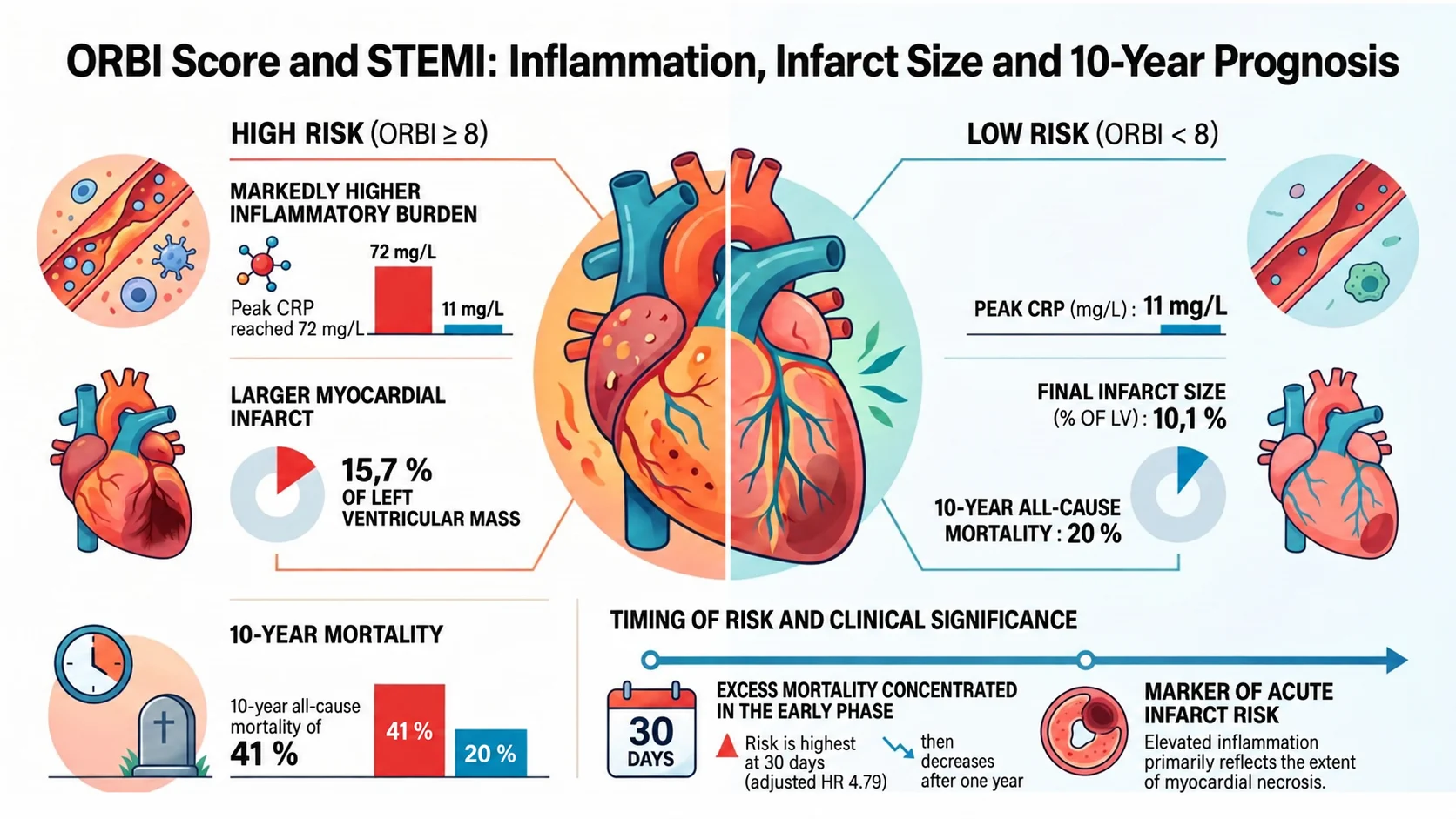
The study included 1,574 patients with STEMI and no cardiogenic shock, grouped according to their ORBI score (risk of shock after primary angioplasty).
Among patients at high risk (ORBI greater than or equal to 8):
- Peak CRP was 72 mg/L, compared with 11 mg/L.
- White blood cell and neutrophil-to-lymphocyte counts were higher.
- Cardiac MRI showed larger infarcts: 15.7% versus 10.1% of left ventricular mass.
- Ten-year mortality was 41% versus 20% (adjusted HR 1.47).
The association was strongest during the first month (HR 4.79). Beyond one year, it was largely explained by age.
Our interpretation
A heart attack triggers an intense inflammatory response: the more extensive the tissue damage, the higher the CRP. It is therefore very difficult to distinguish cause from consequence.
This is not new.
We previously showed in the European Journal of Internal Medicine (Roubille et al., 2010) that CRP measured three days after a revascularised STEMI was associated with prognosis.
The principle is well established: a large heart attack causes a strong inflammatory response.
Does inflammation remain a therapeutic target?
Yes.
The ACVC and ESC clinical consensus on inflammation in acute coronary syndromes reiterates that the causal link between inflammation and atherosclerosis is well established.
However, treatment results have been disappointing:
- Anti-IL-1: Canakinumab reduced cardiovascular risk, but increased infections and is not indicated for this purpose.
- Anti-IL-6: No clinical benefit has been demonstrated to date.
- Low-dose colchicine (0.5 mg/day) remains an option, although results have varied between trials:
- ESC 2023, acute coronary syndromes: “May be considered” (Class IIb, Level A).
- ESC 2024, chronic coronary syndromes: “Should be considered” (Class IIa, Level A).
Key message: Elevated CRP after a heart attack primarily reflects the extent of tissue damage.
It is a risk marker, not currently a treatment target.
Targeted randomised trials are needed to determine which patients might benefit from anti-inflammatory treatment.”
Title: Routinely-feasible multiple biomarkers score to predict prognosis after revascularized STEMI
Authors: F. Roubille, A. Samri, L. Cornillet, C. Sportouch-Dukhan, J.M. Davy, F. Raczka, R. Gervasoni, J.L. Pasquie, T.T. Cung, C. Piot, J.C. Macia, F. Cransac, F. Leclercq

Stay updated on all scientific advances with Hemostasis Today.
-
Oct 6, 2026, 09:20EAS Rare Lipid Disorder Course – Advancing Lipid Disorder Education – European Atherosclerosis Society
-
Oct 6, 2026, 09:12Fionnuala Ní Áinle: Lisa Ryan’s First Thrombocalc VTE Research Report
-
Oct 6, 2026, 09:02David McIntosh: Preventable Maternal and Newborn Deaths – The Urgent Need for Action
-
Oct 6, 2026, 08:55Konstantin Yenkoyan: CAR-T, GLP-1 or Orexin – Who Will Take the 2026 Nobel?
-
Oct 6, 2026, 08:39Emily Bury: Putting Patients at the Centre of VTE Care
-
Oct 6, 2026, 07:44Carolina Moreira Ponce: Thrombosis Month – Why Prevention Starts With Risk Assessment
-
Oct 6, 2026, 07:03Laila Ahmed: Stroke Imaging – A Practical Radiology Approach
-
Oct 6, 2026, 05:52David Esposito: Can Standard Ultrasound Detect May Thurner Syndrome?
-
Oct 6, 2026, 04:33Hessam Kakavand: Rethinking Thrombotic Risk in Modern Cancer Therapy