


Heghine Khachatryan: Patient Safety and Clinical Judgment in Platelet Transfusion Decisions
Heghine Khachatryan, Editor-in-Chief of Hemostasis Today, Head of Hemophilia and Thrombosis Center at Yeolyan Hematology and Oncology Center, shared a post on LinkedIn about a recent article by Ryan A. Metcalf et al, published in JAMA, adding:
”Platelet Transfusion: From Evidence to Clinical Decisions
Published in JAMA, the 2025 AABB and ICTMG International Clinical Practice Guidelines provide an evidence-based framework for platelet transfusion. Drawing on 21 randomized controlled trials and 13 observational studies, the guidelines generally support a restrictive transfusion strategy.
Key Clinical Recommendations
The following thresholds are supported by strong recommendations:
- A platelet count below 10 billion per liter in nonbleeding patients with hypoproliferative thrombocytopenia receiving chemotherapy or undergoing allogeneic stem cell transplantation.
- A platelet count below 20 billion per liter before lumbar puncture.
- A platelet count below 25 billion per liter in preterm neonates without major bleeding.
Conditional Recommendations for Adults
- Central venous catheter placement at anatomically compressible sites: Transfuse when the platelet count is below 10 billion per liter.
- Interventional radiology procedures: Transfuse when the platelet count is below 20 billion per liter for low-risk procedures and below 50 billion per liter for high-risk procedures.
- Major nonneuraxial surgery: Transfuse when the platelet count is below 50 billion per liter.
- Autologous stem cell transplantation or aplastic anemia: A strategy without prophylactic platelet transfusion is recommended for nonbleeding adults.
- Nonoperative intracranial hemorrhage: Platelet transfusion is not recommended when the platelet count exceeds 100 billion per liter, including in patients receiving antiplatelet agents.
Applying these thresholds requires comprehensive clinical assessment. Decisions should incorporate bleeding severity, the underlying condition, medications, procedural risk, and patient preferences. Conditional recommendations require particularly careful interpretation because of the limited certainty of the available evidence.
Patient safety, thoughtful assessment of expected benefits, and responsible stewardship of donated blood components are essential elements of good transfusion practice.”
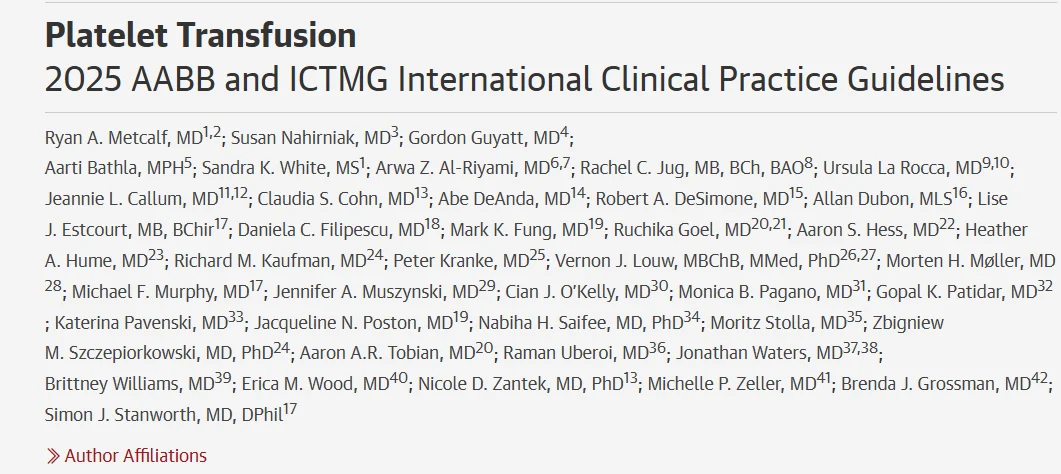
Title: Platelet Transfusion2025 AABB and ICTMG International Clinical Practice Guidelines
Authors: Ryan A. Metcalf, Susan Nahirniak, Gordon Guyatt, Aarti Bathla, Sandra K. White, Arwa Z. Al-Riyami, Rachel C. Jug, Ursula La Rocca, Jeannie L. Callum, Claudia S. Cohn, Abe DeAnda, Robert A. DeSimone, Allan Dubon, Lise J. Estcourt, Daniela C. Filipescu, Mark K. Fung, Ruchika Goel, Aaron S. Hess, Heather A. Hume, Richard M. Kaufman, Peter Kranke, Vernon J. Louw, Morten H. Møller, Michael F. Murphy, Jennifer A. Muszynski, Cian J. O’Kelly, Monica B. Pagano, Gopal K. Patidar, Katerina Pavenski, Jacqueline N. Poston, Nabiha H. Saifee, Moritz Stolla, Zbigniew M. Szczepiorkowski, Aaron A.R. Tobian, Raman Uberoi, Jonathan Waters, Brittney Williams, Erica M. Wood, Nicole D. Zantek, Michelle P. Zeller, Brenda J. Grossman, Simon J. Stanworth
Other posts featuring Heghine Khachatryan on Hemostasis Today.
-
Oct 25, 2026, 16:13Funmi (Vanessa) Ullam: From Lived Experience to Research and Innovation in Sickle Cell Care
-
Oct 25, 2026, 15:13Franky Biles: Celebrating Diversity and Driving Inclusion Through Representation
-
Oct 25, 2026, 14:47Siddharth Mittal: A Sheet-Like Effluent Deposit During Plasma Exchange in iTTP
-
Oct 25, 2026, 14:16Alejandro González Veliz: Can Factor XIa Inhibition Prevent Recurrent Ischemic Events Without Increasing Bleeding?
-
Oct 25, 2026, 13:0910 Posts Not to Miss This Week
-
Oct 25, 2026, 13:02Thomas Dayspring: Advancing Cardiovascular Risk Assessment Through Multidisciplinary Lipid Care
-
Oct 25, 2026, 12:46Ahmar U. Zaidi: RISE UP Study on Sickle Cell Disease
-
Oct 25, 2026, 10:32Jan Sloves: Advanced Venous Ultrasound Training in Poland
-
Oct 25, 2026, 10:20Jeff Sternlicht: Rethinking Cardiovascular Prevention Through Atherosclerosis Imaging