


Hatim Lokhandwala: Landmark HI-PRO Trial Redefines VTE Treatment Guidelines
Hatim Lokhandwala, Clinical Research Coordinator, Hope & Healing Cancer Services LLC, shared a post on LinkedIn:
“Landmark HI-PRO Trial Redefines VTE Treatment Guidelines: Extended Apixaban Significantly Reduces Recurrence Risk in High-Risk Patients
The recently published HI-PRO trial in the New England Journal of Medicine provides critical, evidence-based direction for the challenging clinical scenario of managing Venous Thromboembolism (VTE) in patients with a history of a transient provoking factor but also concomitant enduring risk factors (e.g., obesity, chronic lung disease, autoimmune disorders).
The study, which investigated the use of extended-duration, low-intensity apixaban (2.5 mg twice daily) versus placebo for 12 months, strongly suggests that a simple “provoked vs. unprovoked” paradigm is insufficient for determining anticoagulation duration.
Here are the pivotal findings for the clinical community:
- Significant Efficacy: Low-intensity apixaban resulted in a substantially lower rate of symptomatic recurrent VTE (the primary efficacy outcome) compared to placebo.
- The recurrence rate was 1.3% in the apixaban group versus 10.0% in the placebo group (Hazard Ratio, 0.13; 95% CI, 0.04 to 0.36; P<0.001).
- Favorable Safety Profile: The use of low-intensity apixaban maintained a low risk of the primary safety outcome, major bleeding.
- Only 1 patient (0.3%) in the apixaban group experienced major bleeding, compared to none in the placebo group (P>0.999).
- Clinical Implications: The 10% recurrence risk observed in the placebo group demonstrates that the presence of enduring risk factors places these “provoked” VTE patients at a high risk for recurrence, approximating that of traditional high-risk (unprovoked) VTE patients.
This data strongly supports a move toward personalized risk stratification for VTE, demonstrating that extending anticoagulation with a low-dose Factor Xa inhibitor provides a robust net clinical benefit for a previously ambiguous patient population.”
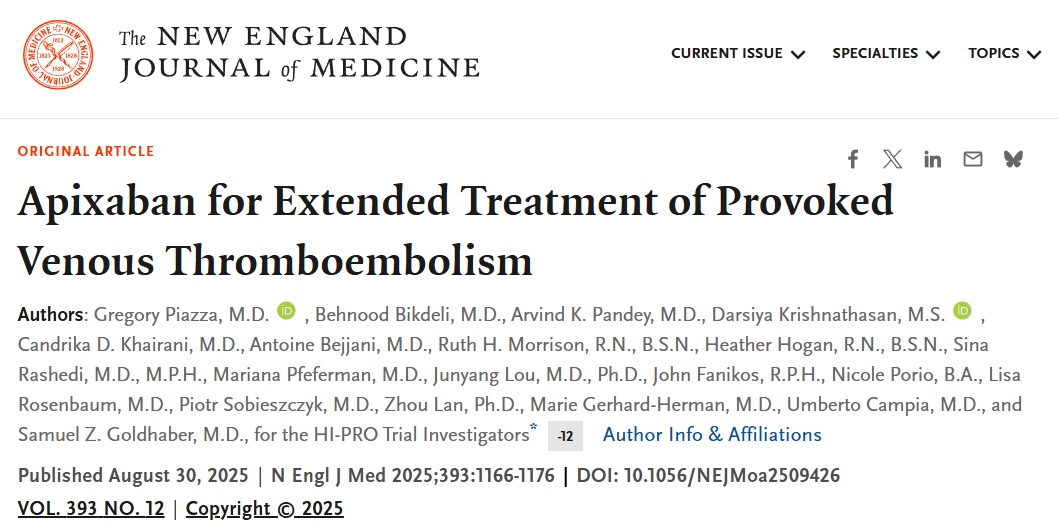
Title: Apixaban for Extended Treatment of Provoked Venous Thromboembolism
Authors: Gregory Piazza, Behnood Bikdeli, Arvind K. Pandey, Darsiya Krishnathasan, Candrika D. Khairani, Antoine Bejjani, Ruth H. Morrison, Heather Hogan, Sina Rashedi, Mariana Pfeferman, Junyang Lou, John Fanikos, Nicole Porio, Lisa Rosenbaum, Piotr Sobieszczyk, Zhou Lan, Marie Gerhard-Herman, Umberto Campia, Samuel Z. Goldhaber
Read full article here.
Stay updated with Hemostasis Today.
-
Oct 9, 2026, 16:23David Boone: Distinguishing Stroke Prevention from Rhythm Control in Atrial Fibrillation
-
Oct 9, 2026, 15:27Mohamed Hegazi: Geostatistical Modelling Maps Global β-Thalassaemia Carrier Prevalence
-
Oct 9, 2026, 15:15Maha Othman: Uncovering the Consensus on TXA in TBI – Call for Collaboration on a Landmark Umbrella Review
-
Oct 9, 2026, 15:07Daniel D. Han: How Inhalation Product Exposure Impairs Cardiac and Platelet Recovery After MI
-
Oct 9, 2026, 14:58William Toole: How Ultrasound-Guided PRP Therapy Relieves Joint and Tendon Pain
-
Oct 9, 2026, 14:50Shayan Mohammadmoradi: In Corpus Christi for the 20th Midwest Platelet Conference
-
Oct 9, 2026, 14:37Tariq Tramboo: High Platelet Concentrate for Osteoarthritis Knee – Recent Meta-Analyses
-
Oct 9, 2026, 14:26Yousma Khan: Hematology Series – Beyond RBCs, WBCs and Platelets
-
Oct 9, 2026, 14:13Jesus Ardila Novoa: Why the WHO’s Historic Essential Medicines List Decision Is Just the Beginning