


Jose Manuel Soria: Can Transcriptomics Improve VTE Risk Prediction?
Jose Manuel Soria, Director and Senior Research Scientist at the Complex Disease Genomics Unit, Research Institute of Hospital de la Santa Creu i Sant Pau (IIB Sant Pau), shared a post on LinkedIn about a recent article he and his colleagues co-authored, published in JTH:
“Proud to share our latest publication on idiopathic venous thromboembolism (VTE) and the potential of transcriptomics to transform risk prediction.
Despite being a major cause of morbidity and mortality worldwide, idiopathic VTE often occurs without identifiable triggering factors, making it difficult to predict using conventional clinical approaches.
In this study, we asked a simple question:
Can gene expression profiles help identify individuals with an underlying predisposition to thrombosis that traditional risk factors fail to capture?
By integrating whole-blood transcriptomic data, genetic information, and clinical variables from the GAIT2 study using machine learning approaches, we developed a novel similarity-based risk model that significantly improved risk stratification.
Our results revealed that:
- Transcriptomic information adds substantial predictive value beyond established clinical risk factors.
- Molecular profiles can identify individuals who resemble VTE patients even before clinical manifestations become evident.
- The resulting similarity score successfully classified a large proportion of VTE cases into a high-risk group, supporting its potential utility for personalized prevention.
More broadly, this work highlights the growing impact of transcriptomics as a bridge between genetic susceptibility and disease manifestation.
While genetics provides information about inherited risk, gene expression captures the dynamic biological processes that ultimately drive disease, offering a powerful new layer for precision medicine.
We believe that integrating transcriptomic signatures into clinical risk assessment could help move thrombosis prevention from a reactive to a proactive paradigm.
Congratulations to all collaborators involved in this work and thank you to everyone who contributed to making this study possible.
Pol Ezquerra Condeminas great job!”
Pol Ezquerra Condeminas, Bioinformatics Scientist at Centro de Investigación Biomédica en Red CIBER, shared this post, adding:
“After a lot of hard work, I am very happy to announce that our new paper is finally online ahead of print in the Journal of Thrombosis and Haemostasis (JTH).
I consider this paper interesting because it presents a new way to integrate transcriptomic data and machine learning models applied to idiopathic thrombosis, a disease that has always been challenging to predict using traditional clinical factors alone.
Beyond venous thromboembolism, this methodology can be adapted to other clinical diseases that are also difficult to predict using standard clinical information.
I believe it is a highly relevant read for anyone involved in risk prediction, phenotype stratification, or thrombosis.
Congratulations to the whole team who made this possible!”
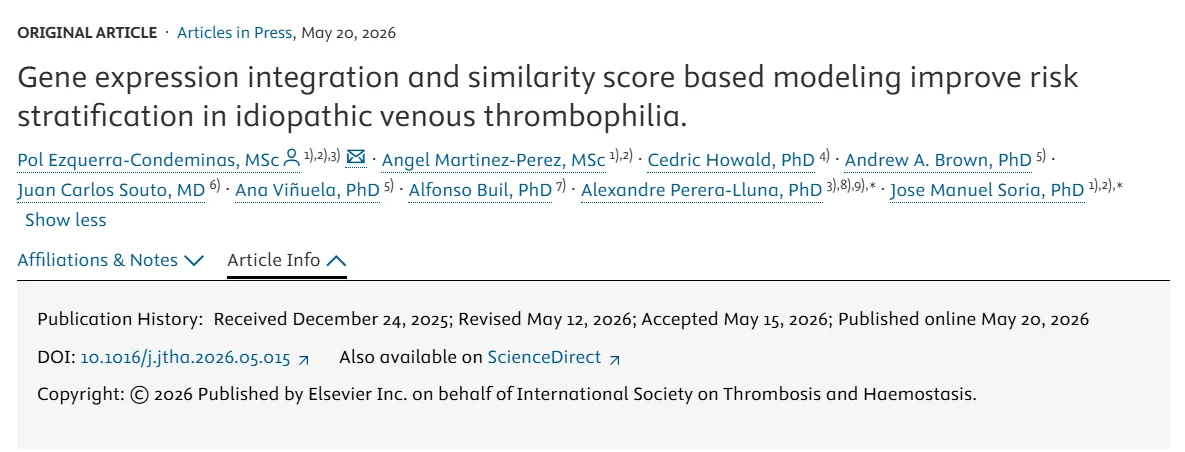
Title: Gene expression integration and similarity score based modeling improve risk stratification in idiopathic venous thrombophilia
Authors: Pol Ezquerra-Condeminas, Angel Martinez-Perez, Cedric Howald, Andrew A Brown, Juan Carlos Souto, Ana Viñuela, Alfonso Buil, Alexandre Perera-Lluna, Jose Manuel Soria
Stay updated with Hemostasis Today.
-
Oct 19, 2026, 02:35Brian O Mahony: Promoting Physical Activity and Sport in Haemophilia Care
-
Oct 19, 2026, 02:35Malusi Mtetwa: Tranexamic Acid – What Does the Evidence Tell Us?
-
Oct 19, 2026, 02:34Rishabh Mishra: Does the Evidence Support Tranexamic Acid Formulations in Skincare?
-
Oct 18, 2026, 23:31Rana Al-Hrout: MAHA – More Than Schistocytes
-
Oct 18, 2026, 17:11Owen McCarty: Understanding Prekallikrein and Its Role in Inflammation and Thrombosis
-
Oct 18, 2026, 17:04Emna Gouider Belhadjali: Don’t Miss GPAS 2026 on Bleeding Disorders
-
Oct 18, 2026, 16:53Mehran Ghasemzadeh: Microparticle-Associated Mitochondrial DNA in Stored Platelet Products
-
Oct 18, 2026, 16:38Edward Lee Carter: A 15-Minute Blood Test for Brain Hemorrhage?
-
Oct 18, 2026, 16:29Patrick Taylor: Oral vs Transdermal Estrogen and Cardiovascular Risk in Menopausal Women