


Kai Rejeski: Why TP53 Mutations May Define a Higher-Risk CAR-T Population
Kai Rejeski, Specialist in Internal Medicine and Hematology and Oncology at LMU Klinikum München, published in Leukemia, shared a post on X about a recent article he and his colleagues co-authored, adding:
”Not all CHIP is created equal when it comes to CAR-T…TP53 mutant CHIP stands out:
- more cytopenias, higher baseline CAR hematotox, reduced CAR expansion and inferior outcomes
- distinct inflamm. proteomic signature”
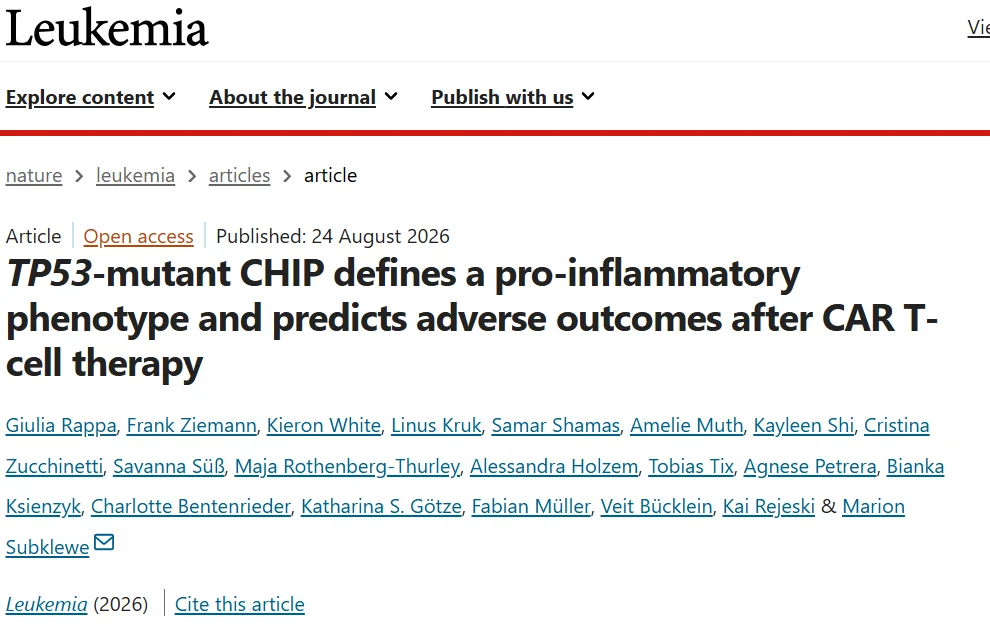
Title: TP53-mutant CHIP defines a pro-inflammatory phenotype and predicts adverse outcomes after CAR T-cell therapy
Authors: Giulia Rappa, Frank Ziemann, Kieron White, Linus Kruk, Samar Shamas, Amelie Muth, Kayleen Shi, Cristina Zucchinetti, Savanna Süß, Maja Rothenberg-Thurley, Alessandra Holzem, Tobias Tix, Agnese Petrera, Bianka Ksienzyk, Charlotte Bentenrieder, Katharina S. Götze, Fabian Müller, Veit Bücklein, Kai Rejeski, Marion Subklewe
Stay updated on all scientific advances with Hemostasis Today.
-
Oct 13, 2026, 11:41Abhishek Kumar: How Three Hemophilia Patients Helped Secure Life-Saving Treatment in Bihar
-
Oct 13, 2026, 11:24Brandon Daniel D’Costa: Building Stronger Stakeholder Relationships Through Empathy and Open Communication
-
Oct 13, 2026, 11:08Renel Tique: 5th International Conference on Hemophilia and Rare Bleeding Disorders
-
Oct 13, 2026, 02:01Nour Al-Mozain: Is It Really Anti-D? – Unraveling Auto-Anti-LW in the Transfusion Laboratory
-
Oct 13, 2026, 01:51Berenice Villegas: The Role of Morphologic Evaluation in Body Fluid Differential Analysis
-
Oct 13, 2026, 01:44Debadrita Ray: Evaluating vWF and VITRO Score for Detecting CSPH in cACLD Patients
-
Oct 13, 2026, 01:34Nagesh Ramesh: Donating Blood for International Plasma Awareness Week
-
Oct 12, 2026, 21:51Sam Botchey: Orthobiologics Are Advancing but the Evidence Must Keep Pace
-
Oct 12, 2026, 21:50Serum Vitamin D, Platelet Function, and Bleeding in Primary ITP – Platelets Journal