

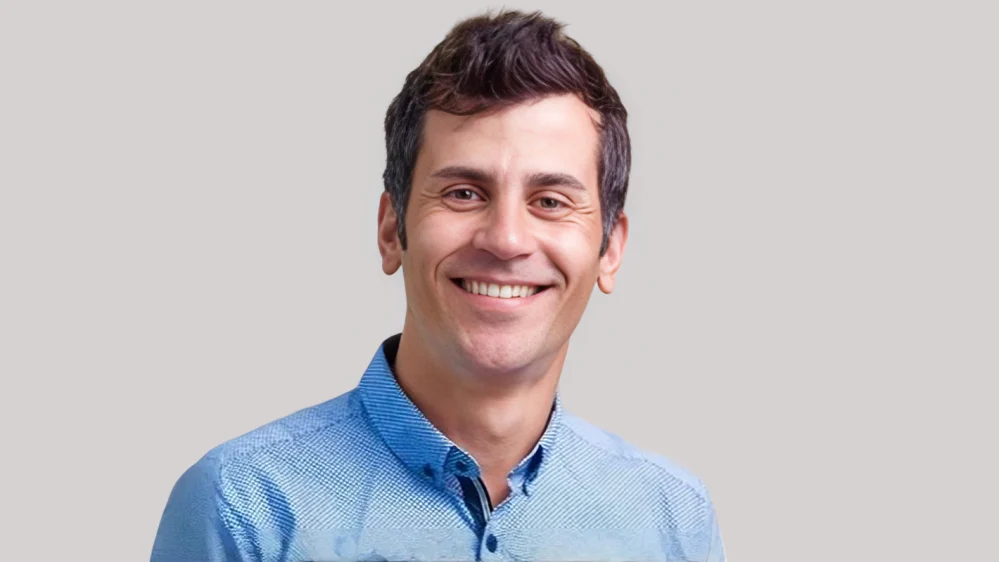
Luciano Martelotto: CD200R1, IL-17A, and the Future of Cancer Thrombosis Prevention
Luciano Martelotto, Director of Global Market Development for Single Cell at Waters Biosciences at Waters Corporation, shared a post on LinkedIn about a recent article by Dimitra Karagkouni et al., published in Science Translational Medicine, adding:
“An amazing paper from my dear friends Ioannis Vlachos, Dimitra Karagkouni and collabs…which also received the cover highlight!
For cancer patients, a blood clot can be just as dangerous as the tumor itself.
Venous thromboembolism (VTE) remains one of the leading causes of mortality in oncology, yet predicting who will clot and who will not has been an uphill clinical battle.
The current standard, the Khorana Score, often struggles in the clinic – failing to flag some patients at high risk while over-identifying others.
A brilliant new study by Karagkouni et al. in Science Translational Medicine is a masterclass in how translational medicine should work.
The research beautifully connects high-throughput proteomics, machine learning, and mechanistic immunology into a single, cohesive story with an immediate therapeutic angle.
The team analyzed over 1,100 plasma proteins from patients newly diagnosed with lung or gastric cancer.
Using a machine learning approach, they whittled this data down to an 11-protein panel. Combined with 5 clinical parameters (e.g., age, hemoglobin levels, etc), this model drastically outperformed standard prediction methods.
The paper moves beyond mere prediction into deep mechanistic biology. The team investigated CD200R1 (CD200 receptor 1), an immune checkpoint receptor that typically keeps inflammatory responses in check.
They noticed that a drop in plasma CD200R1 correlated heavily with elevated D-dimer levels and heightened thrombosis risk.
To prove causality, they turned to a knockout mouse model:
- Deleting CD200R1 led to an upsurge in the inflammatory cytokine IL-17A, causing localized endothelial inflammation and a distinct prothrombotic state.
- When the researchers administered an anti-IL-17A antibody, it neutralized the inflammation and successfully normalized thrombin-antithrombin complexes in vivo.
The most exciting implication here is the immediate potential for drug repurposing.
Anti-IL-17A biologics (like secukinumab) are already FDA-approved and widely used for inflammatory conditions like psoriasis.
This opens a tangible, testable hypothesis: could we use these existing drugs to actively mitigate clotting risks in cancer patients displaying a dysregulated CD200R1 pathway?
Of course, important translational hurdles remain.
We must validate these findings prospectively across broader cancer cohorts, and we need to carefully weigh how dampening IL-17A impacts the broader, incredibly complex tumor microenvironment.
Nevertheless, by elegantly bridging the gap between proteomics, immunothrombosis, and vascular biology, this study provides a blueprint for the future of personalized oncology care.
It is a must-read for anyone working at the intersection of cancer, immunology, and hemostasis.”
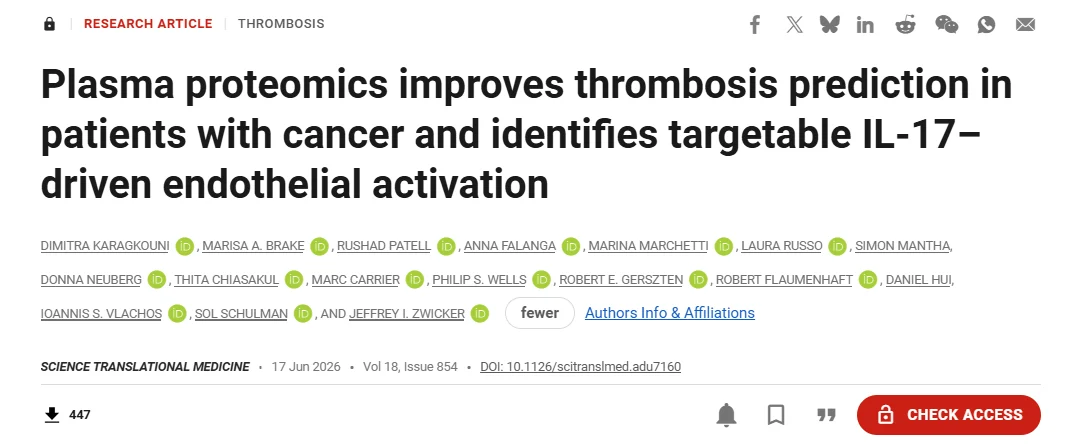
Title: Plasma proteomics improves thrombosis prediction in patients with cancer and identifies targetable IL-17–driven endothelial activation
Authors: Dimitra Karagkouni, Marisa A Brake, Rushad Patell, Anna Falanga, Marina Marchetti, Laura Russo, Simon Mantha, Donna Neuberg, Thita Chiasakul, Marc Carrier, Philip S Wells, Robert E Gerszten, Robert Flaumenhaft, Daniel Hui, Ioannis S Vlachos, Sol Schulman, Jeffrey I Zwicker
Stay updated on all scientific advances with Hemostasis Today.
-
Sep 22, 2026, 02:33Gerardo Moscatelli: The Spike Protein Cascade – From Endothelial Binding to Vascular Collapse
-
Sep 21, 2026, 20:56George Touma: ApoB Should Be Central to All Lipid Guidlines
-
Sep 21, 2026, 20:55Christopher Robinson: Obstetric Risks Are Seen at the Extremes of Birthweight
-
Sep 21, 2026, 20:54Emicizumab for Refractory GI Bleeding in Myeloma-Associated Acquired VWD – JTH
-
Sep 21, 2026, 20:52Ross Baker: ASH 2026 Guidelines on Iron Deficiency in HMB and Bleeding Disorders
-
Sep 21, 2026, 20:50Rainer Kaiser: Genes and Signalling Pathways Implicated in Procoagulant Platelet Generation
-
Sep 21, 2026, 20:49Natalia Dovlatova: Celebrating Stan Heptinstall and His Legacy in Platelet Science
-
Sep 21, 2026, 20:48Norm Roulet: The Interaction of Pb and SARS-CoV-2 and Its Impact on the Cardiovascular System
-
Sep 21, 2026, 20:45Felix Scholkmann: The Spleen Plays a Key Role in Regulating Platelet Activity