


Milka Koupenova: The Role of Platelet RIG-I in Regulating Thrombotic Responses
Milka Koupenova, Assistant Professor at University of Massachusetts Medical School, shared a post on LinkedIn about a recent article she and her colleagues co-authored, published in Blood, adding:
“Excited to share our latest publication in Blood:
‘The Pathogen Recognition Receptor RIG-I is Functional in Platelets and Limits Thrombotic Responses’ work by my first PhD student Anthony Sciaudone:
Heartfelt thank you to all of our co-authors, the reviewers, and the editor!
Our major findings:
- Platelets have functional cytoplasmic RIG-I receptors and downstream signaling.
- RIG-I activates a non-classical pathway in platelets: RIG-I signals through MAVS to promote MLKL phosphorylation, oligomerization, and membrane punctures, without uniform α- or δ-granule release or canonical interferon signaling.
- RIG-I promotes S100A10 surface translocation and release: RIG-I activation promotes S100A10 surface localization and release, but not S100A8/A9; S100A10 is a S100 that promotes an S100 family protein that facilitates plasmin generation from plasminogen in the presence of uPA or tPA.
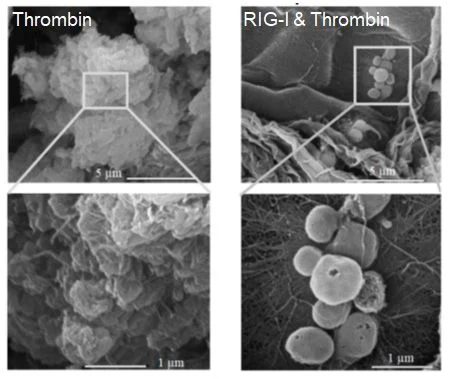
- RIG-I activation changes the thrombus architecture: Thrombi formed by RIG-I-activated platelets contain otherwise unchanged platelets with membrane punctures.
- RIG-I activation reduces platelet aggregation in the presence of plasminogen and facilitates uPA-dependent disaggregation.
- In vivo, at the time points when RIG-I expression is highest following infection, disruption of RIG-I/MAVS signaling increases thrombotic burden during mild influenza infection and alters the temporal pattern of leukocyte presence in lung tissue.
Importantly, many viruses encode mechanisms that inhibit RIG-I activation and signaling.
Our conclusion:
Platelets do more than promote thrombosis during infection. Through RIG-I/MAVS signaling, they sense viral RNA and engage non-classical activation mechanisms that limit thrombotic responses and contribute to the regulation of leukocyte transmigration.”
Title: The Pathogen Recognition Receptor RIG-I is Functional in Platelets and Limits Thrombotic Responses
Authors: Anthony R. Sciaudone, Michael L. Jameson, Heather Learnard, Heather Corkrey, Antonina Risitano, Mark Kelly, Timothy P. Fitzgibbons, Sara E. Cahill, Evelyn A. Kurt-Jones, Jane E. Freedman, Fiachra Humphries, Kahraman Tanriverdi, Jennifer P. Wang, Milka Koupenova
Stay updated on all scientific advances with Hemostasis Today.
-
Nov 12, 2026, 22:50Arun V J: Why Has India Still Not Achieved 100% Voluntary Blood Donation?
-
Nov 12, 2026, 22:49Sickle Cell Disease Deserves to Be Prioritised in Ghana – ISCC
-
Nov 12, 2026, 22:47Samir Kumar Beura: Delighted to Serve as a Topic Editor for a Research Topic in Frontiers in Neuroscience
-
Nov 12, 2026, 22:46Ashish Sharma: In-Hospital Mortality and Bleeding Complications in APL
-
Nov 12, 2026, 22:44Mary Cushman: New Position at the Vermont Center for Cardiovascular and Brain Health
-
Nov 12, 2026, 22:43Lama Alstanbuli: Discussing and Optimizing Stroke Pathways Across Healthcare Systems
-
Nov 12, 2026, 22:35Carmen’s Recovery From Spontaneous Coronary Artery Dissection – American Heart Association
-
Nov 12, 2026, 22:34What’s Next in Comprehensive Care for Hemophilia and Other Bleeding Disorders? – WFH
-
Nov 12, 2026, 22:33Sanjay Ahuja: Presenting on Artificial Intelligence in Hematology Learning and Practice at ASH 2026