


Muhammet Özbilen: What Does New Evidence Tell Us About IV Iron in Pregnancy?
Muhammet Özbilen, Associate Professor Doctor at Ordu University, shared a post on LinkedIn:
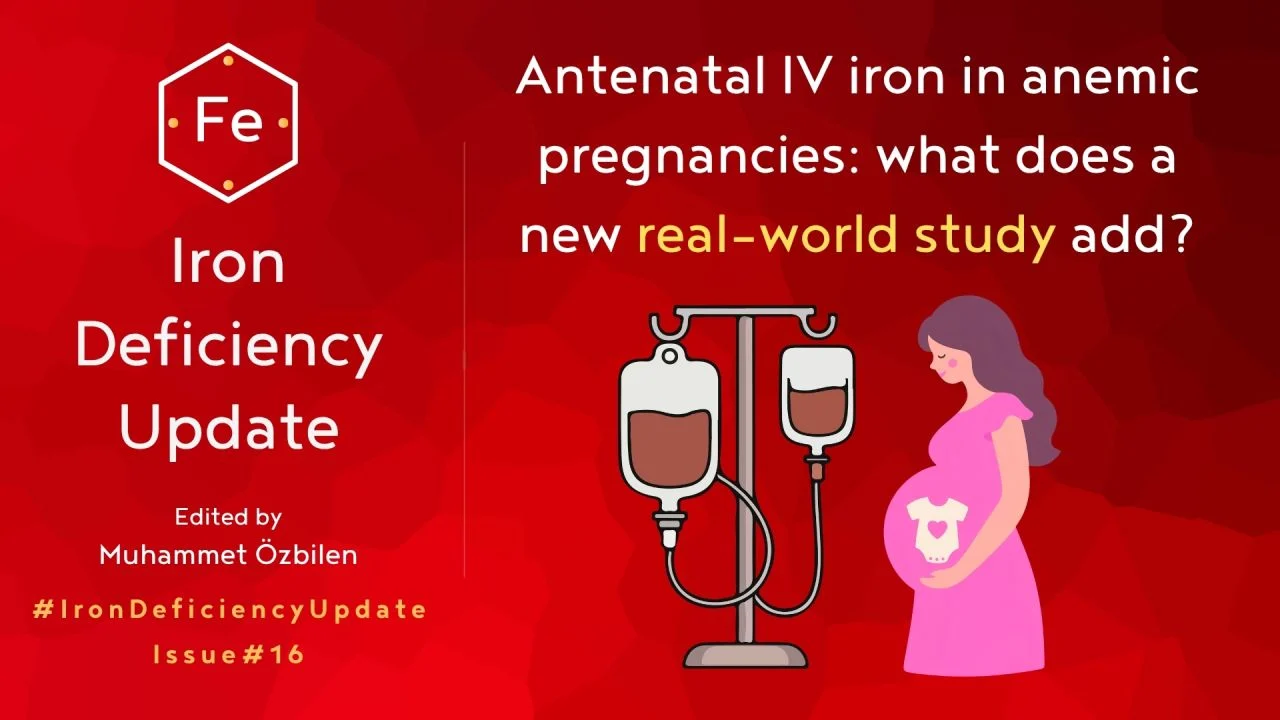
“Antenatal IV iron in anemic pregnancies: what does a new real-world study add?
A multicenter retrospective cohort from Florence and Milan (Romani, Parisi et al., Nutrients 2026) followed 851 pregnant women with iron deficiency anemia. 490 received ferric carboxymaltose (FCM) and 361 did not.
Who got IV iron?
The treated women were the higher-risk group. They had lower baseline Hb (median 9.2 vs 9.8 g/dL) and 4 times more moderate–severe anemia.
They also had more multiple pregnancies, placenta accreta spectrum, prior bariatric surgery and ART conceptions. The median infusion was at 35 weeks, close to delivery.
Key findings
- Crude transfusion rates were similar (3.9% vs 4.7%), as were PPH and blood loss.
- After adjustment, IV iron was associated with lower odds of RBC transfusion (aOR 0.42) and of needing postpartum IV iron (aOR 0.28).
- Postpartum Hb was higher (9.9 vs 8.9 g/dL).
- The benefit was concentrated in women with baseline Hb less than 8.9 g/dL (aOR 0.09).
- Infants of treated mothers had fewer NICU/high-dependency admissions and less jaundice requiring phototherapy.
How I read it?
The message fits Patient Blood Management logic. IV iron does not prevent bleeding; it builds the reserve to tolerate it.
Some caution is needed, though:
- There were only 36 transfusion events for ~9 covariates, so the model risks overfitting (the authors acknowledge this).
- The transfusion signal appears only after adjustment, mainly for baseline Hb.
- The controls were not truly untreated: 54% were on oral iron.
- The neonatal findings may reflect confounding; inadequate prenatal care was 6.1% in controls vs 1% in treated women.
- Serum phosphate was not measured, an important gap for FCM.
Context
The same week, an updated JAMA Network Open meta-analysis of 29 RCTs (n is 11,771) was published.
It found that IV vs oral iron reduced delivery-related transfusion by 37% (RR 0.63), with greater benefit when pretreatment Hb was less than or equal to 9 g/dL. Two very different designs point to the same message.
Take-home: Women with Hb around 9 g/dL or lower in late pregnancy seem to benefit most from IV iron. Ideally, though, iron deficiency should be detected and treated much earlier, not at 35 weeks.”
Title: Intravenous vs Oral Iron for Treating Iron Deficiency Anemia in Pregnancy
Authors: Sarai K. Sales, Swati Rajprohat, Laura Simon, Angela Hardi, Carrie Stoll, Ashley E. Benson, Joseph J. Shatzel, Jamie O. Lo, Methodius G. Tuuli, Adam K. Lewkowitz
Title: Antenatal Intravenous Iron Therapy in Anemic Pregnancies: Associations with Obstetric Patient Blood Management and Neonatal Outcomes
Authors: Eleonora Romani, Francesca Parisi, Sara Zullino, Chiara Lubrano, Silvia Balestri, Clara Massari, Salvatore Barresi, Massimo Micaglio, Felice Petraglia, Irene Cetin, Federico Mecacci
Stay updated with Hemostasis Today.
-
Oct 5, 2026, 11:42Fonkou Steve: A Moment to Celebrate the Journey Ahead
-
Oct 5, 2026, 11:33Abeeha Faisal: Beyond the Textbooks – A Day With Children Living With Thalassemia
-
Oct 5, 2026, 11:26Jan Zlamal: Honoured with the Fritz Schiff Young Investigator Award by the DGTI
-
Oct 5, 2026, 11:21Umar Mansuri: Can Micronutrient Powders Help Reduce Childhood Anemia?
-
Oct 5, 2026, 11:03Vitalina Dzutseva: Could mRNA Encoded TCEs Transform B Cell Depletion?
-
Oct 5, 2026, 10:50Ligia Carolina Facin: Investigating a Novel Therapeutic Strategy for ATTR-CM
-
Oct 5, 2026, 10:45Mohammed Ayaz Ali։ HIT – When an Anticoagulant Causes Thrombosis
-
Oct 5, 2026, 10:24Vishnu Priya Pulipati: The Endocrinologist’s Role in Lp(a) and Cardiovascular Risk Reduction
-
Oct 5, 2026, 09:59William McKeown – A Busy Week with the European Haemophilia Consortium