


Ney Carter Borges: A Safety Advantage of Apixaban over Rivaroxaban Without Clear Superiority
Ney Carter Borges, Member Cardiologist of Global Physician Association at Cleveland Clinic Florida, shared a post on LinkedIn about a recent article by Lana Castellucci et al, published in NEJM:
”COBRRA Trial – Apixaban vs Rivaroxaban in Acute Venous Thromboembolism
Main Clinical Findings
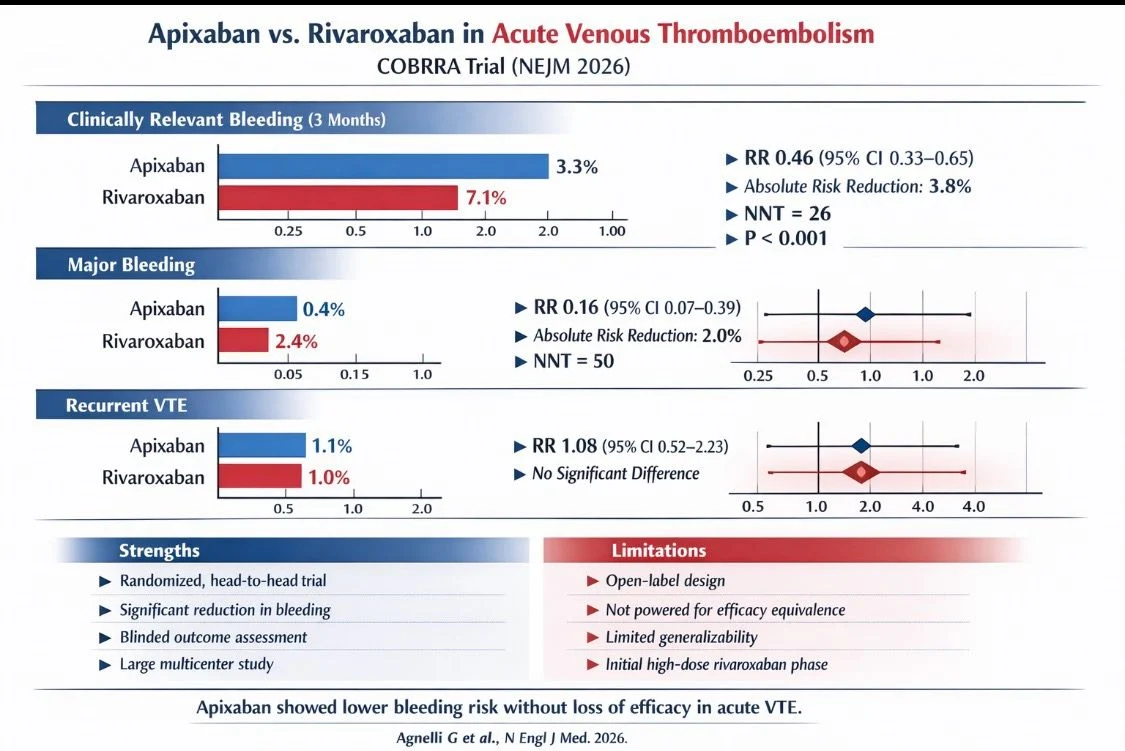
- Primary outcome (clinically relevant bleeding, 3 months)
- Apixaban: 3.3%
- Rivaroxaban: 7.1%
- Relative Risk: 0.46
- 95% CI: 0.33–0.65
- P < 0.001
- Major bleeding
- Apixaban: 0.4%
- Rivaroxaban: 2.4%
- RR: 0.16
- Recurrent VTE
- Apixaban: 1.1%
- Rivaroxaban: 1.0%
- RR: 1.08 (no meaningful difference)
Critical Appraisal
Strengths (Positive Aspects)
1. Direct head-to-head randomized comparison
Until this trial, most comparisons between DOACs came from indirect network meta-analyses or observational cohorts.
2. Clinically meaningful endpoint
The primary endpoint included major bleeding and clinically relevant non-major bleeding, which reflects real-world complications affecting treatment continuation.
3. Robust reduction in bleeding risk
The absolute risk reduction of 3.8% yields an NNT ≈ 26 to prevent one bleeding event within 3 months.
4. Large pragmatic multicenter design
- 2760 patients
- 32 centers
- Real-world acute VTE population.
5. Blinded adjudication of outcomes
Even though the trial was open-label, events were adjudicated blindly, reducing measurement bias.
6. Clinically actionable findings
Results provide clear guidance for first-line DOAC selection in acute VTE.
Limitations (Negative Aspects)
1. Open-label design
Treatment allocation was not blinded, which may introduce behavioral or reporting bias.
2. Study not powered for efficacy equivalence
The trial was designed primarily for bleeding safety, not to prove non-inferiority for recurrent VTE.
3. Limited generalizability
Underrepresented populations:
- severe obesity (>120 kg)
- active cancer-associated thrombosis
- advanced renal disease
4. Geographic concentration
Most participants were recruited in Canada, limiting external validity across broader populations.
5. Dosing strategy difference
The higher bleeding with rivaroxaban may partly reflect:
- Initial intensified dosing phase (15 mg BID), rather than intrinsic drug toxicity.
6. Short follow-up
Primary analysis focused on 3 months, which corresponds to the acute treatment phase but not long-term anticoagulation.
Clinical Interpretation
This trial suggests that apixaban may offer a superior safety profile compared with rivaroxaban during the initial treatment phase of VTE, without compromising thromboembolic protection.
However, the results do not definitively establish superiority in overall efficacy, nor do they fully apply to populations such as cancer-associated thrombosis or extreme obesity.”
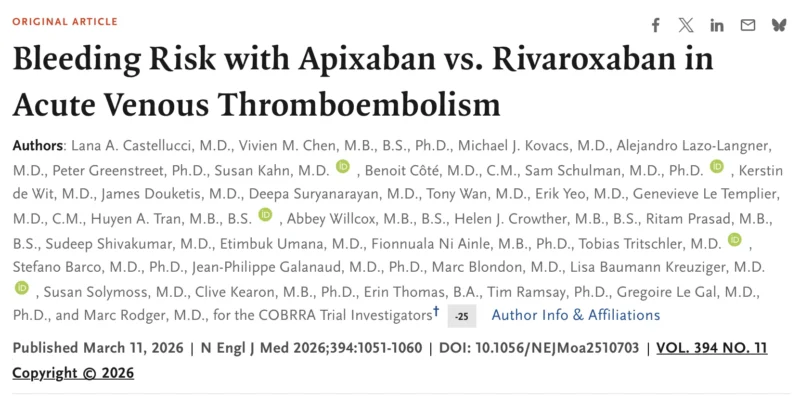
Title: Bleeding Risk with Apixaban vs. Rivaroxaban in Acute Venous Thromboembolism
Authors: Lana A. Castellucci, Vivien M. Chen, Michael J. Kovacs, Alejandro Lazo-Langner, Peter Greenstreet, Susan Kahn, Benoit Côté, Sam Schulman, Kerstin de Wit, James Douketis, Deepa Suryanarayan, Tony Wan, Erik Yeo, Genevieve Le Templier, Huyen A. Tran, Abbey Willcox, Helen J. Crowther, Ritam Prasad, Sudeep Shivakumar, Etimbuk Umana, Fionnuala Ni Ainle, Tobias Tritschler, Stefano Barco, Jean-Philippe Galanaud, Marc Blondon, Lisa Baumann Kreuziger, Susan Solymoss, Clive Kearon, Erin Thomas, Tim Ramsay, Gregoire Le Gal, Marc Rodger, for the COBRRA Trial Investigators
Read the Full Article on NEJM
Stay updated on all scientific advances with Hemostasis Today.
-
Sep 9, 2026, 17:57CRISPR/Cas Gene Editing in β-Thalassemia: From Molecular Correction to Clinical Reality
-
Sep 9, 2026, 17:38Cardiovascular Health in Bleeding Disorders – EHC
-
Sep 9, 2026, 17:33Manasvi Shah: Co-Inheritance of Alpha Globin Gene Multiplication With Beta Globin Gene Abnormalities
-
Sep 9, 2026, 17:29Christina Crossette-Thambiah: One of the Largest Studies to Date in Antiphospholipid Syndrome
-
Sep 9, 2026, 17:25Alan Nurden: A miR-146a Variant Reveals a New Pathway Linking Platelet Metabolism and Thrombosis
-
Sep 9, 2026, 17:17When Is Thrombophilia Testing Appropriate and How Can the Evidence Guide Clinical Care? – ISTH
-
Sep 9, 2026, 16:07Zahra Safarzadeh: From Novel F8 Variant to Clinical Significance
-
Sep 9, 2026, 16:00Maximo Agustin Schiavone: HDL Beyond Cholesterol – Linking Lipids and Immunity
-
Sep 9, 2026, 15:56Abdul Mannan: When Antiseizure Drugs Alter DOAC Risk