

Sip Wijchers: Is It Time to Use Ultrasound for Every AF Ablation Access?
Sip Wijchers, Cardiologist-electrophysiologist at Erasmus MC, shared a post on LinkedIn:
”We’ve optimized anticoagulation in AF ablation. But what about the puncture?
Vascular access complications remain the most common adverse event in AF ablation. And yet, many labs still rely on landmark-based femoral venous access.
The ULYSSES trial challenges that habit.
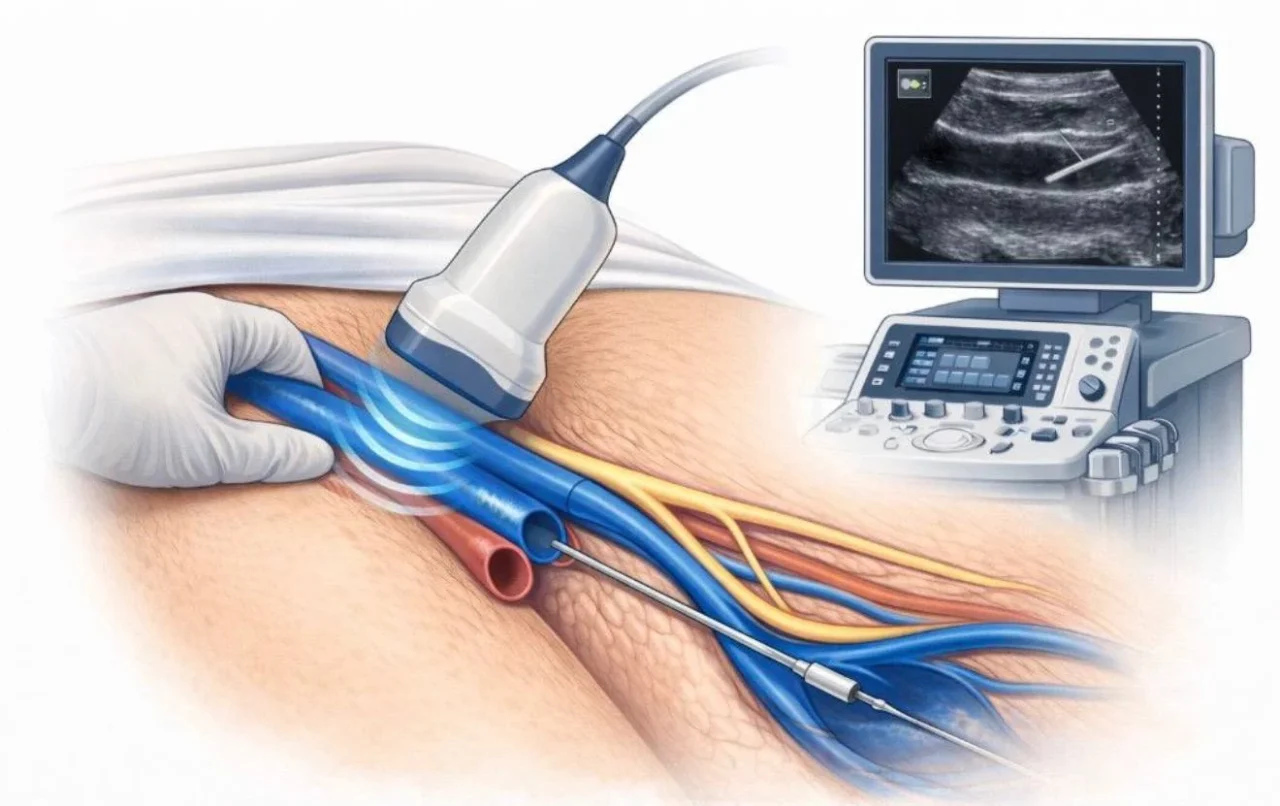
In 986 patients undergoing AF/LA tachycardia ablation, ultrasound-guided access reduced clinically relevant vascular complications from 3.3% to 0.6% (RR 0.19, p=0.002) (Schaack et al., 2026).
But the real signal may be elsewhere:
- Arterial puncture: 16% – 2%
- Failed venous access: 8.2% – 0.2%
- No increase in procedure time
This is not about marginal gains.
This is about predictability and safety at the very first step of the procedure.
And importantly, this aligns with decades of data across vascular access:
Ultrasound improves success and reduces complications in central lines, subclavian access, and femoral arterial puncture (Teja et al., 2024; Zawadka et al., 2023; Strauss et al., 2025).
So the real question is no longer does it help?
It’s:
Can we still justify not using it?
- Yes, the absolute risk reduction is modest.
- Yes, the trial was stopped early.
But when a low-cost, widely available tool reduces the most frequent complication of a high-volume procedure… the bar for “routine use” should be low.
Should ultrasound-guided femoral venous access now be the default in AF ablation?
Or is palpation still acceptable in experienced hands?
Curious how this is implemented in your lab.”
Stay updated with Hemostasis Today.
-
Sep 22, 2026, 13:58Giulia Passaniti: Dual Inferior Vena Cava Anatomy in Tetralogy of Fallot
-
Sep 22, 2026, 13:35Michael Miyamoto: Scaling Guideline Based Lipid Management in Community Practice
-
Sep 22, 2026, 13:15Suvro Sankha Datta: Developing Blood Group Genotyping Platform Using a Gold-Oligo
-
Sep 22, 2026, 13:07Caitlin Raymond: The Plasma Chaser in Therapeutic Plasma Exchange
-
Sep 22, 2026, 09:18Shamee Shastry: How Transfusion Medicine Research Is Evolving in India
-
Sep 22, 2026, 09:11Tarique Shahzad Chachar: Why Warfarin Remains the Gold Standard for Mechanical Heart Valves
-
Sep 22, 2026, 09:04Bianca Rocca: Thromboinflammatory Injury in Ischemic Limb Necrosis During Severe Shock
-
Sep 22, 2026, 09:01Ash Paul: Comparing Left Atrial Appendage Occlusion and Oral Anticoagulation
-
Sep 22, 2026, 08:50Emily Horner: Lipoprotein(a) Links Oxidized Phospholipids to Platelet Hyperactivity