


Nicolas Hubacz: How the Brain’s Blood Supply Predicts Alzheimers
Nicolas Hubacz, Research and Clinical Products Business Development Manager at Magstim, shared a post on LinkedIn about a recent article by Amaryllis A. Tsiknia et al. published in Alzheimer’s & Dementia, adding:
“How the Brain’s Blood Supply Predicts Alzheimers
A new study from USC’s Stevens Neuroimaging and Informatics Institute found that subtle changes in how the brain regulates blood flow and oxygen may provide important clues about Alzheimer’s risk—potentially before significant symptoms appear.
Using two completely noninvasive techniques, researchers measured how effectively the brain adjusts blood flow and oxygen delivery.
They found that more ‘healthy’ vascular patterns were linked to:
- Lower levels of amyloid plaques, a hallmark of Alzheimer’s disease
- Larger hippocampal volumes, a brain region essential for memory
- Better cognitive status overall, with poorer vascular function seen in participants with mild cognitive impairment or dementia
These findings add to growing evidence that Alzheimer’s isn’t solely a disease of amyloid and tau.
The brain’s ability to deliver oxygen and maintain healthy blood flow may play an important role much earlier in the disease process.
Even more promising, these techniques are less expensive and less invasive than MRI or PET scans, requiring no radiation or injections.
While the study doesn’t establish cause and effect, ongoing research will determine whether these vascular signals can predict future cognitive decline.
Sometimes the earliest warning signs aren’t found in what accumulates in the brain, but in how the brain nourishes itself.
Study: Tsiknia et al., Alzheimer’s and Dementia (2026)
Credit: Stevens Neuroimaging and Informatics Institute, Keck School of Medicine of USC.”
Proceed to the video attached to the post
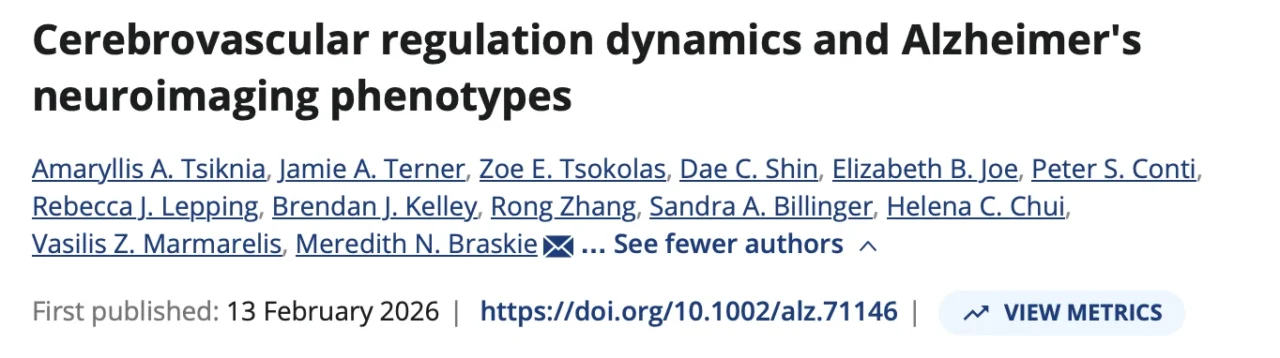
Title: Cerebrovascular regulation dynamics and Alzheimer’s neuroimaging phenotypes
Authors: Amaryllis A. Tsiknia, Jamie A. Terner, Zoe E. Tsokolas, Dae C. Shin, Elizabeth B. Joe, Peter S. Conti, Rebecca J. Lepping, Brendan J. Kelley, Rong Zhang, Sandra A. Billinger, Helena C. Chui, Vasilis Z. Marmarelis, Meredith N. Braskie
Stay updated on all scientific advances with Hemostasis Today.
-
Oct 2, 2026, 12:50Ravi C Dara: ADHAR 2026 – Red Cell Exchange in Sickle Cell Disease
-
Oct 2, 2026, 12:37David McIntosh: WeDonate Partners with Dr. Martens to Reward UK Blood Donors
-
Oct 2, 2026, 12:31Ahmed Salah El-Deen: HELLP Syndrome – An Obstetric Emergency
-
Oct 2, 2026, 12:28Swapnil Hiremath: Transitioning from Idiopathic Thrombocytopenia to Antiphospholipid Syndrome in Recurrent Severe Preeclampsia
-
Oct 2, 2026, 12:08Austin Camp: Learn How to Treat HIT from an ICU Pharmacist in 60 Seconds!
-
Oct 2, 2026, 12:02Fahad Laghari: Flow Diversion for a Cavernous Internal Carotid Artery Aneurysm
-
Oct 2, 2026, 12:02Archil Jaliashvili: Exploring BHOC as a Complementary Oxygen-Delivery Strategy
-
Oct 2, 2026, 11:57Cornelia Elena Predoi: Peri-Interventional Prophylactic Plasma Transfusion in Anaesthesia and Critical Care
-
Oct 2, 2026, 11:41Daniel Pereira Monteiro: Why HbA1c Fails in Hemoglobinopathies – Modern Glycemic Monitoring and Therapeutic Approaches