


Javier Amador-Castañeda: When a 32 Percent Reduction Tells Only Part of the Story
Javier Amador-Castañeda, Founder and Creator of the Interprofessional Critical Care Network LLC FB group, Chief Executive Officer at Interprofessional Critical Care Network (ICCN), shared a post on LinkedIn:
“A JAMA trial reported that a new catheter lock solution reduced central line complications by 32 percent. It did.
But the composite that moved was carried almost entirely by one component, and the component every clinician actually worries about contributed five events across 1468 patients.
Here is how to take a composite apart.
Here is a number I want you to hold onto: two hundred.
That is the total count of primary outcome events in a trial published in JAMA in May of this year.
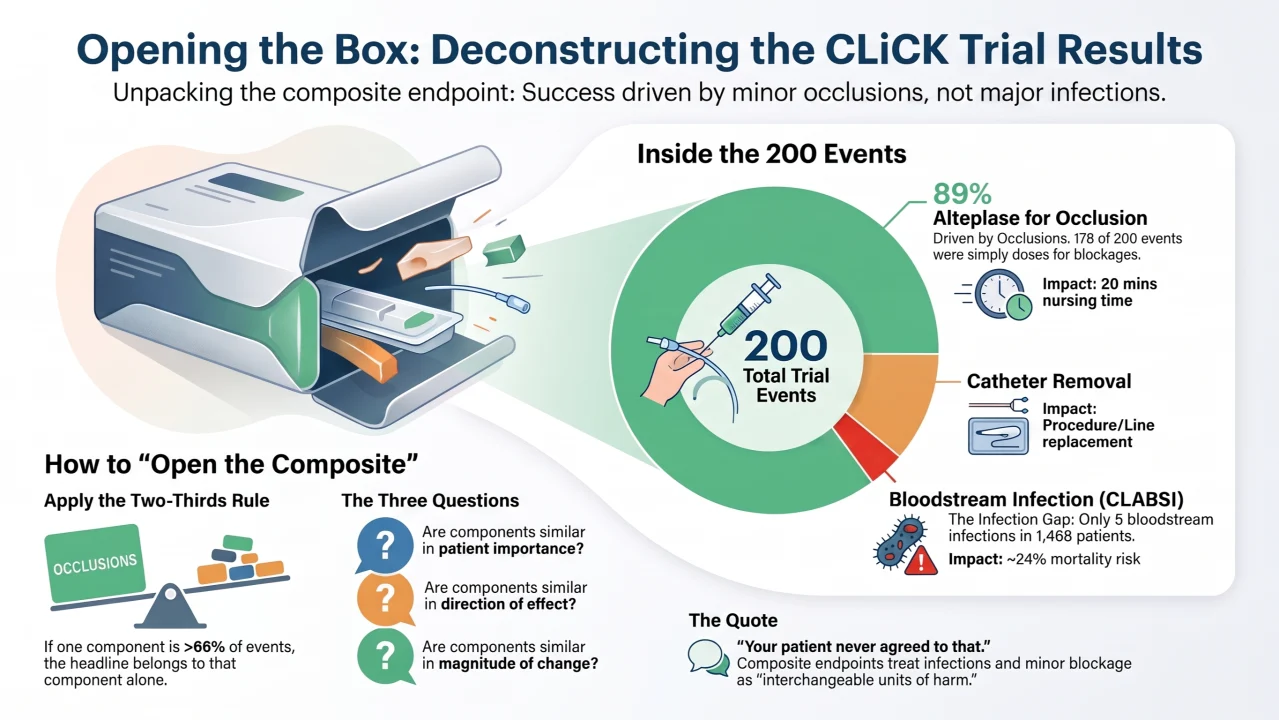
The CLiCK trial randomized 1468 adult ICU patients across six Canadian hospitals to a 4% tetrasodium EDTA catheter lock solution or to usual care, and its primary outcome was a composite of three things: central line-associated bloodstream infection, catheter occlusion requiring alteplase, and catheter removal because of occlusion.
The composite moved.
Thirteen point one events per 1000 catheter-days with the intervention against 19.9 with control. Adjusted rate ratio 0.68, confidence interval 0.47 to 0.96, P equals .03. Number needed to treat, twenty.
That is a real result from a triple-blind, cluster-randomized trial, and it deserves to be taken seriously.
Now open the box.
Of those two hundred events, 178 were doses of alteplase given for an occluded lumen.
Seventeen were catheters pulled because they were blocked.
Five were bloodstream infections. Two in the intervention arm, three in control, across 1468 patients and nearly twelve thousand catheter-days.
The trial is honest about this.
The abstract says so directly, and the discussion says so again.
But the summaries will not, and the conversation in your unit will not, because a composite endpoint that includes the word ‘bloodstream infection’ gets remembered as an infection trial.
It was not one.
It was an occlusion trial that also counted infections and did not find enough of them to say anything.
That gap, between what a composite is called and what a composite is made of, is the subject of this article.
Why this matters
Composite endpoints are everywhere in critical care research, and for defensible reasons.
Our event rates are low, our trials are expensive, and pooling several related outcomes into one count buys statistical power that a single outcome cannot afford.
Without composites, most of the trials we rely on would be unaffordably large.
But there is a price, and the methodology literature has been describing it for twenty years.
Freemantle and colleagues laid it out in JAMA in 2003 in a title that says the whole thing: greater precision, but with greater uncertainty. Montori and colleagues followed in the BMJ in 2005 with the validity criteria.
Ferreira-González and colleagues then went and looked at what actually happens in practice, reviewing cardiovascular trials with composite endpoints, and found the pattern that should worry all of us: treatment effects tend to be larger for the less important components and smaller for the most important ones.
Cordoba and colleagues found in a 2010 systematic review that composites are frequently defined, reported, and interpreted poorly.
Tomlinson and Detsky summarized the whole problem in a JAMA editorial title that I have never improved on: there is no free lunch.
Here is why this matters to you specifically, on a weekday, in a unit.
A composite endpoint is a claim about equivalence.
When you pool bloodstream infection with a dose of alteplase, you are asserting, structurally, that those events are interchangeable units of harm.
One of each counts the same toward the total. Your patient does not experience them that way.
A CLABSI carries roughly 24% mortality in reported cohorts and adds days of ICU stay and tens of thousands of dollars.
A dose of alteplase costs a nurse twenty minutes and a delayed antibiotic.
Both are worth preventing.
They are not the same thing, and a design that counts them identically will report a result that most readers will attribute to the more frightening component.”
Proceed to the video attached to the post.
Stay updated with Hemostasis Today.
-
Sep 30, 2026, 22:28Recent Mechanical Risk Factors and Young-Onset Cryptogenic Ischemic Stroke – American Heart Association International
-
Sep 30, 2026, 22:22Expert Consensus on Inferior Vena Cava Thrombosis – Thrombosis and Haemostasis Journal
-
Sep 30, 2026, 22:21Markus Abeln: How Platelets, Coagulation, Glycosylation, and Complement Regulate Placental Blood Flow
-
Sep 30, 2026, 22:19Fatma Al Arbawi: Studying Blood Clot Mechanics to Understand Aspirin Resistance and Thrombosis
-
Sep 30, 2026, 22:17Sudhir Kumar: Stroke is a Medical Emergency – and Every Minute Matters
-
Sep 30, 2026, 22:15Luisa Medeiros Visentini: Our Research on Cognitive Impairment After CVT Cited in the International Journal of Stroke
-
Sep 30, 2026, 21:50Jagat Narula: Connecting Cardiovascular Health and Sickle Cell Disease on World Heart Day 2026
-
Sep 30, 2026, 21:38John Kastelein: Exploring the Biology of Cardiovascular Disease at BioCentury Grand Rounds Europe
-
Sep 30, 2026, 21:36Mark Murphy: Irish Heart Foundation Meets With Senator Teresa Costello on World Heart Day