

Gut Microbiota and Platelet Recovery After Radiation – Platelets Journal
Platelets Journal shared a post on LinkedIn about a recent article by Qian Jia et al., adding:
“Recently published in Platelets!
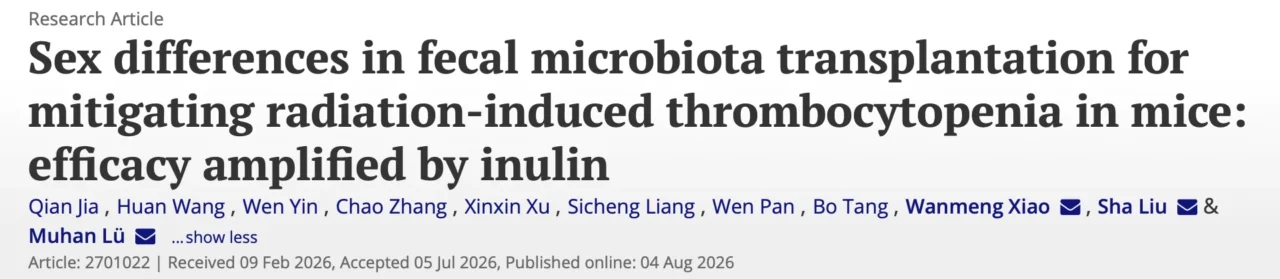
‘Sex differences in fecal microbiota transplantation for mitigating radiation-induced thrombocytopenia in mice: efficacy amplified by inulin’ by Qian Jia, et al. (2026).
Radiation-induced thrombocytopenia (RIT) is a dose-limiting toxicity of radiotherapy, and the current mainstays, platelet transfusion and thrombopoietic agents, offer inconsistent, short-lived benefit while leaving the underlying gut-bone marrow axis untouched.
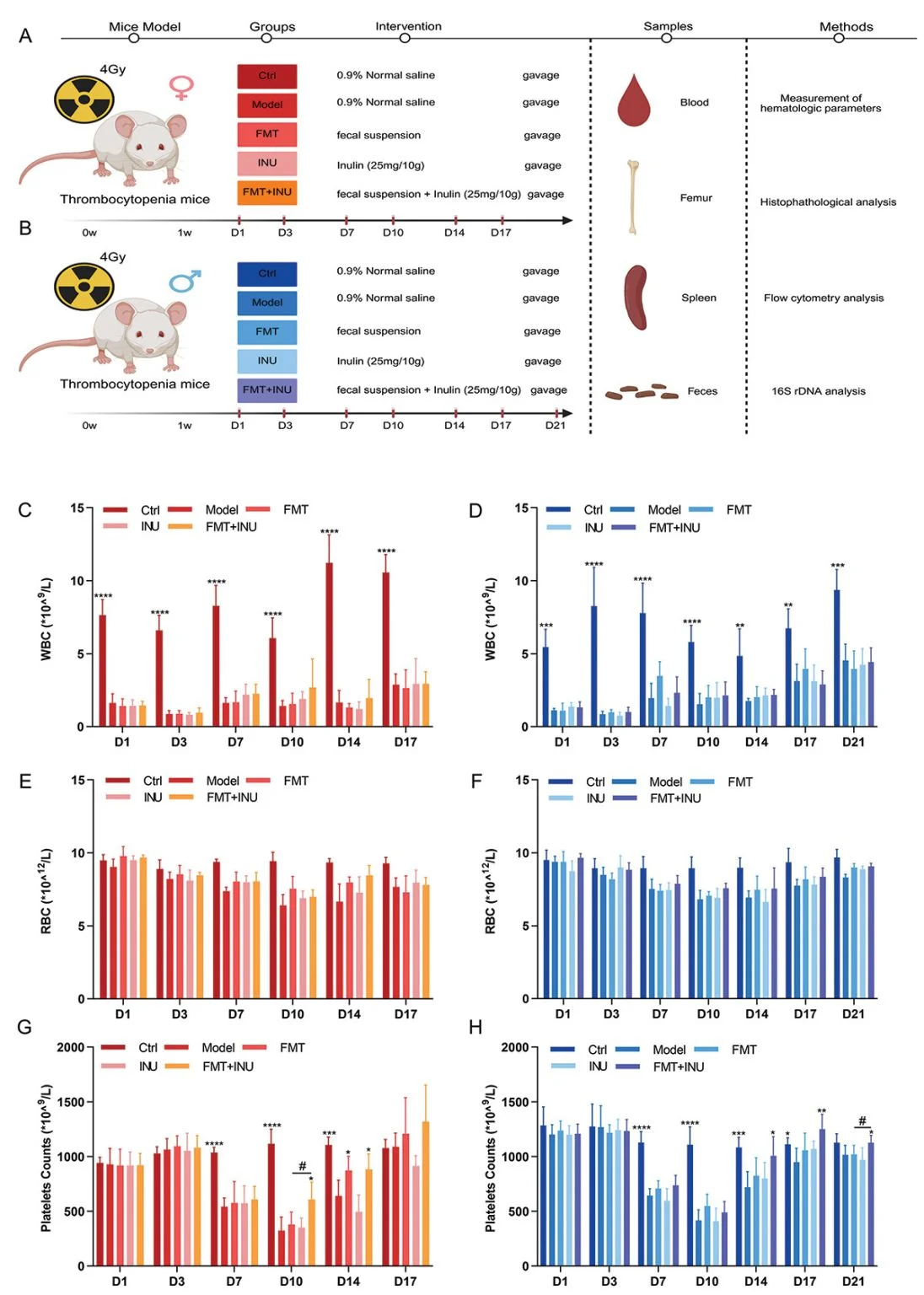
Working from a 4 Gy total-body irradiation model in Kunming mice, Jia and colleagues asked whether faecal microbiota transplantation (FMT) could manipulate the gut-bone marrow axis, and whether donor and recipient sex determine the response.
Notably, sex-matched FMT restored peripheral platelet counts and drove megakaryopoiesis in the bone marrow and spleen of female recipients, but produced only a non-significant trend in males.
The effect tracked with an enrichment in Akkermansia, which the authors nominate as the candidate functional taxon behind recovery.
The differences observed in sex were further validated through a cross-sex design, in which female-donor faeces accelerated platelet recovery in irradiated male mice, while male-donor faeces did not.
Layering the prebiotic inulin onto FMT tightened the benefit again, enriching beneficial commensals and recovering platelet counts earlier than FMT alone (see Figure 1G-H, below).
The proposed mechanism, an Akkermansia-associated short-chain fatty acid route feeding into megakaryocyte differentiation, still requires functional validation.”
Title: Sex differences in fecal microbiota transplantation for mitigating radiation-induced thrombocytopenia in mice: efficacy amplified by inulin
Authors: Qian Jia, Huan Wang, Wen Yin, Chao Zhang, Xinxin Xu, Sicheng Liang, Wen Pan, Bo Tang, Wanmeng Xiao, Sha Liu, Muhan Lü
Stay updated on all scientific advances with Hemostasis Today.
-
Sep 29, 2026, 03:53Nahrwan Masaoodi: Iron Deficiency Can Exist Without Anemia
-
Sep 29, 2026, 03:38Muhammad Yousaf: Iron Deficiency Beyond Diet
-
Sep 29, 2026, 03:21Parvez Ahmed Chowdhury: Synthesizing Aspirin in the Organic Chemistry Lab
-
Sep 29, 2026, 03:12Ahmed Hamandi: Building the Future of Hematopoietic Transplantation in Iraq
-
Sep 29, 2026, 03:09M V Chandrakanth: Aspirin in CRC – Old Drug, New Precision Oncology?
-
Sep 29, 2026, 03:07Caroline Pothet: Advancing Treatment Development in Sickle Cell Disease and Thalassaemia
-
Sep 29, 2026, 02:53Astha Jain: Thalassemia Care Through a Public Health Lens
-
Sep 29, 2026, 02:50Emma Groarke: Starting a New Career Path in Homeland
-
Sep 28, 2026, 19:14Aditya Sharma: An Outstanding Start to the Final Day of VSS 2026!