


Pradeep Natarajan: Key New Aspects of the 2026 ACC/AHA Dyslipidemia Guidelines
Pradeep Natarajan, Director, Preventive Cardiology at Massachusetts General Hospital, shared on LinkedIn about a recent article he and his colleagues co-authored, adding:
“Honored to contribute to the 2026 ACC/AHA Dyslipidemia Guidelines!
Key new aspects:
Risk assessment starts earlier. PREVENT-ASCVD (30-79yo) is endorsed, superseding PCE (40-79yo).
Due to improved average calibration, risk categories have changed:
- Low (<3%)
- Borderline 3-5%
- Intermediate 5-10%
- High ≥10%.
Individuals with low 10-year risk but high (≥10%) 30-year risk or LDL-C 160-189 mg/dl, (often younger individuals missed in the recent prior framework) could be eligible for statins to achieve LDL-C < 100 mg/dl toward lifetime risk optimization.
Risk enhancers now have stronger support for guiding treatment in borderline risk patients. CAD polygenic risk score has made this list. And now there is a stronger endorsement for assessing reproductive risk markers.
Lipid targets are more clearly back, and are more aggressive.
We have reintroduced LDL-C and non-HDL-C targets, alongside % LDL-C reduction.
- High-risk primary prevention: LDL-C <70 mg/dl
- Very high-risk ASCVD: LDL-C <55 mg/dl.
CAC plays a larger role with class I when treatment decisions are uncertain. Risk estimation with risk enhancers are a starting point, and CAC can help resolve. Now there is additional support for using CAC to guide treatment aggressiveness.
- CAC ≥100: LDL-C <70 mg/dl
- CAC 300-999: LDL-C <70 mg/dl (consider <55 mg/dl)
- CAC ≥1000: LDL-C <55 mg/dl.
Incidental CAC from other chest CTs from other indications can be used to influence treatment decisions.
The guidelines now recommend measuring Lp(a) at least once in all adults. Given Lp(a)-lowering capability, PCSK9 mAb is recommended second-line for patients with ASCVD, high Lp(a), and suboptimal LDL-C on statins.
Once LDL-C goals are achieved, apoB can be used to confirm or support further treatment intensification.
ApoB goals are:
- LDL-C <100mg/dl: apoB <90mg/dl
- LDL-C <70 mg/dl: apoB <70 mg/dl
- LDL-C <55 mg/dl: apoB <55 mg/dl.
More LDL-C-lowering medicines have been added to the armament since the last guidelines: bempedoic acid and inclisiran.
However, guidelines emphasize PCSK9 mAb over PCSK9i siRNA (inclisiran) because CV outcomes benefit has not been demonstrated for the latter.
The guidelines now more specifically support genetic testing for severe hypercholesterolemia (LDL-C > 190mg/dl) for familial hypercholesterolemia.
FH genetic testing is now also supported for children and adolescents with a suggestive clinical presentation. Genetic confirmation of HeFH supports further treatment intensification with lower LDL-C targets as well as enabling cascade screening. And a diagnosis of HoFH supports evinacumab.
Genetic diagnosis of familial chylomicronemia syndrome and severe hypertriglyceridemia (TG > 1,000 mg/dl) supports the addition of olezarsen.
Among those with ASCVD or diabetes with risk factors, and persistent TG 150-499 mg/dl, icosapent ethyl could be considered.”
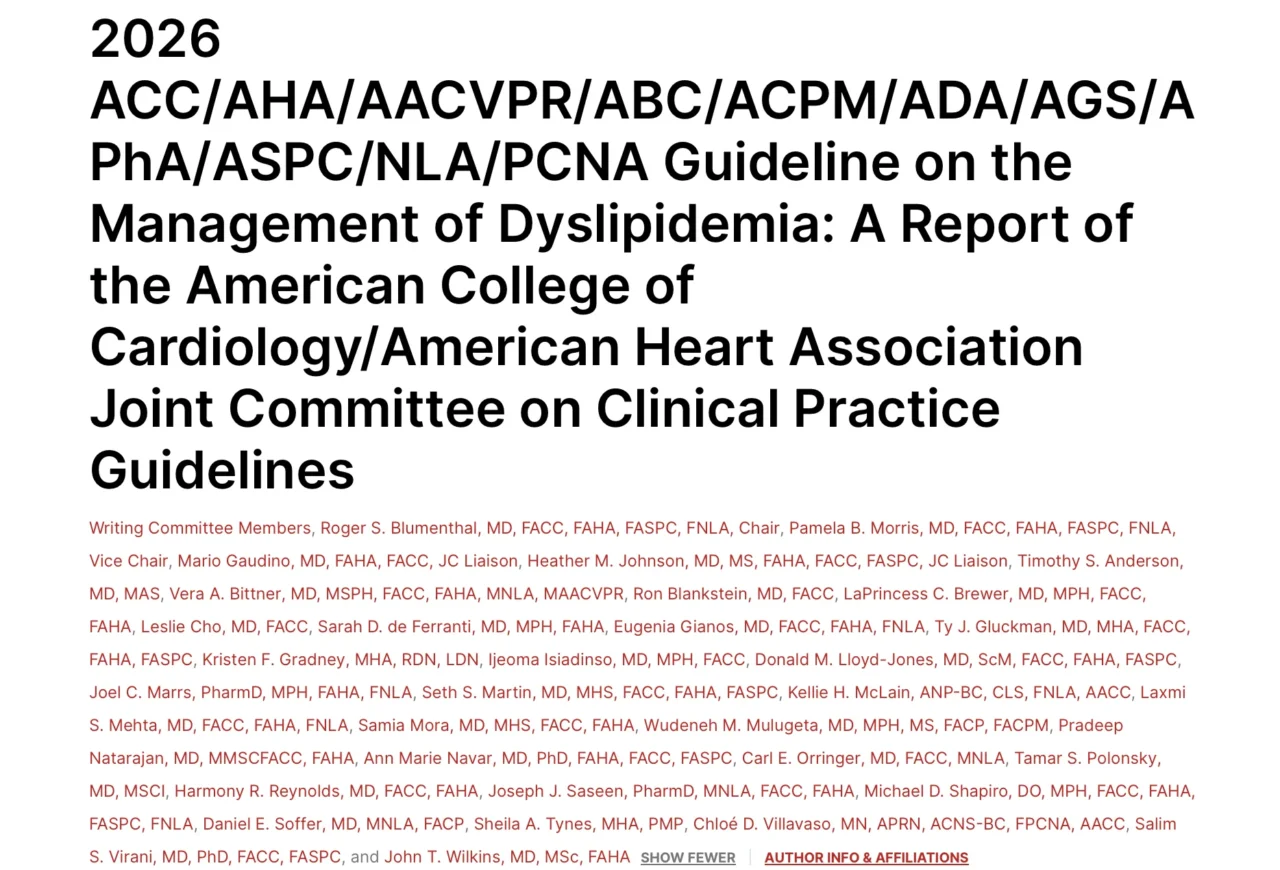
Title: 2026 ACC/AHA/AACVPR/ABC/ACPM/ADA/AGS/APhA/ASPC/NLA/PCNA Guideline on the Management of Dyslipidemia: A Report of the American College of Cardiology/American Heart Association Joint Committee on Clinical Practice Guidelines
Authors: Roger S. Blumenthal, Pamela B. Morris, Mario Gaudino, Heather M. Johnson, Timothy S. Anderson, Vera A. Bittner, Ron Blankstein, LaPrincess C. Brewer, Leslie Cho, Sarah D. de Ferranti, Eugenia Gianos, Ty J. Gluckman, Kristen F. Gradney, Ijeoma Isiadinso, Donald M. Lloyd-Jones, Joel C. Marrs, Seth S. Martin, Kellie H. McLain, Laxmi S. Mehta, Samia Mora, Wudeneh M. Mulugeta, Pradeep Natarajan, Ann Marie Navar, Carl E. Orringer, Tamar S. Polonsky, Harmony R. Reynolds, Joseph J. Saseen, Michael D. Shapiro, Daniel E. Soffer, Sheila A. Tynes, Chloé D. Villavaso, Salim S. Virani, John T. Wilkins.
Read the Full Article on Circulation.
Stay updated on all scientific advances with Hemostasis Today.
-
Sep 6, 2026, 13:33Antoine Francis: Albumin – The Donor Patient Equation
-
Sep 6, 2026, 12:5810 Posts Not to Miss This Week
-
Sep 6, 2026, 12:38Parveen Yograj: Atrial Fibrillation More Than an Irregular Heartbeat
-
Sep 6, 2026, 12:38Marsha McLeod: The Safety Question Behind Canada’s High-Frequency Plasma Donations
-
Sep 6, 2026, 12:27Alan Nurden: Inherited GPIV (CD36) Deficiency Linked to Bleeding for the First Time
-
Sep 6, 2026, 12:19Zaid Siddiqui: Hemophilia From a Broader Perspective
-
Sep 6, 2026, 12:13Claire Harrison: MPN Does Not Define Your Dreams
-
Sep 6, 2026, 12:12Ilenia Calcaterra: Beyond Bleeding Control Emicizumab and the Evolution of Joint Health in Hemophilia A
-
Sep 6, 2026, 12:11Agisilaos Zerdelis: My CRTH Journey From Trial Idea to Clinical Research