

Why Pediatric ROTEM Needs Race-Specific Reference Ranges?
Vera Ignjatovic, Founder and Managing Director of Ignis Innovations Pty Ltd, shared a post by Journal of Thrombosis and Haemostasis (JTH) on LinkedIn:
”Here is the link to our paper describing the age and race-specific association of fibrinogen and Rotational Thromboelastometry (ROTEM) parameters in a diverse pediatric population.
Inclusion of a diverse population in establishing race-specific pediatric RIs has clinical and public health relevance for a more accurate diagnosis and personalized treatment.
Thank you, Marium Malik, Maha Al-Ghafry, Maribel Lema, Vijay Nandi, Linda Shore-Lesserson, and Suchitra S. Acharya for making this study possible. I am privileged to have worked with you in the late stages of this study.”
Quoting Journal of Thrombosis and Haemostasis (JTH)’s post:
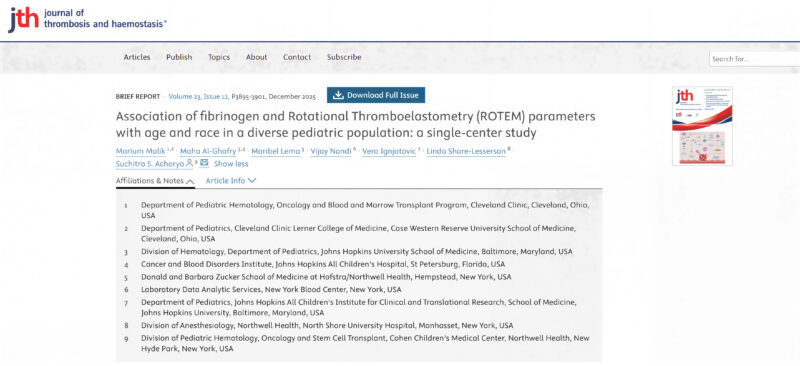
”Association of fibrinogen and ROTEM parameters with age and race in a diverse pediatric population: a single-center study
By Marium Malik, Maha Al-Ghafry, Maribel Lema, Vijay Nandi, Vera Ignjatović, Linda Shore-Lesserson, and Suchitra S. Acharya
• Pediatric reference ranges for Rotational Thromboelastometry (ROTEM) – a whole-blood coagulation assay – are limited and rarely account for racial diversity.
• In 105 racially diverse children (1–21 years), investigators analyzed how age and race affect fibrinogen and ROTEM variables (EXTEM, INTEM, and FIBTEM).
• Fibrinogen and FIBTEM clot strength increased with age. Among Black/African American participants, rising age correlated with shorter clot times and stronger clot firmness, suggesting a prothrombotic hemostatic profile. This underscores the need for race-specific pediatric reference intervals for personalized coagulation assessment.
Read the article here.”
Title: Association of fibrinogen and Rotational Thromboelastometry (ROTEM) parameters with age and race in a diverse pediatric population: a single-center study
Authors: Marium Malik, Maha Al-Ghafry, Maribel Lema, Vijay Nandi, Vera Ignjatovic, Linda Shore-Lesserson, Suchitra S. Acharya
Stay updated with Hemostasis Today.
-
Oct 8, 2026, 12:53Hellen Ishikawa-Ankerhold: PhD and Postdoctoral Positions in Advanced Microscopy and Immunothrombosis at LMU Munich
-
Oct 8, 2026, 12:45Pedro Perez: World Thrombosis Day 2026 – Raising Awareness of Women’s VTE Risk
-
Oct 8, 2026, 12:20Berrin Gunaydin: Functional Biomarkers of Iron Deficiency in Pregnancy
-
Oct 8, 2026, 11:45Wolfgang Miesbach: Milvexian After Acute Coronary Syndrome – What LIBREXIA ACS Found
-
Oct 8, 2026, 11:36John Erbey: Kidney Disfunction as a Cause of Anemia
-
Oct 8, 2026, 11:31Navneet Mishra: Sitosterolemia as an Under-Recognised Cause of Cytopenias
-
Oct 8, 2026, 11:06Houman Khosravani: Stroke and Thrombosis – Bridging Neurology and Hemostasis
-
Oct 8, 2026, 04:28Jeff Molter: Electrophysiological PIEZO1 Analysis Advances Diagnosis in Hereditary Xerocytosis
-
Oct 8, 2026, 04:23Barbara Adams Krolak: Women and Blood Clots Are We Missing the Warning Signs