


How Social Determinants and Clinical Drivers Impact Hospital Outcomes – RPTH Journal
RPTH Journal shared a post on LinkedIn about a recent article by Doris Akolbire et al., adding:
“Who dies from pulmonary embolism in hospital: why does it depend on more than just physiology
Despite advances in diagnosis and management, in-hospital mortality from acute pulmonary embolism (PE) remains substantial.
A new study in RPTH Journal uses nationally representative US data to identify which clinical and socioeconomic factors predict death and the findings go beyond the expected.
Key findings from 723,579 PE hospitalisations (National Inpatient Sample, 2018–2021; 3% in-hospital mortality):
Clinical predictors:
- Lactic acidosis: 7-fold increase in mortality odds (aOR 7.04), the strongest single predictor
- Each 1-point increase in comorbidity burden: 20% increase in mortality odds
- Metastatic cancer, liver disease, arrhythmias, and coagulopathy were also significant predictors
- Obesity and chronic hypertension were associated with lower adjusted mortality
Socioeconomic predictors:
- Female sex and Black and Asian/Pacific Islander patients had higher adjusted mortality than White patients
- Self-pay status was associated with higher mortality than Medicare
- Higher household income was progressively associated with lower mortality
These findings are a stark reminder that PE outcomes are not determined by physiology alone.
Systemic inequities, in access, insurance coverage, and race, independently predict who survives.
A truly multidimensional approach to PE risk assessment must account for social determinants of health, not just clinical parameters.”
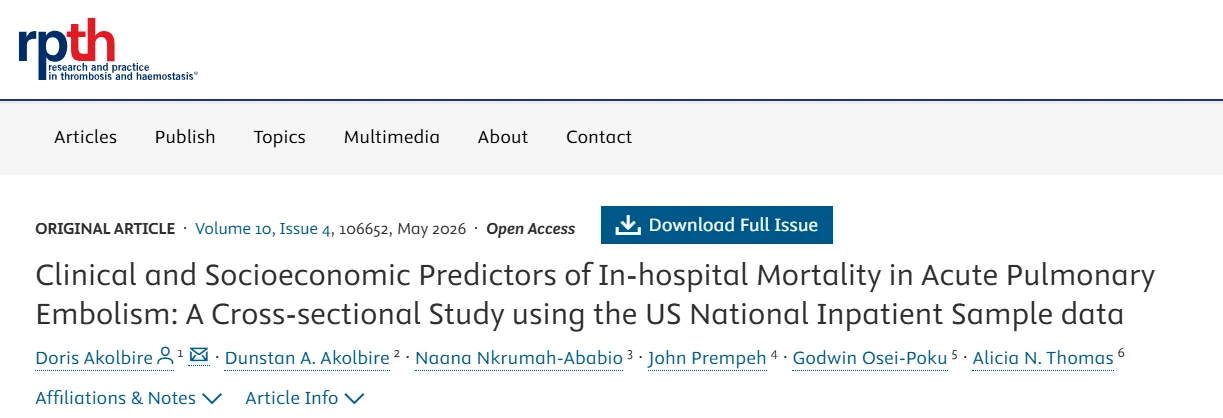
Title: Clinical and Socioeconomic Predictors of In-hospital Mortality in Acute Pulmonary Embolism: A Cross-sectional Study using the US National Inpatient Sample data
Authors: Doris Akolbire, Dunstan A. Akolbire, Naana Nkrumah-Ababio, John Prempeh, Godwin Osei-Poku, Alicia N. Thomas
Other posts featuring RPTH Journal on Hemostasis Today.
-
Sep 30, 2026, 12:52Paul Watton: Could Repetitive Head Impacts Leave a Molecular Memory?
-
Sep 30, 2026, 12:41The Journey to ISTH 2027 Starts in Vancouver
-
Sep 30, 2026, 11:36Basit Ali: A Closer Look at CT Venography
-
Sep 30, 2026, 11:16Christina Pohlman: Could aPL Levels Help Predict Stroke Recurrence?
-
Sep 30, 2026, 10:55Rana Al Hrout: Diagnostic Approach to Hypochromic Microcytic Anemia
-
Sep 30, 2026, 01:52Javed Anees: DADA2 – When a Young Stroke Is More Than a Stroke
-
Sep 30, 2026, 01:51How a Venous Thrombus Becomes Revascularized – ISTH
-
Sep 29, 2026, 22:45Victor Agunyego: Paracetamol – The Most Common Drug We Underestimate
-
Sep 29, 2026, 22:42Nova Sinclair: Advancing the Future of Hematology – Meet Our 2027 Organizing Committee