

Why Does Plasma Form Such Robust Fibrin Clots – RPTH Journal
RPTH Journal shared a post on LinkedIn about a recent article by François Caton et al, adding:
“Why does plasma form such robust fibrin clots?
Fibrin clot architecture is a recognised signature of cardiovascular disease, but the fundamental mechanisms linking clot-forming chemistry to clot structure in plasma remain poorly understood. A new study in RPTH Journal takes a rigorous quantitative approach to answer this question.
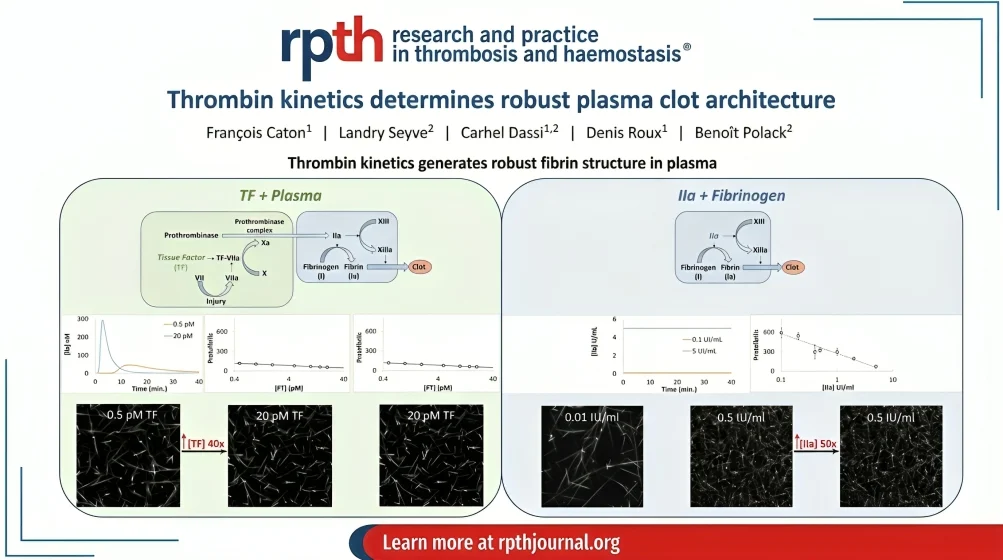
Key findings comparing plasma clots with purified fibrinogen/thrombin systems:
In purified systems, a 100-fold increase in thrombin concentration caused a 30-fold decrease in protofibril number and a 5-fold change in pore size, highly sensitive to trigger concentration
In contrast, plasma clots showed remarkable robustness: a 40-fold increase in tissue factor concentration resulted in only a 2-fold change in protofibril number, with minimal pore size evolution
Purified and plasma clots appeared morphologically identical, their ultrastructural parameters behaved fundamentally differently
Key driver: it is the characteristic shape of the thrombin burst over time, not the total amount of thrombin produced, that governs plasma fibrin architecture
This inherent robustness of plasma clot formation may explain the existence of a ‘normal’ clot structure, and positions fibrinography as a promising structural biomarker for detecting deviations from this norm in cardiovascular disease.”
Title: Thrombin kinetics determines robust plasma clot architecture
Authors: François Caton, Landry Seyve, Carhel Dassi, Denis Roux, Benoît Polack
Stay updated on all scientific advances with Hemostasis Today.
-
Nov 11, 2026, 15:42Tareq Abadl: The Clinical Impact of Kell Alloimmunization
-
Nov 11, 2026, 15:30Alejandro González Veliz: Does PCI Change The Long-Term Outcome In Stable Coronary Artery Disease?
-
Nov 11, 2026, 15:25Preparing for the SoHO Regulation – EBA Board Convenes in Vienna – European Blood Alliance
-
Nov 11, 2026, 15:20Vaidehi Prasanth: IV Iron in Heart Failure – Exploring Hospitalisation Benefits vs. Infection Risk in Open Heart
-
Nov 11, 2026, 15:18Stefan Prendić: Can Algorithms Support Antibody Identification in Immunohematology?
-
Nov 11, 2026, 15:12Perioperative Challenges in Hemophilia Patients on Rebalancing Therapies
-
Nov 11, 2026, 15:03Maria Elisa Mancuso: World-Renowned Faculty and 33 Global Participants Unite at Hemophilia Academy 2026
-
Nov 11, 2026, 15:01Hassan Raza: The JAK2 V617F Revolution
-
Nov 11, 2026, 14:57Edward Lee Carter: Factor Xla Inhibition Enters Clinical Practice – FDA Approval of Asundexian