

Are Circadian Rhythms Fueling Thrombotic Risk in Space? – RPTH Journal
RPTH Journal shared a post on LinkedIn about a recent article by Zeinab Ibrahim et. al, adding:
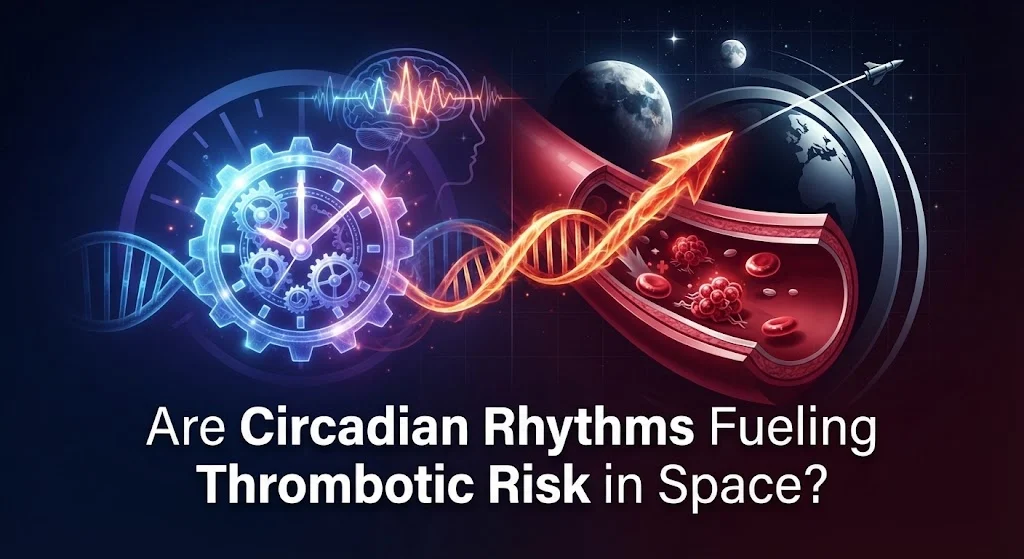
“Space, clocks and clots: a critical mechanistic gap in astronaut health
We know that blood clotting follows circadian rhythms.
We know that spaceflight disrupts circadian timing.
And we know that spaceflight may increase thrombotic risk, particularly in the head and neck.
Yet circadian biology and haemostasis have almost never been studied together in space.
A new systematic review in RPTH Journal synthesises evidence from real spaceflight missions and ground-based analogs to map what we know, and crucially, what we don’t.
Key findings from 38 included studies:
- Haemostasis studies: dynamic changes in coagulation cascades, platelet activation, fibrinogen, endothelial markers, and complement components across multiple spaceflight analog models.
- Circadian studies: phase shifts, altered autonomic rhythmicity, and disruption of molecular clock regulators under simulated and real space conditions.
The critical gap: not a single included study simultaneously assessed circadian-phase regulation and haemostatic outcomes
- Most haemostatic studies used endpoint or milestone-based sampling, without circadian-phase resolution.
- Circadian studies used dense temporal sampling,but rarely assessed thrombotic endpoints.
The two fields are evolving in parallel, but not yet talking to each other.
As missions to the Moon and Mars become a reality, integrative ‘chronothrombotic’ study designs are urgently needed to determine whether disrupted biological timing directly contributes to thrombotic vulnerability in space.”
Title: Biological clocks and blood clots in space: circadian disruption-induced modulation of thrombosis risk
Authors: Zeinab Ibrahim, Ronan P. Murphy, Germaine Cornelissen Guillaume, David Andrew Green, Roopen Arya, Suzanne C. Cannegieter, Nandu Goswami

Stay updated with on all scientific advances Hemostasis Today.
-
Nov 10, 2026, 16:28Can the VWF to ADAMTS-13 Ratio Predict Mortality in Sepsis-Induced Coagulopathy? – RPTH Journal
-
Nov 10, 2026, 16:28Ruth Willems: PhD Defence at Maastricht University on Thrombosis and Bleeding in HPB Disease
-
Nov 10, 2026, 16:09Edward Lee Carter: Factor XIa Inhibition Enters Clinical Practice
-
Nov 10, 2026, 16:08Edward C.C. Wong: Deriving Ferritin Cutoffs for Iron Deficiency Using RBC Parameters
-
Nov 10, 2026, 16:07Milad Abdalla: Decoding Hemoglobin Electrophoresis – A Practical Diagnostic Reference
-
Nov 10, 2026, 15:13Wolfgang Miesbach: Nonviral Gene Therapy for Haemophilia A Using Lipid Nanoparticles
-
Nov 10, 2026, 15:06Dahra Teles: First Speaking Experience at HEMO 2026 on First-Line Multiple Myeloma Treatment
-
Nov 10, 2026, 14:55Yazan Abou-Ismail: First FDA-Approved Factor XIa Inhibitor for Stroke Prevention
-
Nov 10, 2026, 14:49Ifeanyichukwu Ifechidere: The Role of Coagulation in Anaesthesia and Surgery