


Sadashiva Pai: The Molecular Gateway for Sphingosine-1-Phosphate Release
Sadashiva Pai, Editorial Board at Aging Brain, Founder and CEO of Science Mission LLC, shared a post on LinkedIn about a recent article by Shahbaz Ahmed et al, published in Nature Communications, adding:
“How blood cells release key signaling lipid.
Scientists have discovered how blood cells release an important signaling fat called sphingosine-1-phosphate, or S1P, into the bloodstream.
S1P plays an important role in keeping blood vessels healthy, helping immune cells move around the body, and supporting normal cell function.
To carry out these roles, S1P must first leave the cells in which it is produced.
However, it cannot pass through the cell membrane freely and on its own.
Instead, it relies on specialised proteins that act like gateways.
One such gateway is MFSD2B, a protein found mainly in red blood cells and platelets.
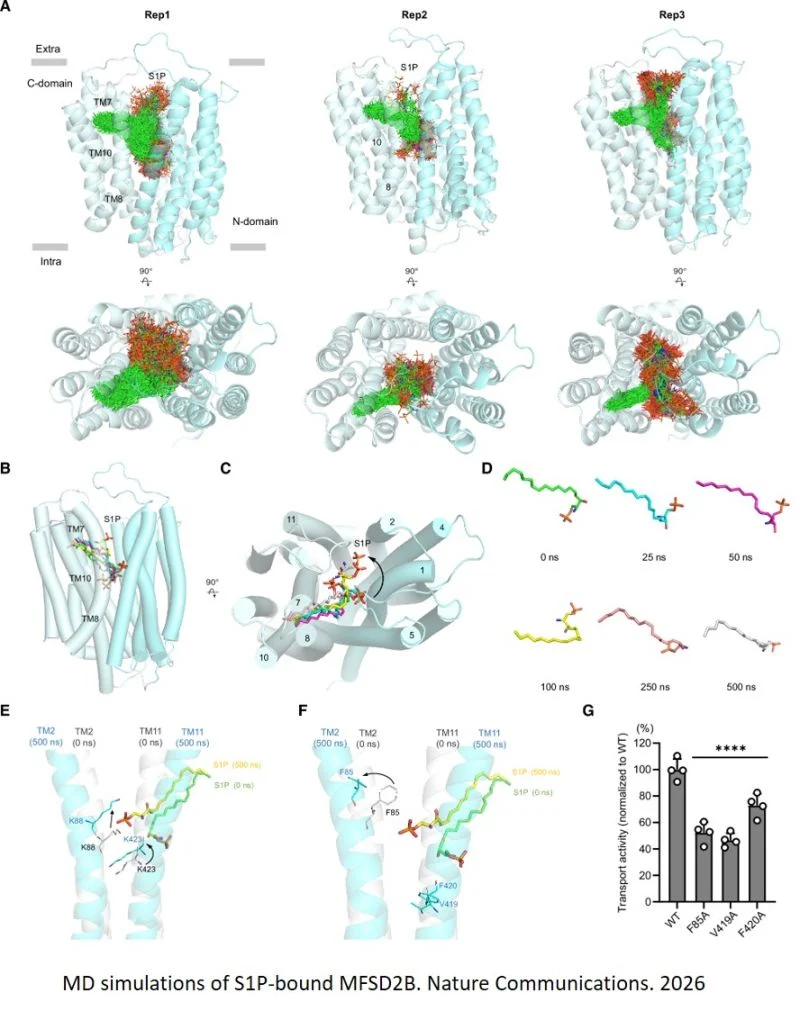
In the new study, published in Nature Communications, researchers used cryo-electron microscopy (cryo-EM), computer simulations, and protein engineering to capture a detailed view of MFSD2B while S1P was sitting inside it.
Using cryo-EM, the researchers were able to view MFSD2B at close to the atomic level.
They found that S1P fits deep inside the transporter.
Its long fatty tail sits inside a pocket within the protein, while its charged head interacts with specific parts of MFSD2B that help hold and guide it.
The team also identified an opening in MFSD2B that is likely to serve as the main route through which S1P moves in and out of the transporter.
Two amino acids of the protein, K88 and K423, appear to act like a series of handholds, briefly interacting with S1P and helping guide it along the transport pathway.
The researchers also found that MFSD2B moves S1P in a relatively simple and energy-efficient way.
Instead of relying on sodium or other sources of energy to push S1P across the cell membrane, MFSD2B allows the lipid to move from an area where it is abundant to an area where it is less abundant.
Red blood cells naturally contain higher levels of S1P than the surrounding blood plasma.
This difference in concentration can therefore help drive S1P out of the cells and into the bloodstream.
The researchers also found that a change involving just one building block of the MFSD2B protein could alter the way the transporter works.
Changing one amino acid made the transporter dependent on acidic conditions, showing how a small change in the protein can affect the way it moves S1P.”
Title: Structure and mechanism of human sphingosine-1-phosphate transporter MFSD2B
Authors: Shahbaz Ahmed, Min Huang, Yaxin Dai, Xuebo Yang, Jiajun Dong, Xiang Yu, Chia-Hsueh Lee, Long N. Nguyen
Stay updated with Hemostasis Today.
-
Oct 2, 2026, 14:17Aditya Rawat: Clopidogrel, CYP2C19 and the Role of Pharmacogenetics
-
Oct 2, 2026, 14:12Monitoring Iron Deficiency in Glanzmann Thrombasthenia – Glanzmann’s Research Foundation
-
Oct 2, 2026, 14:06Giang Tran: Residual Internal Carotid Artery Aneurysm After Flow-Diverter Stenting
-
Oct 2, 2026, 14:05Shadiah Nassanga: The Economic Impact of Sickle Cell Disease
-
Oct 2, 2026, 13:56Mapping the Care Gaps for Hemophilia and Sickle Cell Disease in Ghana – Novo Nordisk Haemophilia and Haemoglobinopathies Foundation
-
Oct 2, 2026, 13:50Arnav Garcha: New Insights Into Platelet Transport in Arterial Flow
-
Oct 2, 2026, 13:49Alessandro Lucchesi: RiseMPN 2026 – Shaping the Future of MPN Treatment
-
Oct 2, 2026, 13:43Ronald Mahomane: Bangladesh Moves Toward Sustainable Hemophilia Treatment Access
-
Oct 2, 2026, 13:38Sathya-Prasad Burjonrappa: Pediatric Trauma and Deep Venous Thrombosis