


Vincent Ten Cate: Could Lipid-Lowering Therapy Enhance Anticoagulation for VTE Prevention
Vincent Ten Cate, Group Leader at the University Medical Center Mainz, shared a post on LinkedIn about a recent article he and his colleagues co-authored, published in Med by Cell Press, adding:
“Happy to share our new publication in Med by Cell Press, where we systematically evaluated whether lipid-lowering therapy (LLT) provides additional benefit when added to anticoagulation (AC) for the prevention of recurrent venous thromboembolism (VTE).
There is already substantial evidence from randomized trials that statins and other lipid-lowering therapies reduce VTE risk, without an apparent increase in bleeding.
However, it has remained unclear whether adding LLT on top of anticoagulation provides an additional antithrombotic effect, and whether combining the two could increase bleeding risk.
In this first systematic review and Bayesian meta-analysis addressing this question, we compiled the available evidence, which was predominantly observational, and found:
- 27 percent lower risk of recurrent VTE with anticoagulation plus lipid-lowering therapy compared with anticoagulation alone, with a high posterior probability (97 percent) of a beneficial effect.
- 15 percent lower bleeding risk with the combination (posterior probability of beneficial effect 99 percent ). Importantly, none of the included studies estimated a higher bleeding risk with AC plus LLT than with anticoagulation alone.
- Randomized trial evidence consistently demonstrated reductions in C-reactive protein, reflecting the well-established anti-inflammatory effects of lipid-lowering therapy.
Of course, these findings need to be interpreted cautiously.
The evidence base is overwhelmingly observational, and randomized trials are needed to establish whether the apparent additional benefit is causal.
Beyond the meta-analysis, we also systematically reviewed the potential mechanisms through which lipid-lowering therapies may influence the coagulation system.
We hypothesize that the absence of an increase in bleeding when combining anticoagulation with lipid-lowering therapy could partly relate to the pleiotropic anti-inflammatory and antioxidant effects of these drugs, which may contribute to endothelial protection.
Overall, this work adds to the growing evidence that the benefits of lipid-lowering therapy may extend well beyond LDL cholesterol reduction.
In particular, there may be a therapeutic opportunity to combine anticoagulation with lipid lowering for recurrent VTE prevention.
An important next step would be randomized trials testing whether lipid-lowering therapy can safely be added to low-dose anticoagulation, particularly in patients at high risk of both thrombosis and bleeding, such as those with chronic kidney disease or cancer.
Many thanks to all co-authors who contributed to this work.”
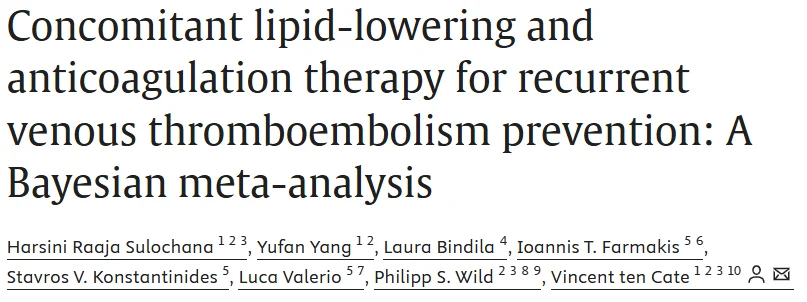
Title: Concomitant lipid-lowering and anticoagulation therapy for recurrent venous thromboembolism prevention: A Bayesian meta-analysis
Authors: Harsini Raaja Sulochana, Yufan Yang, Laura Bindila, Ioannis T. Farmakis, Stavros V. Konstantinides, Luca Valerio, Philipp S. Wild, Vincent ten Cate
Stay updated on all scientific advances with Hemostasis Today.
-
Oct 18, 2026, 01:44Marta Velia Antonini: How to Deliver CRRT during ECMO?
-
Oct 18, 2026, 01:19Aamir Saeed: Anticoagulation, Cirrhosis, and Other Risk Factors for Post-ERCP Bleeding
-
Oct 18, 2026, 00:33Elad Asher: Does Opening the Clot Change How a Patient Feels Three Months Later?
-
Oct 18, 2026, 00:22Richa Sharma: Evaluating Heterogeneity in Anticoagulation Treatment Effects in Cryptogenic Stroke
-
Oct 18, 2026, 00:07Irem Karaman Sebin: The Evidence Favoring Warfarin in High-Risk Antiphospholipid Syndrome
-
Oct 18, 2026, 00:07Emma Stevens: Lighting Up Buildings in Red and Blue for World Thrombosis Day
-
Oct 17, 2026, 23:18Maha Othman: Establishing ISTH-BAT Reference Ranges for Children and Adolescents
-
Oct 17, 2026, 17:27John Strouse: Building Standards for Whole-Person Sickle Cell Care Through Collaboration
-
Oct 17, 2026, 17:20Jean-Jacques Kiladjian: Exploring the Future of Polycythemia Vera Treatment at MPN Horizons 2026