

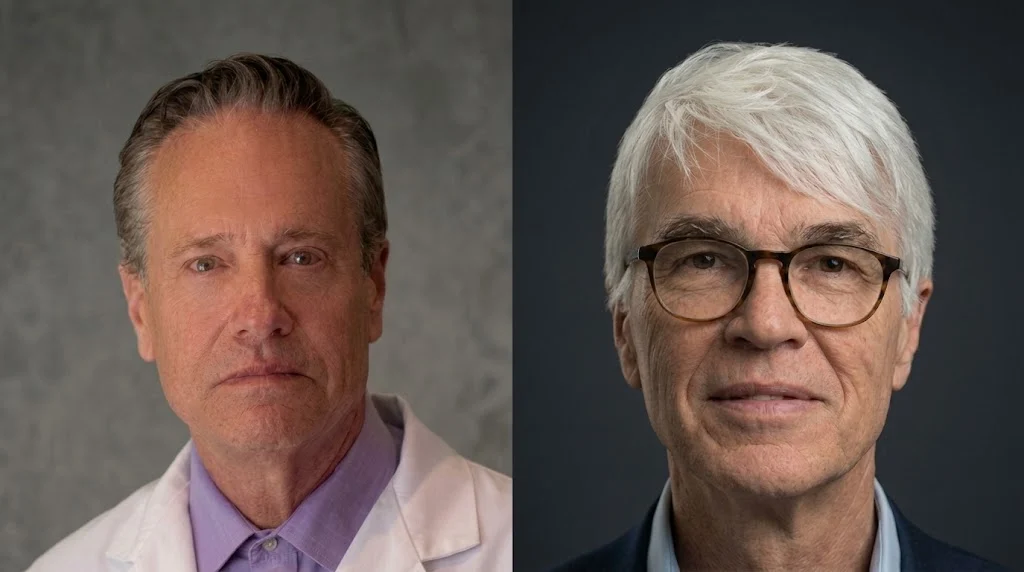
Wolfgang Miesbach: Milvexian After Acute Coronary Syndrome – What LIBREXIA ACS Found
Wolfgang Miesbach, Head of Hemostasis/Hemophilia Center at Medical Clinic 2 at University Hospital Frankfurt, shared a post on LinkedIn about a recent article by C. Michael Gibson et al, published in the New England Journal of Medicine, adding:
“14,194 patients to confirm what factor XI deficiency already suggested
People born with low factor XI have fewer strokes and venous clots, with little spontaneous bleeding.
The evidence that they have fewer heart attacks is weak.
Milvexian is an oral tablet that blocks activated factor XI (FXIa).
LIBREXIA ACS tested it after a heart attack:
- 14,194 patients, within 7 days of an acute coronary syndrome
- 25 mg twice daily or placebo, on top of dual antiplatelet therapy (95%)
- Stopped early for lack of benefit; median follow-up 12.2 months
- CV death, heart attack or ischaemic stroke: 5.4% vs 5.1% (HR 1.05)
- Intracranial or fatal bleeding: 0.3% in both groups
- The drug was working: aPTT about 60% longer than before treatment
The authors explanation: FXI may matter more for clots in small arteries, such as those in the brain, than in the coronary arteries.
This fits OCEANIC-STROKE, where another FXIa inhibitor, asundexian, added to antiplatelet therapy cut recurrent ischaemic stroke from 8.4% to 6.2%.”
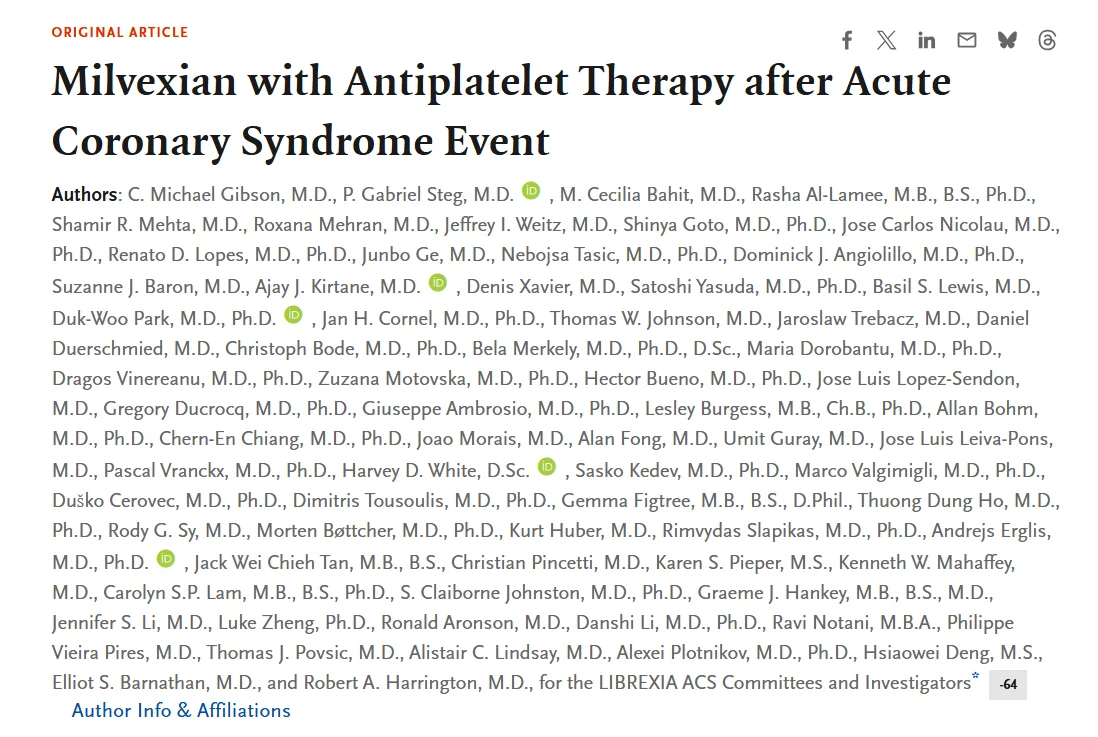
Title: Milvexian with Antiplatelet Therapy after Acute Coronary Syndrome Event
Authors: C. Michael Gibson, P. Gabriel Steg, M. Cecilia Bahit, Rasha Al-Lamee, Shamir R. Mehta, Roxana Mehran, Jeffrey I. Weitz, Shinya Goto, Jose Carlos Nicolau, Renato D. Lopes, Junbo Ge, Nebojsa Tasic, Dominick J. Angiolillo, Suzanne J. Baron, Ajay J. Kirtane, Denis Xavier, Satoshi Yasuda, Basil S. Lewis, Duk-Woo Park, Jan H. Cornel, Thomas W. Johnson, Jaroslaw Trebacz, Daniel Duerschmied, Christoph Bode, Bela Merkely, Maria Dorobantu, Dragos Vinereanu, Zuzana Motovska, Hector Bueno, Jose Luis Lopez-Sendon, Gregory Ducrocq, Giuseppe Ambrosio, Lesley Burgess, Allan Bohm, Chern-En Chiang, Joao Morais, Alan Fong, Umit Guray, Jose Luis Leiva-Pons, Pascal Vranckx, Harvey D. White, Sasko Kedev, Marco Valgimigli, Duško Cerovec, Dimitris Tousoulis, Gemma Figtree, Thuong Dung Ho, Rody G. Sy, Morten Bøttcher, Kurt Huber, Rimvydas Slapikas, Andrejs Erglis, Jack Wei Chieh Tan, Christian Pincetti, Karen S. Pieper, Kenneth W. Mahaffey, Carolyn S.P. Lam, S. Claiborne Johnston, Graeme J. Hankey, Jennifer S. Li, Luke Zheng, Ronald Aronson, Danshi Li, Ravi Notani, Philippe Vieira Pires, Thomas J. Povsic, Alistair C. Lindsay, Alexei Plotnikov, Hsiaowei Deng, Elliot S. Barnathan, Robert A. Harrington
Stay updated on all scientific advances with Hemostasis Today.
-
Nov 19, 2026, 15:58Hema Goyal: Hematocon 2026 Bringing Together Knowledge, Innovation and Excellence in Hematology
-
Nov 19, 2026, 15:44Chukwuemeka Amarachi: Understanding Complex Blood Grouping Beyond Routine ABO And RhD Typing
-
Nov 19, 2026, 14:19Long-Read Sequencing Is Closing Diagnostic Gaps in Inherited Bleeding Disorders
-
Nov 19, 2026, 13:36Raja Prince: Protein S Silencing and the Future of Hemostatic Therapy
-
Nov 19, 2026, 13:26M. Sekip Altunkan: The Thrombotic Risk of Andexanet Alfa
-
Nov 19, 2026, 13:18Felice Gragnano: Personalizing Antiplatelet Therapy After PCI
-
Nov 19, 2026, 13:11When Postpartum Warning Signs Are Ignored – National Blood Clot Alliance
-
Nov 19, 2026, 12:56Batool Abuhalimeh: The Hidden Psychological Burden of Pulmonary Embolism
-
Nov 19, 2026, 12:45Pedro Perez: PE Recovery – From Acute Treatment to Long-Term Follow-Up