


Sadik Kükrer: New ASH Thresholds and a Critical Look at the Latest IV Iron Meta-Analysis
Sadik Kükrer, Obstetrician and Gynecologist at SBÜ Adana City Training and Research Hospital, shared a post on LinkedIn:
“Two sources on iron deficiency in pregnancy appeared within weeks of each other.
The first is the American Society of Hematology’s diagnostic guideline (Blood Advances, November 10, 2026 issue).
For pregnant patients, it suggests a ferritin threshold of ≤ 30 µg/L (conditional, low certainty) and recommends against ≤ 15 µg/L (strong recommendation).
It notes that ≤ 50 µg/L may be appropriate in pregnant patients with anemia.
The second is a JAMA Network Open meta-analysis of 29 randomized trials (11 771 participants).
Compared with oral iron, IV iron was associated with higher hemoglobin (+5.9 g/L) and ferritin at delivery and with a lower transfusion rate (RR 0.63).
The transfusion difference appeared in trials whose participants had a mean pretreatment hemoglobin ≤ 90 g/L (RR 0.58); no test for subgroup differences was reported.
A critical read of the meta-analysis raises four points:
- I² is about 95% for the primary outcomes; the pooled mean is not a single ‘typical effect.’
- The funnel plot is asymmetric (Egger p = 0.04); high heterogeneity may contribute.
- In the largest trial, RAPIDIRON, hemoglobin at delivery was not higher in either IV arm; however, rescue therapy was allowed in the oral arm, and reaching a nonanemic state without additional treatment was more frequent in both IV arms.
- The oral arms of two multi-arm trials were reused in two comparisons, and three numbers disagree within the report.
Practical takeaway: for diagnosis, ASH suggests a threshold of 30; the transfusion signal comes from trials whose participants had a mean hemoglobin ≤ 90 g/L (trial-level, not a patient-level rule).
Weigh the results against heterogeneity and possible publication bias.
Details and full references are in the document; references in the first comment.
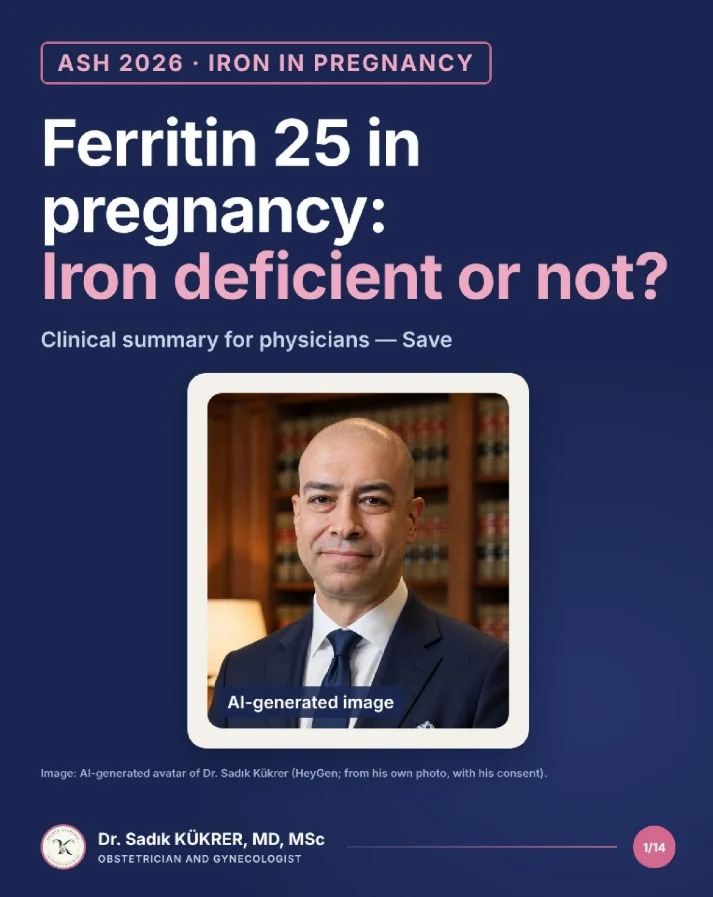
The document cover shows an AI-generated avatar image.
Educational content for physicians; not patient information, and not a substitute for individualized diagnosis or treatment.
Outcomes of any surgical or interventional procedure vary from person to person; patients should seek detailed advice from their physician beforehand.
Conflicts of interest: none · Sponsor: none. We have no affiliation with ASH, JAMA Network Open, or the authors; this is an independent educational summary.”
Stay updated with Hemostasis Today.
-
Nov 23, 2026, 19:11Svetislav Matic: Optimizing Perioperative Patient Outcomes Through PBM and Sample Volume Management
-
Nov 23, 2026, 19:10Subhadip Misra: TRANSMEDCON 2026 – Where Science Met Conversations, Collaboration and Purpose
-
Nov 23, 2026, 18:51Anirban Sen Gupta: Platelet-Inspired Nanoparticles for Targeted Drug Delivery at Vascular Disease Sites
-
Nov 23, 2026, 18:50Jan Sloves: Honored to Serve as Faculty at VEITH Symposium 2026
-
Nov 23, 2026, 18:50Edward Lee Carter: AI vs FDA Anticoagulant Education – The Most Important Finding Wasn’t Who Scored Highest
-
Nov 23, 2026, 16:04Gamunu Wijetunge: Stop Leaving TRICARE Transfusion Reimbursement on the Table
-
Nov 23, 2026, 15:58Mohsin Raza: Why is Anemia so Common in Patients with Chronic Kidney Disease?
-
Nov 23, 2026, 15:39Thirunavukkarasu Angappan: From Donated Plasma to Life – Saving Medicines
-
Nov 23, 2026, 15:06Giuseppe Biondi Zoccai: Hemoglobin-to-Creatinine Ratio Linked to Early Markers of Anthracycline-Induced Cardiac Injury