

My Free Blood Is Being Sold: Addressing Medical Mistrust in Blood Donation
Blood Track shared a post on LinkedIn:
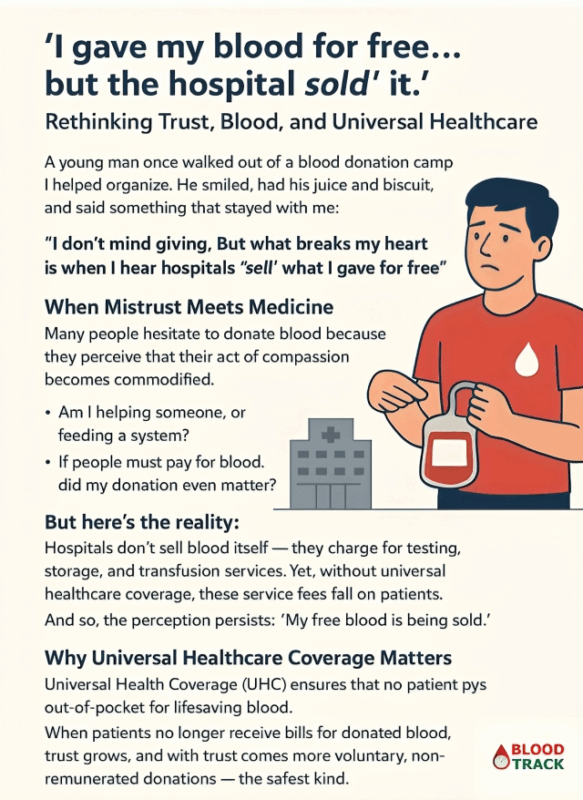
“I gave my blood for free… but the hospital sold it.”
Rethinking Trust, Blood, and Universal Healthcare
A young man once walked out of a blood donation camp I helped organize.
He smiled, had his juice and sandwich, and said something that stayed with me:
“I don’t mind giving. But what breaks my heart is when I hear hospitals sell what I gave for free.”
That moment captured the silent tension that often hides beneath our healthcare systems: medical mistrust.
When Mistrust Meets Medicine
Many people hesitate to donate blood because they perceive that their act of compassion becomes commodified.
They imagine their blood bag sitting on a shelf with a price tag, and they wonder:
“Am I helping someone, or feeding a system?”
“If people must pay for blood, did my donation even matter?”
But here’s the reality:
Hospitals don’t sell blood itself, they charge for testing, storage, and transfusion services.
Yet, without universal healthcare coverage, these service fees fall on patients.
And so, the perception persists: “My free blood is being sold.”
Why Universal Healthcare Coverage (UHC) Matters
UHC ensures that no patient pays out-of-pocket for lifesaving blood.
When patients no longer receive bills for donated blood, trust grows, and with trust comes more voluntary, non-remunerated donations: the safest kind.
Countries with strong UHC frameworks often have:
- Higher rates of regular voluntary blood donors
- Lower reliance on family/replacement donors
- Greater public confidence in hospitals and blood banks
Organizations like the World Health Organization (WHO), the International Federation of Red Cross and Red Crescent Societies (IFRC), and national blood services worldwide continue to advocate for safe, voluntary blood donation as part of UHC goals.
How can we regain trust with our donors and community?
Have you ever hesitated to donate blood because of mistrust or misconceptions?
Or have you seen how universal coverage can transform healthcare trust?
Share your thoughts, your experiences, or your ideas below.
Let’s co-create a culture of compassion backed by systems that deserve our trust.”
Find similar posts on Hemostasis Today.
-
Oct 8, 2026, 12:53Hellen Ishikawa-Ankerhold: PhD and Postdoctoral Positions in Advanced Microscopy and Immunothrombosis at LMU Munich
-
Oct 8, 2026, 12:45Pedro Perez: World Thrombosis Day 2026 – Raising Awareness of Women’s VTE Risk
-
Oct 8, 2026, 12:20Berrin Gunaydin: Functional Biomarkers of Iron Deficiency in Pregnancy
-
Oct 8, 2026, 11:45Wolfgang Miesbach: Milvexian After Acute Coronary Syndrome – What LIBREXIA ACS Found
-
Oct 8, 2026, 11:36John Erbey: Kidney Disfunction as a Cause of Anemia
-
Oct 8, 2026, 11:31Navneet Mishra: Sitosterolemia as an Under-Recognised Cause of Cytopenias
-
Oct 8, 2026, 11:06Houman Khosravani: Stroke and Thrombosis – Bridging Neurology and Hemostasis
-
Oct 8, 2026, 04:28Jeff Molter: Electrophysiological PIEZO1 Analysis Advances Diagnosis in Hereditary Xerocytosis
-
Oct 8, 2026, 04:23Barbara Adams Krolak: Women and Blood Clots Are We Missing the Warning Signs