


Mahesan Subramaniam: Multiple Sclerosis Could Be Caused by Bacteria
Dato Capt. Mahesan Subramaniam, Co-Founder United Health Tourism, shared a post on LinkedIn:
“Multiple sclerosis could be caused by bacteria, and scientists might have just identified two of them.
In a rare study of 81 identical twins—where only one sibling had MS—researchers identified two gut bacteria, Eisenbergiella tayi and Lachnoclostridium, as likely triggers of the disease. Since identical twins share the same genes, the researchers could isolate environmental differences, focusing on gut microbes from the small intestine’s ileum, where immune activity is high.
These two bacterial species consistently appeared in higher numbers in MS-affected twins and were confirmed again in a larger international study with over 1,000 participants.
To test whether the bacteria were actually causing MS, scientists transplanted gut microbes from the twins into germ-free mice. The results were striking: over 60% of mice that received bacteria from MS-affected twins developed spinal lesions and signs of paralysis, while fewer than 10% of the control mice did.
In several cases, spikes in Eisenbergiella tayi or Lachnoclostridium growth directly preceded the onset of symptoms, especially in female mice, matching MS’s higher prevalence in women.
Both bacteria belong to a larger family usually seen as harmless, but this study suggests that under certain conditions, like low dietary fiber, they may shift from helpful to harmful.
These bacteria appear to feed on mucus sugars in the gut lining, potentially weakening the barrier and triggering inflammation. Eisenbergiella tayi also produces compounds like ethanol and succinate, which are known to stimulate immune responses that can damage nerves.”
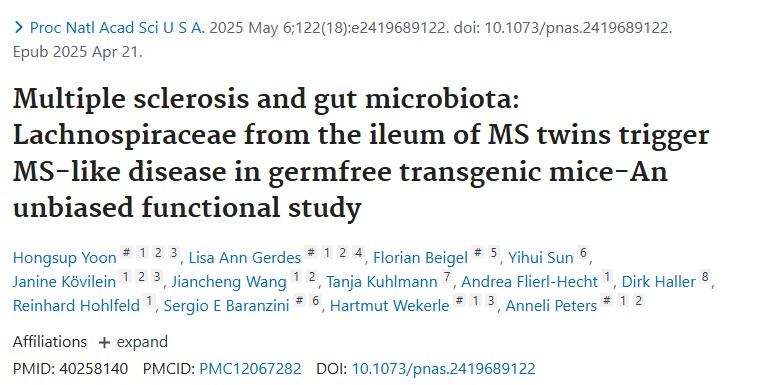
Title: Multiple sclerosis and gut microbiota: Lachnospiraceae from the ileum of MS twins trigger MS-like disease in germfree transgenic mice-An unbiased functional study
Authors: Hongsup Yoon, Lisa Ann Gerdes, Florian Beigel, Yihui Sun, Janine Kövilein, Jiancheng Wang, Tanja Kuhlmann, Andrea Flierl-Hecht, Dirk Haller, Reinhard Hohlfeld, Sergio E Baranzini, Hartmut Wekerle, Anneli Peters

Read the full article here.
Stay updated with Hemostasis Today.
-
Oct 25, 2026, 17:04Tehila Alter: Tracking Hematopoietic Cell Engraftment in Bone Marrow Using CEST MRI
-
Oct 25, 2026, 16:45Shauna Riley։ First Guidelines for Hemoglobin SC Disease
-
Oct 25, 2026, 16:26Heghine Khachatryan: Patient Safety and Clinical Judgment in Platelet Transfusion Decisions
-
Oct 25, 2026, 16:13Funmi (Vanessa) Ullam: From Lived Experience to Research and Innovation in Sickle Cell Care
-
Oct 25, 2026, 15:13Franky Biles: Celebrating Diversity and Driving Inclusion Through Representation
-
Oct 25, 2026, 14:47Siddharth Mittal: A Sheet-Like Effluent Deposit During Plasma Exchange in iTTP
-
Oct 25, 2026, 14:16Alejandro González Veliz: Can Factor XIa Inhibition Prevent Recurrent Ischemic Events Without Increasing Bleeding?
-
Oct 25, 2026, 13:0910 Posts Not to Miss This Week
-
Oct 25, 2026, 13:02Thomas Dayspring: Advancing Cardiovascular Risk Assessment Through Multidisciplinary Lipid Care