


Benedikt Lorenz on Liver Failure and Coagulation – Myths, Traps, and Bad Habits
Benedikt Lorenz, Senior Physician, Interdisciplinary Surgical Intensive Care Medicine at Schleswig-Holstein University Hospital, shared on LinkedIn:
”Liver failure and coagulation – myths, traps, and bad habits.
Liver failure and hepatic insufficiency cause profound changes in standard lab tests — and anyone treating these patients must know the pitfalls.
A colleague asks whether to give PCC before inserting a Shaldon catheter for ADVOS therapy in a patient with right heart failure and liver failure.
“We never give PCC blindly – except
A) if a patient is on warfarin and bleeding, or
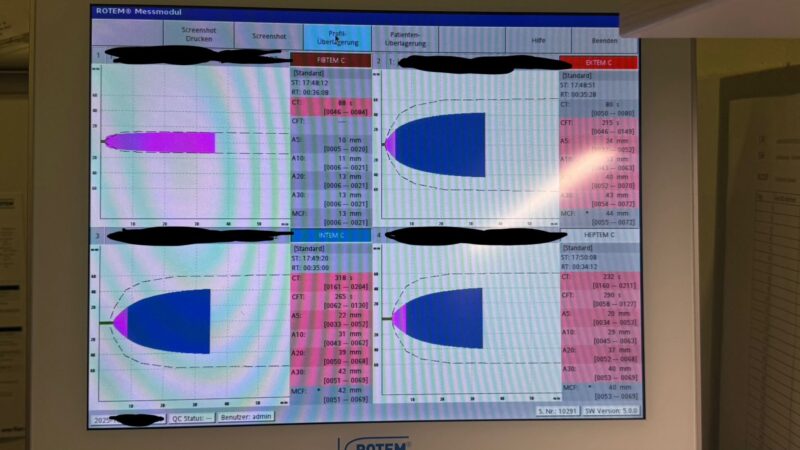
B) if the ROTEM shows a prolonged CT in the EXTEM after (!) correction of hypofibrinogenemia and/or thrombocytopenia!”
This patient with a Quick of 26% and INR 2.46 must not receive PCC — the clotting time is perfectly normal.
If this patient bleeds, he needs fibrinogen concentrate (never plasma or whole blood – hypervolemia only makes things worse! [portal hypertension]).
Even platelet transfusion must be considered carefully: in thrombocytopenic liver failure, VWF levels rise and ADAMTS13 activity falls, creating a prothrombotic state despite low platelet counts.
It becomes tricky, as here, after cardiac surgery, when platelet function is already impaired.
Treat first what kills first!
Coagulation therapy must be individualized – there is no one-size-fits-all recipe.
Giving PCC in this context means risking thromboembolic events, jeopardizing vascular anastomoses after liver transplantation or generally in surgery, and clogging oxygenators in ECMO or other extracorporal therapies like ADVOS oder hemodialysis circuits.
Everyone who has ever transplanted a liver knows: there is no correlation between Quick/INR and bleeding – but a very real one between PCC and thrombosis while it is super effective in patients who really need it.
And one day, even our friends in trauma surgery across the Atlantic will understand:
A low Quick is not a coagulopathy to be fixed with PCC (that’s why it doesn’t work in your studies)– it’s the footprint of hypofibrinogenemia or thrombocytopenia.
The only reliable guide in these patients? Thromboelastography.
The only reliable therapy in these patients? Pure factor concentrate.”
Stay updated with Hemostasis Today.
-
Jul 28, 2026, 13:22Raelene Kambli: Advocating for Safer Blood Access
-
Jul 28, 2026, 13:07Connie Montgomery: Conversations That Change Hemophilia Care
-
Jul 28, 2026, 09:06Payal Desai: Highlights from the NASCC 2026 Sickle Cell Workshop
-
Jul 28, 2026, 08:43Flora Peyvandi։ Acquired Hemophilia A – An Illustrated Review Based on French Guidelines
-
Jul 28, 2026, 08:28Ujjal Didar Singh Sekhon: Exploring SynthoPlate Under P2Y12 Blockade
-
Jul 28, 2026, 08:27Sujeet Katiyar: You Share Patient Data with Your TPA. Where Is the Contract?
-
Jul 28, 2026, 07:50Mihail Celeski: Personalizing Anticoagulant Therapy for Frail Patients With Atrial Fibrillation
-
Jul 28, 2026, 07:36Ifeanyichukwu Ifechidere: What If the Test We’ve Trusted for Decades Has Been Telling Us Half the Story?
-
Jul 28, 2026, 07:10Wolfgang Miesbach: How Safe Is AAV Gene Therapy?