

Leonardo Roever: Brain Age as a Biomarker of Neuroplasticity and Motor Recovery After Stroke
Leonardo Roever, CEO of Brazilian Evidence-Based Health Network, shared on LinkedIn about a recent article by Gilsoon Park et al, published in The Lancet Digital Health:
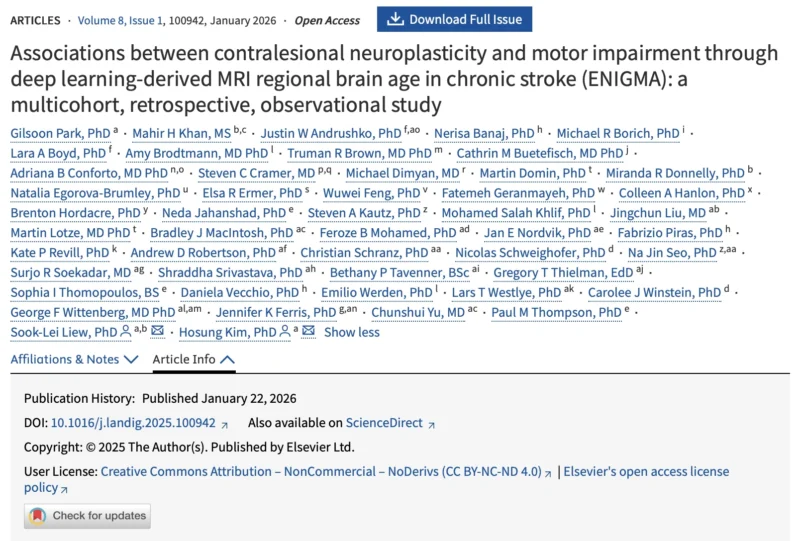
”Associations between contralateral neuroplasticity and motor impairment through deep learning-derived regional brain age in MRI in chronic stroke (ENIGMA): an observational, retrospective, multicenter study
Stroke leads to complex brain changes, both structural and functional, that specifically affect motor outcomes.
Predicted brain age difference (PBAD) has emerged as a sensitive biomarker of both sensorimotor and cognitive function after stroke.
A previous study found a higher global brain PBAD associated with worse motor function after stroke.
However, the association between local stroke lesion burden, regional brain age, and motor impairment is unclear.
This study aimed to investigate the associations between focal lesion damage, regional brain PBAD in both hemispheres, and motor outcomes in chronic stroke, and to identify key predictors of motor impairment.
The findings of this study reveal that larger stroke lesions are associated with accelerated aging in the ipsilateral hemisphere and, paradoxically, with decelerated brain aging in the contralateral hemisphere, suggesting compensatory neural mechanisms.
Regional brain age assessment can serve as a biomarker for neuroplasticity and guide targeted interventions to improve motor recovery after stroke.”
Title: Associations between contralesional neuroplasticity and motor impairment through deep learning-derived MRI regional brain age in chronic stroke (ENIGMA): a multicohort, retrospective, observational study
Authors: Gilsoon Park, Mahir H Khan, Justin W Andrushko, Nerisa Banaj, Michael R Borich, Lara A Boyd, Amy Brodtmann, Truman R Brown, Cathrin M Buetefisch, Adriana B Conforto, Steven C Cramer, Michael Dimyan, Martin Domin, Miranda R Donnelly, Natalia Egorova-Brumley, Elsa R Ermer, Wuwei Feng, Fatemeh Geranmayeh, Colleen A Hanlon, Brenton Hordacre, Neda Jahanshad, Steven A Kautz, Mohamed Salah Khlif, Jingchun Liu, Martin Lotze, Bradley J MacIntosh, Feroze B Mohamed, Jan E Nordvik, Fabrizio Piras, Kate P Revill, Andrew D Robertson, Christian Schranz, Nicolas Schweighofer, Na Jin Seo, Surjo R Soekadar, Shraddha Srivastava, Bethany P Tavenner, Gregory T Thielman, Sophia I Thomopoulos, Daniela Vecchio, Emilio Werden, Lars T Westlye, Carolee J Winstein, George F Wittenberg, Jennifer K Ferris, Chunshui Yu, Paul M Thompson, Sook-Lei Liew, Hosung Kim
Read the Full Article on The Lancet Digital Health
Stay updated on all scientific advances with Hemostasis Today.
-
Sep 11, 2026, 17:41Khaled Musallam: Earlier Recognition, Better Outcomes in NTDT
-
Sep 11, 2026, 17:29Reyhan Kose Cobanoglu: APS ACTION Registry Study Published in Lupus
-
Sep 11, 2026, 17:14Obi Light Ogbonnia: From Kenya to Global Sickle Cell Advocacy
-
Sep 11, 2026, 17:01EAHAD 2027 Marks 20 Years
-
Sep 11, 2026, 16:54Denise Braendgaard: Reimagining Health Systems Through Collective Action
-
Sep 11, 2026, 16:47Jehad Khamaysa: Budd-Chiari Syndrome as the Initial Presentation of Behçet’s Disease in a 16-Year-Old
-
Sep 11, 2026, 16:44Mostafa Faisal Mohammed Saleh: From HLA Biology to Curative Therapy
-
Sep 11, 2026, 16:38Jim Kaveney: Class I, Level A – Lifestyle is Now the Official Standard in AFib Care
-
Sep 11, 2026, 16:31George Touma: Do We Really Need to Implant Metal in Every High-Bleeding-Risk Patient?