


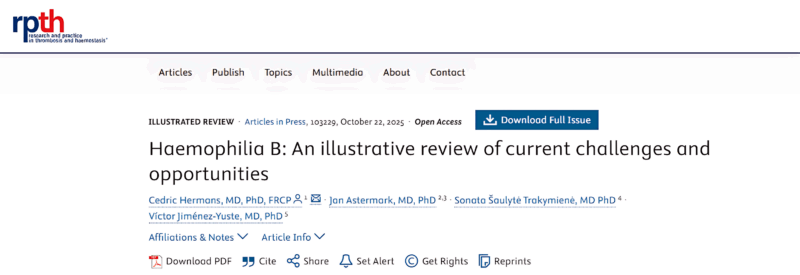
Haemophilia B – An illustrative review of current challenges and opportunities
Wolfgang Miesbach, Professor of Medicine at Frankfurt University Hospital, posted on LinkedIn:
”Excellent illustrated review on haemophilia B just published. Haemophilia B represents only 15% -20 % of haemophilia cases but has distinct challenges.
This compehensive review by Cedric HERMANS MD PhD FRCP (Lon, Edin), Jan Astermark, Sonata Saulyte Trakymiene, and Victor Jiménez-Yuste highlights current insights and clinical advances as well as challenges in haemophilia B care.
The visual content makes it perfect for teaching and patient information:
– Basics – F9 gene (33.5kb, 8 exons), FIX protein (55 kDa), X-linked inheritance
– Clinical picture – bleeding patterns across all severities, quality of life impacts
– Treatment timeline – from 1920s ice packs → plasma → rFIX → EHL products → gene therapy → non-factor therapies
– Tricky situations – inhibitors, surgery protocols, mild/moderate disease
– Pharmacokinetics – why FIX behaves differently (extravascular distribution, collagen IV binding)
– Individualization – matching treatment to patient life, not just labs
– Carriers and research gaps – underserved populations and what we still don’t know
Differences between haemophilia B and haemophilia A:
– Pharmacokinetics: FIX circulates both inside and outside blood vessels
Binds to collagen IV in extravascular tissues (FVIII doesn’t)
Lab tests miss extravascular FIX
– Inhibitors: Lower incidence (1.5-10% vs. 30%) but higher complication rates and ITI only works in 20-30%
– Pregnancy: FIX doesn’t rise like FVIII does – higher bleeding risk for HB carriers during delivery
Gene therapy in haemophilia B:
Haemophilia B was the first target for AAV gene therapy – smaller gene, easier packaging. Recent data show sustained benefit over 10 years
Novel therapies coming:
Anti-TFPI agents & fitusiran (AT siRNA): Subcutaneous options that restore thrombin generation without replacing FIX
No bispecific antibody yet for HB (unlike emicizumab for HA) – but research ongoing
Two neglected populations:
– Mild/moderate HB patients:
May have worse quality of life than severe patients – they bleed unpredictably but rarely get prophylaxis and experience joint damage, hospitalizations, treatment uncertainty.
– Female carriers:
Often undiagnosed or excluded from haemophilia care
FIX doesn’t rise during pregnancy (unlike FVIII)
Only 6% of reported HB population
What we still don’t know:
– Long-term effects of extravascular FIX binding
– Whether cross-reactive material (dysfunctional FIX protein) reduces treatment efficacy
– Optimal dosing for non-factor therapies in HB
– Gene therapy safety beyond 10 years
– How to better diagnose and treat female carriers”
Read the full review here.
Title: Haemophilia B: An illustrative review of current challenges and opportunities
Authors: Cedric Hermans, Jan Astermark, Sonata Šaulytė Trakymienė, Víctor Jiménez-Yuste
Stay updated with Hemostasis Today.
-
Sep 23, 2026, 00:08Janar Sathananthan: The Importance of Durable Drug Delivery in DCB Therapy
-
Sep 23, 2026, 00:07Arun V J: How Does a Good Conference Destroy My Ego?
-
Sep 23, 2026, 00:06Akshat Jain: Sickle Cell Disease Is Not One Size Fits All
-
Sep 23, 2026, 00:05Sherri Ozawa: Nicole De Vita’s Iron Deficiency Infographic Recognized at SABM
-
Sep 23, 2026, 00:04Zafar Ali: How Does Hemoglobin Know When to Hold Oxygen and When to Let It Go?
-
Sep 23, 2026, 00:02Ahmed Elsharkawy: Drug-Drug and Drug-Diluent Incompatibilities in ICUs and Hematology Units
-
Sep 22, 2026, 23:58Nishant Rajendra Tiwari: Hereditary TTP With the Same ADAMTS13 Variants but Strikingly Different Disease Courses
-
Sep 22, 2026, 23:57Akhil Santhosh: Pacritinib Versus Ruxolitinib in Myelofibrosis With Thrombocytopenia
-
Sep 22, 2026, 23:56Nathan Punwani: EASIX and sC5b-9 Predict TMA After Allogeneic Stem Cell Transplantation