


Raul Santos: Waist-to-Height Ratio and Coronary Artery Calcium Incidence
Raul Santos, Researcher at ARO Hospital Israelita Albert Einstein, shared on LinkedIn:
“Our new study shows that visceral adiposity is independently associated with the incidence of subclinical atherosclerosis in the ELSA-Brasil study. The waist-to-height ratio was the only measure of adiposity robust enough to identify CAC incidence in 2721 middle-aged Brazilian civil servants. The study led by Marcio Sommer Bittencourt and Thiago Mendes reinforces the role of excess adiposity in the atherosclerosis process.
Not only is the importance of this biomarker, but the need to fight obesity to prevent cardiovascular disease! cardiovascular disease prevention obesity Paulo Lotufo Isabela Bensenor International Atherosclerosis Society (IAS) World Heart Federation”
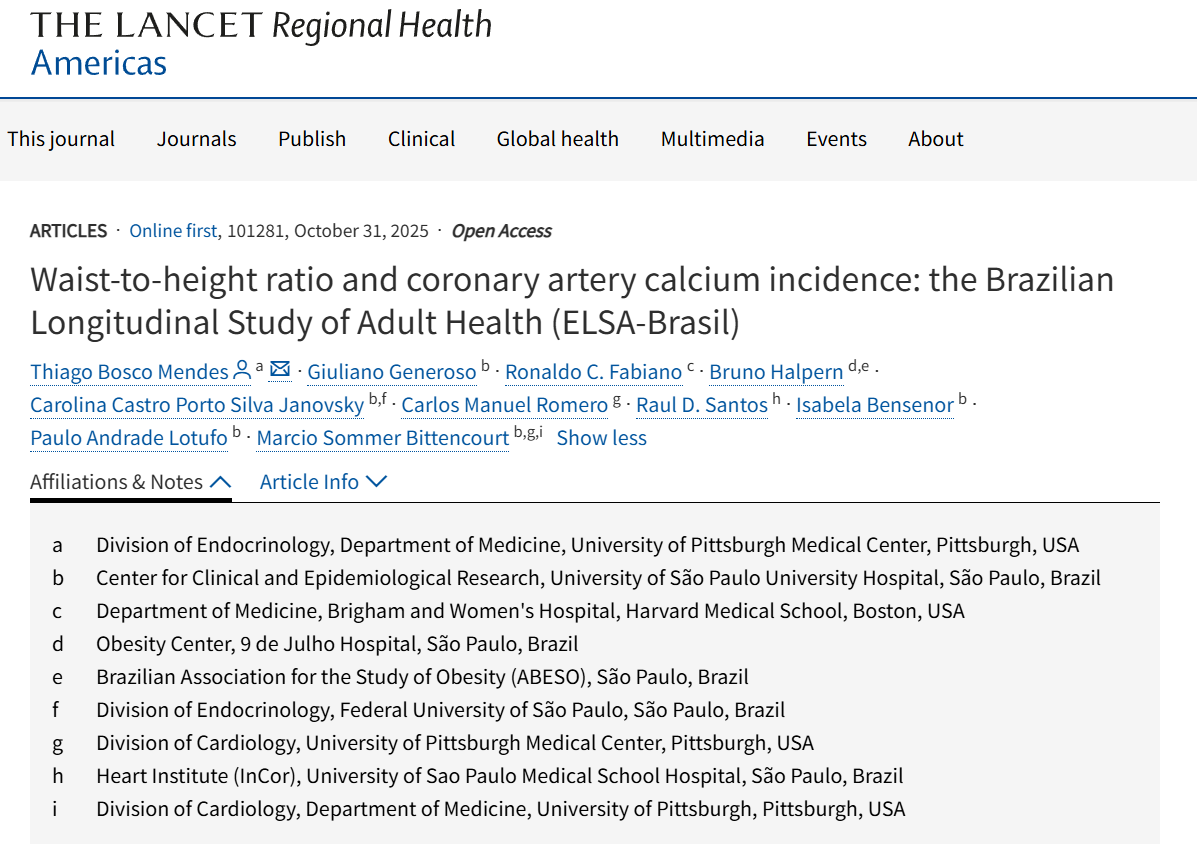
Title: Waist-to-height ratio and coronary artery calcium incidence: the Brazilian Longitudinal Study of Adult Health (ELSA-Brasil)
Authors: Thiago Bosco Mendes, Giuliano Generoso, Ronaldo C. Fabiano, Bruno Halpern, Carolina Castro Porto Silva Janovsky, Carlos Manuel Romero, Raul D. Santos, Isabela Bensenor, Paulo Andrade Lotufo, Marcio Sommer Bittencourt
Read full paper here.
Stay informed with Hemostasis Today.
-
Oct 19, 2026, 19:44Where You Live Should not Determine Whether You Receive Care – World Federation of Hemophilia
-
Oct 19, 2026, 19:42Belen Bianco: Prevention, Early Suspicion and an Interdisciplinary Approach Save Lives
-
Oct 19, 2026, 19:40Christina Chrysohoou: Catheter-Based LAAC vs OAC for Stroke Prevention in Atrial Fibrillation
-
Oct 19, 2026, 19:38Matthew Flick: A Two-Day Research Meeting on Fibrinogen, Hemostasis and Thrombosis
-
Oct 19, 2026, 19:37Hayat Saeed: Excited to Share Our Publication on the FGL1–Hepcidin Axis in Iron Homeostasis and Disease
-
Oct 19, 2026, 19:08IPAW 2026 Comes to a Close, but the Work Continues – PPTA
-
Oct 19, 2026, 17:44Paul Riley: Moderating a Webinar on Anticoagulation Monitoring
-
Oct 19, 2026, 16:36Christopher Pittman: Blood Clot Prevention Cannot End at Hospital Discharge
-
Oct 19, 2026, 16:13Javier M. Floren: When Immune Cells Move With Their Environment