


Pall T. Onundarson: The History of Thromboplastin Based Monitoring of VKAs
Pall T. Onundarson, Professor Emeritus at Landspitali University Hospital, shared a post on LinkedIn:
“It is useful to recall history.
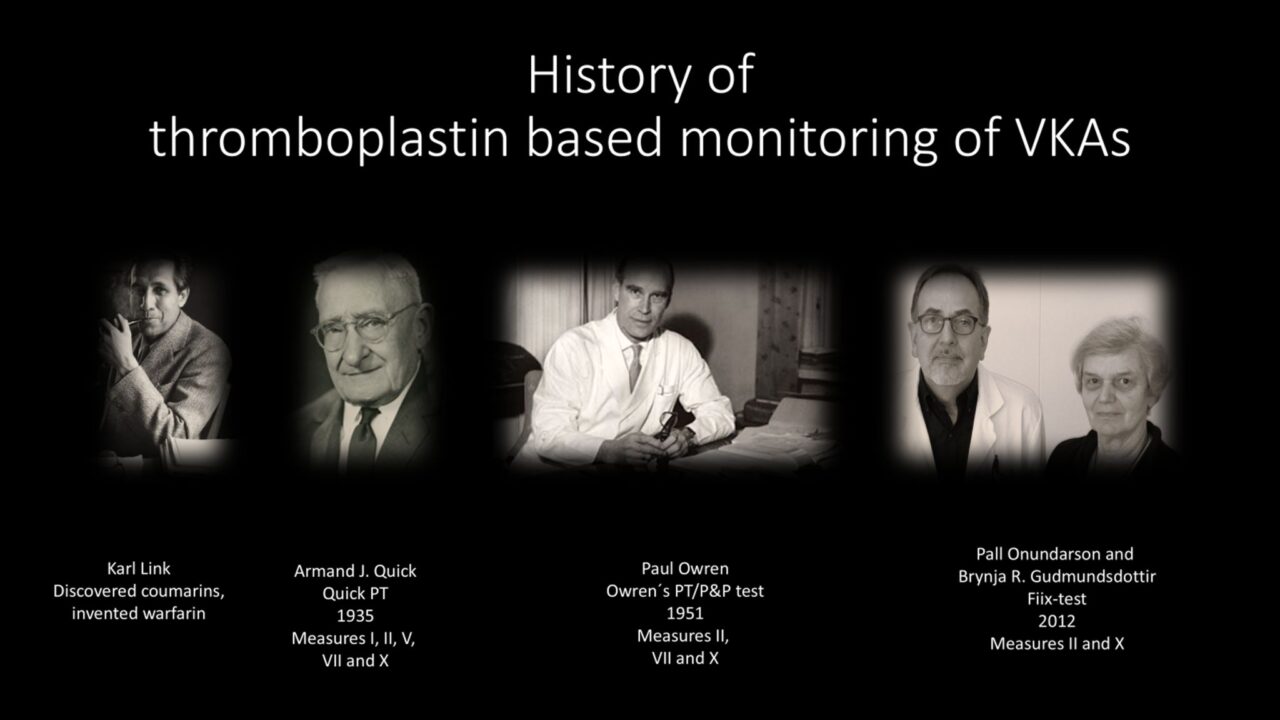
The prothrombin time (PT) test, invented by Armand Quick in 1935, made clinical use of vitamin K antagonists (VKAs) possible, first dicoumarol and later warfarin and others. At that time, only factors I (fibrinogen) and II (prothrombin) were known, and only factor II was recognized as being affected by VKAs. Despite this limited understanding, PT testing allowed clinicians to dose dicoumarol and later warfarin – albeit suboptimally – and to define their narrow therapeutic range.
In 1944, the Norwegian Paul Owren discovered factor V, and in 1949, factor VII (proconvertin) was identified. The PT test was then thought to measure factors I, II, V, and VII. Based on this knowledge, Owren developed the prothrombin–proconvertin test (P&P-test, later called Owren’s PT) which used thromboplastin but was designed to measure factors II and VII (factor X was not yet discovered). Owren’s PT was not affected by the unstable factor V and therefore less prone to preanalytical variation than the Quick PT.
In the 1980s, the international normalized ratio (INR, PT-INR) system standardized PT results worldwide for the purpose of VKA monitoring. Studies showed that Quick PT and Owren’s PT produced comparable results in VKA-treated patients. Both tests fluctuated widely, in part due to the short half-life of factor VII that influences them to a high degree. Most laboratories continued using the older Quick PT for INR reporting.
However, it became clear that neither test accurately reflected the true antithrombotic effect of warfarin. Research by Conrad Hemker’s group (Netherlands) and Samuel Rapaport’s group (La Jolla, USA) then showed that warfarin´s anticoagulant effect depends mainly on lowering factors II and X, not factors VII or IX. Building on this, we (Pall Onundarson and Brynja Guðmundsdóttir) developed a new thromboplastin-based assay sensitive only to factors II and X, the Fiix test. We hypothesized that monitoring warfarin with this test would yield more stable anticoagulation and that excluding factor VII would not compromise safety. A grant reviewer said we would kill the patients by ignoring FVII – but our hypothesis has now been confirmed in three clinical studies (one randomized controlled trial, one pre-post study, and one propensity score–weighted observational study). Fiix monitoring produced more stable anticoagulation, required fewer dose adjustments, and reduced thromboembolic events by about 50%, without increasing bleeding. In our opinion, target Fiix normalized ratios might probably be safely lowered in the future that could improve safety.
Despite this pharmacologically more accurate and clinically beneficial advance in VKA monitoring – which simplifies management for high risk patients who still need warfarin – medical, commercial and health-services´ interest remains surprisingly low. I cannot help but wonder why. Maybe the reader can tell me.”
Stay updated with Hemostasis Today.
-
Oct 9, 2026, 14:13Jesus Ardila Novoa: Why the WHO’s Historic Essential Medicines List Decision Is Just the Beginning
-
Oct 9, 2026, 14:07Chokri Ben Lamine: Pain After Allogeneic Stem Cell Transplantation in Sickle Cell Disease
-
Oct 9, 2026, 13:55Chandler Purser: AABB 2026 Focuses on Transfusion Safety and Audit-Driven Practice Improvement
-
Oct 9, 2026, 13:48Maxime Dely: Raising Awareness for Blood Donation
-
Oct 9, 2026, 13:48Vera Ghali: Anemia in Myelofibrosis and Its Impact on Treatment Outcomes and Overall Survival
-
Oct 9, 2026, 13:32W David Freeman։ The Mechanical Penumbra in Intracerebral Hemorrhage and Its Potential for Tissue Recovery
-
Oct 9, 2026, 13:11Ayshathul Noora։ Carbetocin vs Oxytocin in Preventing Postpartum Hemorrhage
-
Oct 9, 2026, 13:07The Rebalanced Patient: New Therapies and New Thrombotic Risks in Hemophilia
-
Oct 9, 2026, 12:48Santiago Cepeda Chafla: CereBleed Simplifies Brain Hemorrhage Assessment