


Vera Ghali: Anemia in Myelofibrosis and Its Impact on Treatment Outcomes and Overall Survival
Vera Ghali, Member of the Lebanese Order of Physicians and Lebanese Pediatric Society, shared Blood Journals Portfolio’s post on X, adding:
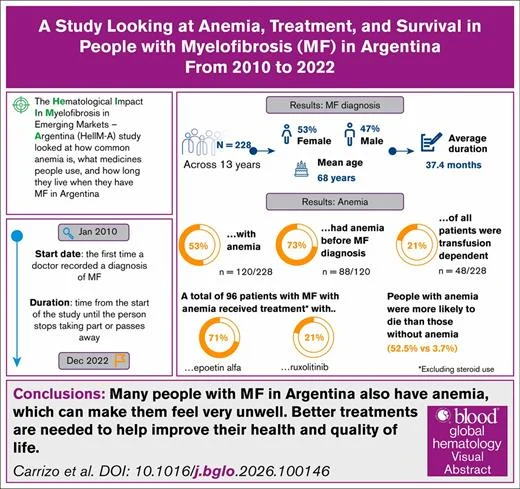
”A retrospective longitudinal analysis on the prevalence of anemia in patients with Myelofibrosis (MF) in Argentina found that anemia was present in 52.6 percent of patients with MF and was associated with decreased overall survival (OS).
MF is a rare chronic myeloproliferative neoplasm (MPN) characterized by the build-up of scar tissue in the bone marrow, disrupting production of healthy blood cells. It can be primary or may develop secondary to other BM disorders such as Polycythemia Vera (PV) or Essential Thrombocythemia (ET).
It is driven by acquired mutations in the JAK2, CALR, and MPL genes. These mutations hyperactivate janus kinase/signal transducer and activator of transcription (JAK/STAT) cell-signaling pathways, driving megakaryocyte proliferation, releasing large amounts of inflammatory cytokines exacerbating BM fibrosis, and triggering fibroblasts to produce dense connective tissue which creates extensive fibrosis and scarring in the BM impairing normal erythropoiesis and crowding out healthy blood-producing cells.
RBC sequestration results in splenomegaly and ineffective extramedullary hematopoiesis (EMH). Prominent among MF symptoms are splenomegaly and pancytopenia with severe anemia, neutropenia, and thrombocytopenia with systemic symptoms and cardiac dysfunction. It may further lead to progressive leukemic transformation resulting in Acute Myeloid Leukemia (AML).
In the Argentinian study, hydroxyurea was the most commonly used treatment followed by epoetin-alpha, and fewer patients received ruxolitinib, a JAK inhibitor. Also, 21 percent of patients with anemia-related MF were transfusion-dependent.
Current management of MF relies on JAK inhibitors such as ruxolitinib and fedratinib which alleviate constitutional symptoms and reduce splenomegaly but exacerbate anemia and thrombocytopenia requiring careful and regular CBC monitoring with dose adjustments.
In the Argentinian study, treatments varied across different regions according to economic considerations, quality of healthcare, accessibility of diagnostic tools, and limited resources which underscores the importance of tailoring patient care in anemia-related MF and addressing regional challenges.
Patients with anemia-related MF showed increasing mortality and lower OS rates in comparison to patients without anemia.
It should be noted that allogeneic HSCT is the only curative treatment so far for myelofibrosis (MF), but due to its intense high-risk complications, allo-HSCT therapy is reserved for highly selected eligible and fit patients.”
Blood Journals Portfolio shared a post on X about a recent article by Mariano Carrizo et al., published in Blood Global Hematology, adding:
”Anemia was present in 52.6 percent of patients with MF in Argentina and was associated with increased mortality.
Common treatments for patients with anemia included epoetin alfa (70.8 percent) and ruxolitinib (20.8 percent).
Read in Blood Global Hematology.”
Title: Anemia, drug use, and survival in myelofibrosis: a retrospective analysis of Argentine patients (2010-2022)
Authors: Mariano Carrizo, Gabriela de Azevedo Abreu, Juliana Domenico Queiroz, Georgina E. Bendek Del Prete, Claudia Soares, Lucas Perelli, Paula Scibona, Ventura A. Simonovich, Veronica Privitera, Bhumika Aggarwal
Stay updated on all scientific advances with Hemostasis Today.
-
Oct 9, 2026, 13:48Maxime Dely: Raising Awareness for Blood Donation
-
Oct 9, 2026, 13:32W David Freeman։ The Mechanical Penumbra in Intracerebral Hemorrhage and Its Potential for Tissue Recovery
-
Oct 9, 2026, 13:11Ayshathul Noora։ Carbetocin vs Oxytocin in Preventing Postpartum Hemorrhage
-
Oct 9, 2026, 13:07The Rebalanced Patient: New Therapies and New Thrombotic Risks in Hemophilia
-
Oct 9, 2026, 12:48Santiago Cepeda Chafla: CereBleed Simplifies Brain Hemorrhage Assessment
-
Oct 9, 2026, 12:34Abdul Muqtadir Abbasi: Pancytopenia Is a Finding, Not a Diagnosis
-
Oct 9, 2026, 12:24Mercy Lung’aho: When Diet Quality and Nutritional Biomarkers Tell Different Stories
-
Oct 9, 2026, 12:22Eugene Fan: Bridging Therapeutic Breakthroughs and Equitable Thalassaemia Care
-
Oct 9, 2026, 12:14Brittany Busse: A New Focus on Iron Deficiency Before Anemia