


Wolfgang Miesbach – New Hope for Hereditary Haemorrhagic Telangiectasia: First Trial Results for Engasertib Published in NEJM
Wolfgang Miesbach, Professor of Medicine at Frankfurt University Hospital, shared on LinkedIn:
“New Hope for Hereditary Haemorrhagic Telangiectasia: First Trial Results for Engasertib Published in NEJM. A groundbreaking proof-of-concept trial has just been published on a novel oral therapy specifically developed for hereditary haemorrhagic telangiectasia (HHT) – a disease that has no licensed treatments worldwide despite affecting approximately 1 in 3,800 individuals. Current options – antifibrinolytics, invasive procedures, or off-label bevacizumab, thalidomide and pomalidomide – are inadequate, often inaccessible, and carry significant burden.
The Disease Burden
HHT is the second most common inherited bleeding disorder globally, yet it remains significantly undertreated. Patients suffer from:
– Recurrent, severe epistaxis (nosebleeds) in >90% of cases, often starting in childhood
– Chronic anaemia requiring repeated iron infusions and transfusions
– Arteriovenous malformations affecting lungs, liver, brain and GI tract
– Profound impact on quality of life, with associated depression and anxiety
The Innovation
Engasertib (VAD044) is an oral, once-daily, allosteric AKT inhibitor developed specifically for HHT. The drug works by addressing the underlying pathophysiology – mutations in the ALK1 signalling pathway lead to AKT overactivation, driving telangiectasia formation.
The Trial Results
This multicentre, double-blind, placebo-controlled trial enrolled 75 patients randomised 1:1:1 to engasertib 30mg, engasertib 40mg, or placebo for 12 weeks:
– Safety: Excellent tolerability profile
Most common adverse events: mild-to-moderate rash (42% at 40mg dose) and hyperglycaemia (12%), both reversible
Serious adverse events similar across all groups
Notably favourable compared to existing off-label therapies (bevacizumab, pomalidomide)
– Efficacy signals (40mg dose):
41.4% reduction in epistaxis duration
27.8% reduction in epistaxis frequency
1.6-point decrease in Epistaxis Severity Score
61% of patients reported feeling “much better” on Patient Global Impression of Change
– The open-label extension (up to 12 months) showed even more impressive results:
65.6% reduction in epistaxis duration
54.9% reduction in frequency
Mean increase of 8.7 epistaxis-free days per month
Why This Matters
For the first time, we have a purpose-built therapy for HHT with:
- Once-daily oral administration
- Manageable safety profile
- Dose-dependent efficacy
- Sustained benefit with continued treatment
- Potential for regulatory approval and global accessibility
This represents a paradigm shift from repurposed cancer drugs with unknown optimal dosing to a rationally designed therapy addressing the underlying disease mechanism.
Congratulations to Dr Hanny Al-Samkari and the entire international research team on this important milestone!”
Ttile:Engasertib versus Placebo for Bleeding in Hereditary Hemorrhagic Telangiectasia
Authors: Hanny Al-Samkari, Josefien Hessels, Antoni Riera-Mestre, Sophie Dupuis-Girod, Thibaut Van Zele, Vicente Gómez del Olmo, Pamela G. Hodges, Hans-Jurgen Mager
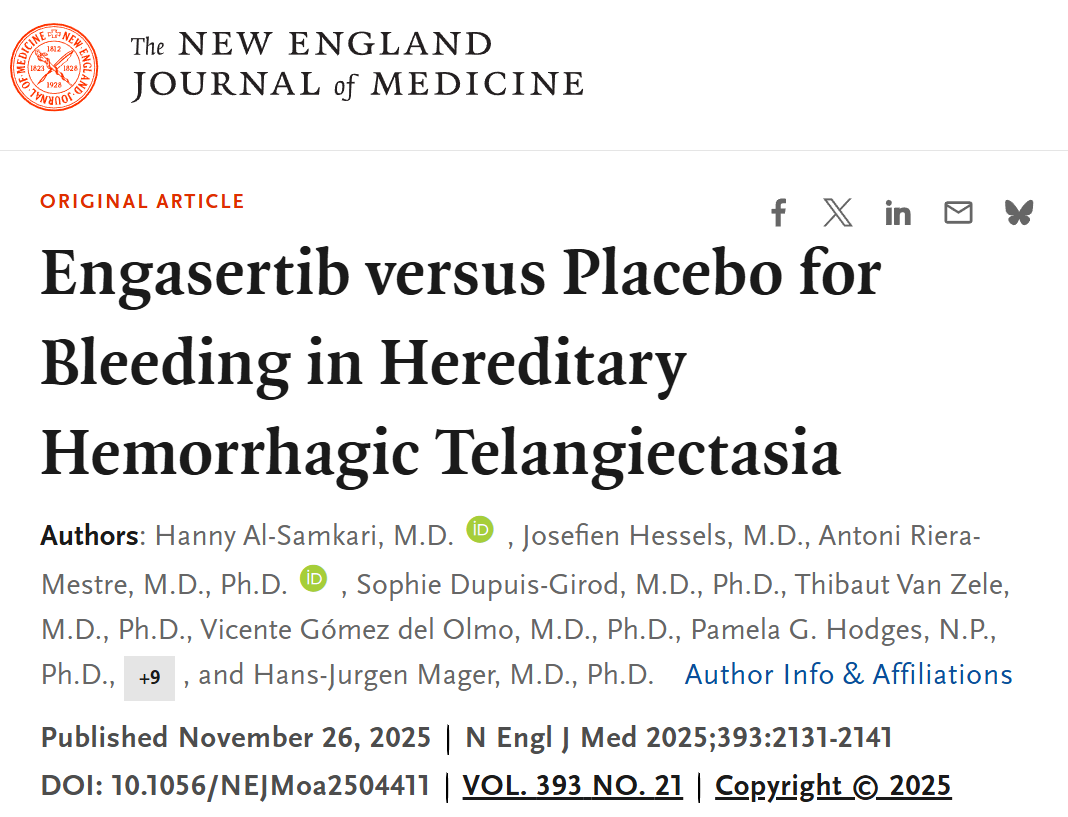
Access the Original Research.
Elevate your knowledge with Hemostasis Today.
-
Oct 18, 2026, 10:31Working Together for Better Outcomes in Hemophilia Care – Hemophilia Federation (India)
-
Oct 18, 2026, 08:02Neda Ashayeri: Global Perspectives on Hemophilia and Rare Bleeding Disorders in Abu Dhabi
-
Oct 18, 2026, 07:55Anu Thomas: A Stepwise Laboratory Approach to Positive IAT and Pretransfusion Compatibility
-
Oct 18, 2026, 07:49Matthew Hazell: Molecular Matching and the Future of Transfusion Practice
-
Oct 18, 2026, 07:05Behnood Bikdeli: Vasculearn Network Highlights Expert Perspectives on PE Risk Stratification and Advanced Therapies
-
Oct 18, 2026, 06:27Gregory Makris: NEJM Study Supports Earlier Catheter-Directed Intervention in Intermediate-High–Risk PE
-
Oct 18, 2026, 06:26Danny Hsu: BLOOD 2026 Return to Aotearoa
-
Oct 18, 2026, 02:43Priya Sriskandarajah: Diagnosis and Management of PV and JAK2-Unmutated Erythrocytosis
-
Oct 18, 2026, 02:41C. Michael Gibson: A Meta-Analysis of DOACs and DAPT After Left Atrial Appendage Closure