


Tareq Abadl Explains Hemolysis and Potassium Measurement Connections
Tareq Abadl, Medical Laboratory Specialist and Director of the Blood Bank at Dr. Abdelkader Al-Mutawakkil Hospital, shared a post on LinkedIn:
“Hemolysis and Potassium Measurement.
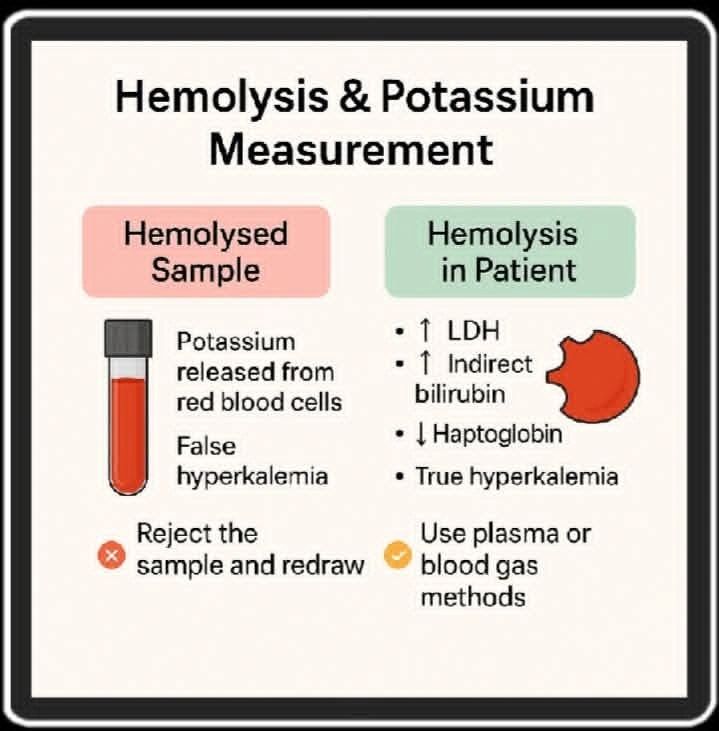
First: Hemolyzed Sample (Pre-analytical Error)
When hemolysis occurs during blood collection, handling, or transport, potassium leaks from red blood cells into serum or plasma.
Intracellular potassium concentration in RBCs is ~20–25× higher than in plasma.
Even mild hemolysis can cause a false elevation of potassium.
This is called Pseudo-hyperkalemia (not a true patient condition).
Correct laboratory action:
Reject the sample and do not report potassium.
Add a clear comment: Sample rejected due to hemolysis.
Request recollection while avoiding common causes:
Use an appropriate needle (preferably 21G or larger).
Avoid prolonged tourniquet use and excessive suction.
Do not shake the tube vigorously.
Separate serum/plasma from cells promptly.
Avoid heat exposure and transport delays.
Second: In Vivo (Pathological) Hemolysis
Hemolysis occurs inside the patient, not during sampling.
In this situation, elevated potassium may be real (True hyperkalemia).
Laboratory findings supporting in vivo hemolysis:
- LDH
- Indirect (unconjugated) bilirubin
- Haptoglobin
- Reticulocyte count
Peripheral smear abnormalities (e.g., schistocytes, spherocytes)
Important precautions:
Do not rely on visibly hemolyzed serum samples.
Use more reliable alternatives:
Plasma potassium (lithium heparin tube).
Whole blood potassium via blood gas analyzer (less affected by hemolysis).
Always correlate with clinical context:
ECG changes suggestive of hyperkalemia
Renal failure or other risk factors
Consistency with other hemolysis markers
Additional Key Points
Severe thrombocytosis or leukocytosis can cause Pseudo-hyperkalemia due to potassium release during clotting, even without visible hemolysis.
In such cases, plasma or whole blood potassium is preferred over serum.
Never act on a potassium value without clinical correlation.
Summary
- Hemolyzed sample (pre-analytical error) → Invalid result, reject and recollect.
- In vivo hemolysis → Potassium may be truly elevated; use alternative measurement methods.
- Thrombocytosis / leukocytosis → Consider Pseudo-hyperkalemia.
- Interpretation must always match the clinical picture, not just the number.”
Explore hematology with Tareq Abadl on Hemostasis Today.
-
Oct 17, 2026, 02:36Archil Jaliashvili: Oxygen Transport in Capillaries
-
Oct 17, 2026, 02:35Carly Newton: Understanding Access to Red Blood Cell Exchange for People Living With SCD
-
Oct 17, 2026, 02:34Raising Awareness of Blood Clots During and After Pregnancy – Thrombosis UK
-
Oct 17, 2026, 02:33Alaa Salamat: Our Research Accepted for Publication at ASH 2026
-
Oct 17, 2026, 02:32Mohammed Al Sharif: Discussing Factor XIII Testing and Its Clinical Significance
-
Oct 17, 2026, 02:31Joanna Popiolek-Kalisz: Talking about Novel Pharmacotherapy for Hypertension at CV Prevention and Intervention
-
Oct 17, 2026, 02:00How Antiphospholipid Syndrome Can Affect the Adrenal Glands – APS Foundation of America
-
Oct 17, 2026, 01:59Liza-Marie Johnson: How Far Should Clinicians Go to Influence Parents’ Decisions?
-
Oct 17, 2026, 01:54Jim Hoffman: The Importance of Self-Advocacy and Understanding Autoimmune Mechanisms