


Shiny K. Kajal: Why Blood from First-Degree Relatives is Not Recommended for Transfusion
Shiny K. Kajal, Senior Resident at Adesh University, shared a post on LinkedIn:
” ‘Have you ever heard blood banks say that directed donation from immediate family members is not accepted?’
Here’s why
- It’s not about mistrust.
- It’s not about infection.
- It’s about immunology.
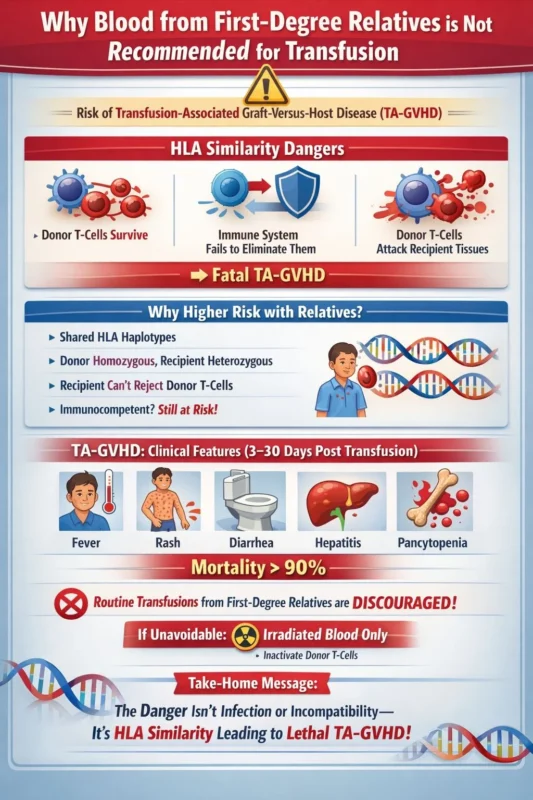
First-degree relatives share HLA haplotypes.
When such blood is transfused:
- Donor viable T-lymphocytes enter the recipient
- Due to partial HLA similarity, the recipient’s immune system may fail to recognize them as foreign
- These donor T-cells engraft, proliferate, and attack host tissues
This leads to Transfusion-Associated Graft-Versus-Host Disease (TA-GVHD) —
a rare but often fatal (>90% mortality) complication.
Even an immunocompetent person is at risk if HLA similarity allows donor cells to escape rejection.
That is why blood banks avoid directed donation from immediate family.
If unavoidable, irradiated blood components are mandatory to inactivate donor T-cells.
The issue is not compatibility —it is HLA similarity leading to lethal immune attack.”
Find more posts featuring Shiny K. Kajal on Hemostasis Today.
-
Oct 5, 2026, 15:31Irma Bagdoniene: Multidisciplinary Management of High-Risk Familial Hypercholesterolaemia and CAD
-
Oct 5, 2026, 15:00Serena Williams and Pulmonary Embolism: From Personal Crisis to Lessons in Venous Thromboembolism
-
Oct 5, 2026, 14:55Marco Moscarelli: 3D Reconstruction Enhances Volumetric Assessment of Post-TAVI Thrombosis
-
Oct 5, 2026, 13:24Abdul Muqtadir Abbasi: Diagnostic Pearls for Evaluating Isolated Thrombocytopenia in Residents
-
Oct 5, 2026, 13:16Katerina Pavenski: Rethinking What ‘Normal’ Means for Iron Deficiency
-
Oct 5, 2026, 13:09Rick Matthews: Balancing Established VTE Partnerships with Innovative Interventional Technologies
-
Oct 5, 2026, 13:01Nawsherwan Mohammad: Recognizing TTP Before the ADAMTS13 Result Arrives
-
Oct 5, 2026, 12:51Bruno Pougault: The Hidden Challenges Behind Anti Xa Testing
-
Oct 5, 2026, 12:41Syed Huzaifa Khan: Rethinking CTRP12 as a Biomarker for In Stent Restenosis