

Sifat Jubaira/LinkedIn
Feb 15, 2026, 10:26
Sifat Jubaira: K₂-EDTA vs K₃-EDTA – Same Anticoagulant, Very Different Accuracy
Sifat Jubaira, Lab Medicine Specialist at United Hospital Limited, shared a post on LinkedIn:
“K₂-EDTA vs K₃-EDTA – Same Anticoagulant, Very Different Accuracy
Both K₂-EDTA and K₃-EDTA prevent blood clotting by binding calcium.
But their impact on hematology results is not the same.
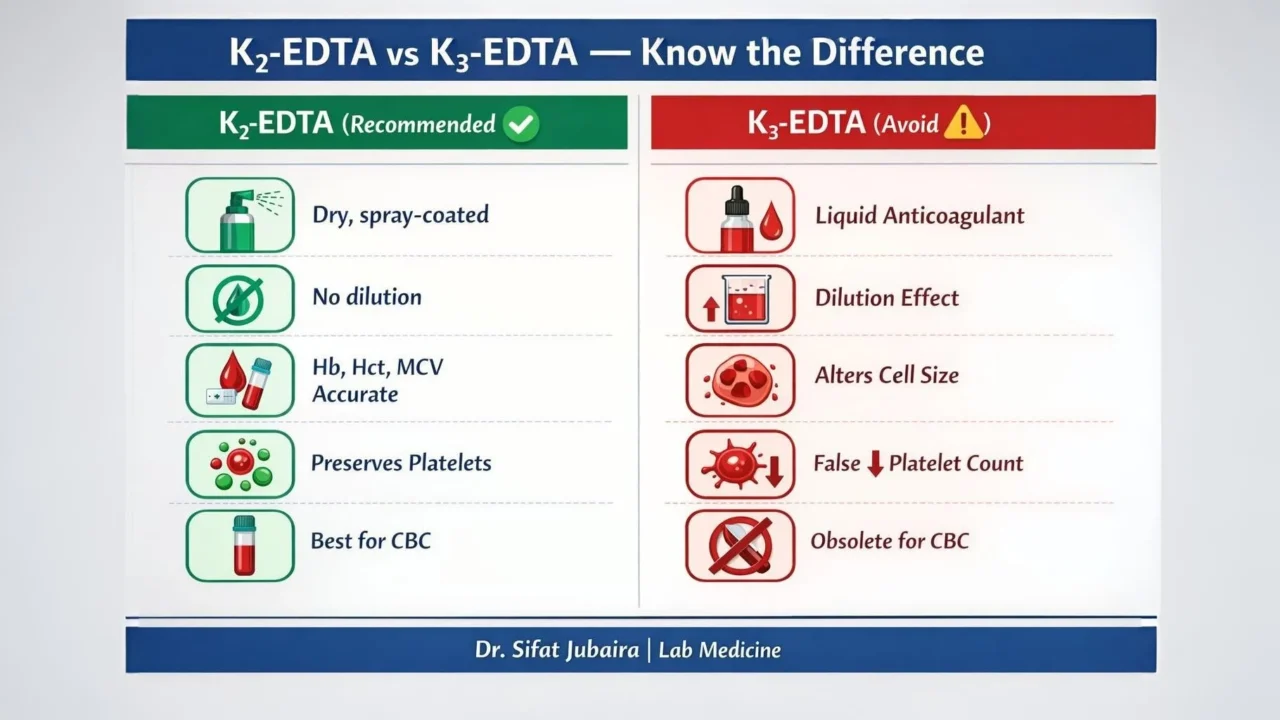
K₂-EDTA (Dipotassium EDTA)
- Dry, spray-coated
- No dilution effect
- Preserves RBC size and platelet count
- Gold standard for CBC
K₃-EDTA (Tripotassium EDTA)
- Liquid leads to sample dilution
- May falsely decrease Hb, Hct, MCV and platelets
- Alters cell morphology
- No longer recommended for routine hematology
Bottom line:
For accurate hematological values and reliable cell morphology, K₂-EDTA is the anticoagulant of choice.
Authentic References
- ICSH Guidelines – Recommendations for EDTA anticoagulants in hematology
- CLSI GP34 / H21 – Collection, transport and processing of blood specimens
- Bain BJ. Blood Cells: A Practical Guide, Wiley-Blackwell
- Dacie and Lewis. Practical Haematology, Elsevier”
Find more posts featuring Sifat Jubaira on Hemostasis Today.
-
Oct 10, 2026, 17:58Archo Farzana Batool: Exploring Medical Writing Through an Article on Iron Deficiency Anemia
-
Oct 10, 2026, 17:53Assessing Frailty in Adults With Hemophilia – JTH
-
Oct 10, 2026, 17:52Fatma Sadeghi: Reducing Maternal Health Inequalities Through Nursing Advocacy
-
Oct 10, 2026, 17:50Grzegorz Hensler: How Apheresis Transformed Blood Cell Separation and Collection
-
Oct 10, 2026, 17:47Hemant K Sharma: Japan’s Universal Artificial Blood Research – A Potential Breakthrough in Transfusion Medicine
-
Oct 10, 2026, 17:40John Strouse: Learning About Bleeding Disorders and Sickle Cell Disease at FWGBD
-
Oct 10, 2026, 17:34Mae Caime: Speaking at the Annual Women’s Retreat for the Hemophilia Community in Florida
-
Oct 10, 2026, 17:30Chokri Ben Lamine: PNH beyond the Textbook Triad
-
Oct 10, 2026, 17:29Ruah Alyamany: Thrombosis and Anticoagulation in Hematological Malignancies at SOHO KSA 2026