

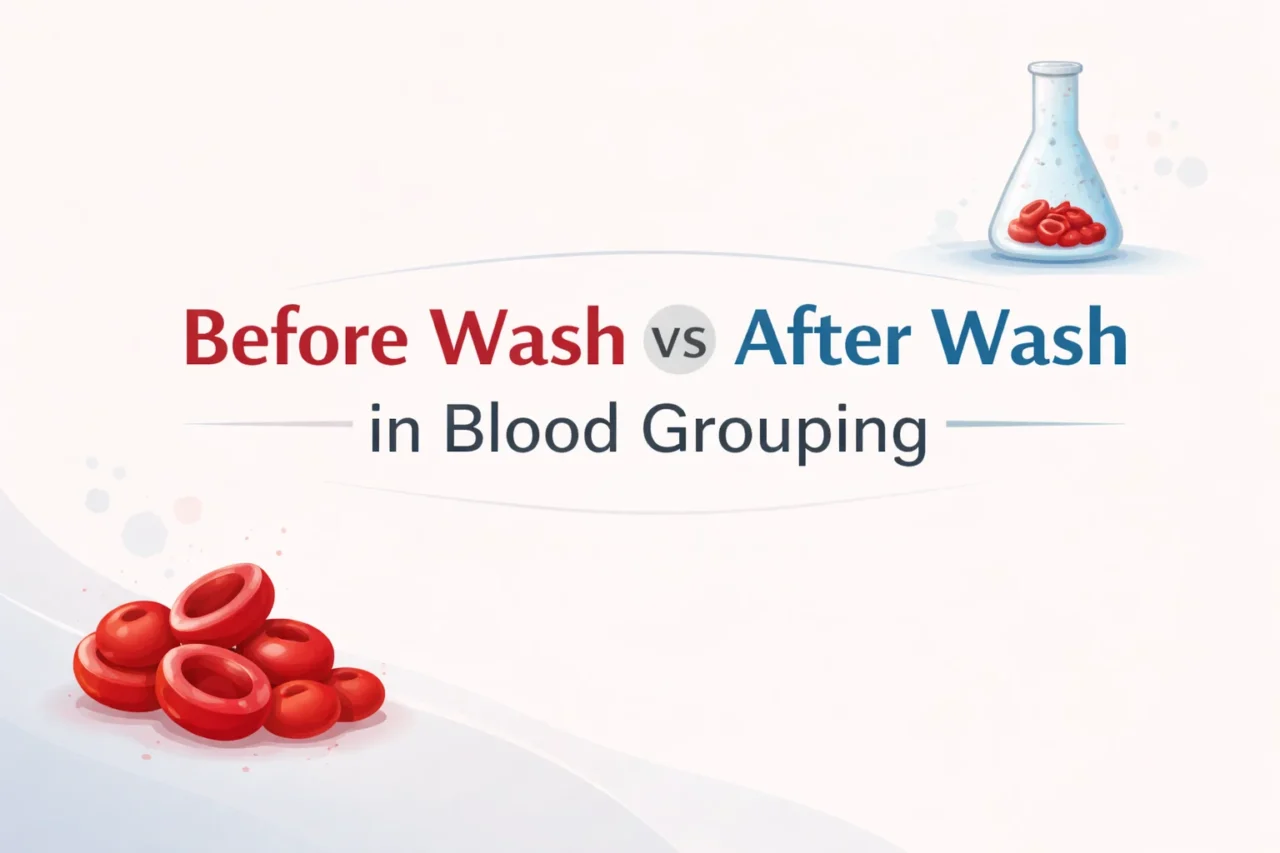
Yves Bikorimana: Before Wash vs After Wash in Blood Grouping
Yves Bikorimana, CEO at MedData-Rwanda and Lab Scientist at The University Teaching Hospital of Kigali-Chuk, shared a post on LinkedIn:
“Before Wash vs After Wash in Blood Grouping – Why It Matters
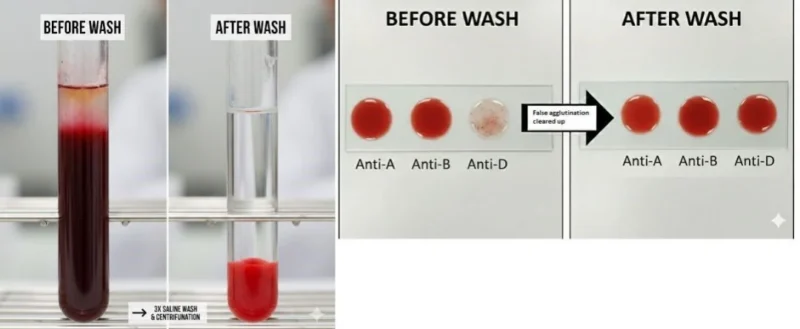
In immunohematology, small technical details can completely change interpretation. This image perfectly demonstrates the importance of the saline wash step during blood grouping and antibody testing.
Let’s break it down
Left Side: Tube Method (Cell Washing)
Before Wash
We see a red cell suspension with plasma and possible interfering substances still present. Proteins, rouleaux formation, or excess antibodies can create pseudo-agglutination or mask true reactions.
After 3× Saline Wash plus Centrifugation
The supernatant becomes clear, and only packed red cells remain at the bottom.
Why is this important?
- Removes unbound antibodies
- Eliminates excess plasma proteins
- Prevents false reactions
- Improves accuracy of antiglobulin testing
Washing ensures we are detecting true antigen–antibody reactions, not artifacts.
Right Side: Slide/Card Agglutination (Anti-A, Anti-B, Anti-D)
Before Wash
Anti-D appears weakly positive — but note the label: False agglutination.
Sometimes:
- Rouleaux formation
- Fibrin strands
- High protein states
- Improper cell suspension
can mimic agglutination.
After Wash
The false Anti-D reaction disappears.
Result interpretation becomes clear and reliable.
- Anti-A: Negative
- Anti-B: Negative
- Anti-D: Negative
Final Blood Group: O Rh(D) Negative
Key Takeaway
In transfusion medicine, accuracy is patient safety.
A simple saline wash step can:
- Prevent mislabeling of blood groups
- Avoid incompatible transfusions
- Reduce risk of hemolytic transfusion reactions
In laboratory science, precision isn’t optional — it’s ethical responsibility.”
Stay updated with Hemostasis Today.
-
Oct 21, 2026, 09:13Jarod Horobin: Blood 2026 – Connecting Science and People
-
Oct 21, 2026, 08:35Raeeda Gheewala: VTE in Athletes – Risks Beyond the Playing Field
-
Oct 21, 2026, 08:29Andreas Kronbichler: The Changing Landscape of CV Risk in ANCA-Associated Vasculitis
-
Oct 21, 2026, 08:21Pham Quy: Taking Stroke Awareness Beyond Hospitals and Into the Community
-
Oct 21, 2026, 07:15Mahmoud Saad: Successful Mechanical Thrombectomy for Right Atrial Thrombosis
-
Oct 21, 2026, 06:55Hunain Shahbaz: Extended Dual Antiplatelet Therapy Beyond 12 Months After Drug-Eluting Stent Implantation
-
Oct 21, 2026, 06:19Dawood Findakly: When Should Anticoagulation Be Held or Resumed?
-
Oct 21, 2026, 03:36Steve Watson: Ligand Epitope Ratios Influence Antagonist Inhibition
-
Oct 21, 2026, 03:18Stephen D. Coombs: Superficial Venous Thrombosis in Athletes and Importance of Early Recognition and Referral