


Hussien Hishmat: The 2026 Guide to Pulmonary Embolism – Diagnosis Decoded
Hussien Hishmat, Professor at Cairo University, Consultant interventional cardiologist at Tadawi Healthcare, Fellow at European Society of Cardiology, shared on LinkedIn:
”The ‘Great Masquerader’ has new rules.
The ACC AHA 2026 Pulmonary Embolism Guidelines just decoded the complexity of diagnosis.
Less unnecessary radiation, faster decisions.
Are you up-to-date on:
- How the YEARS Algorithm can cut CT use by nearly 50%?
- The Age-Adjusted D-dimer formula (for patients >50)?
- Why routine Venous Duplex is no longer recommended?
Don’t miss PE. Stay ahead of the curve with our complete breakdown of PE diagnosis.
Pulmonary Embolism (PE) remains one of the most challenging diagnoses in clinical practice.
Often called the ‘great masquerader,’ it easily mimics myocardial infarction, pneumonia, or even simple musculoskeletal pain.
Following the February 2026 Guidelines, we are refining how we approach the ‘Three Pillars’ of diagnosis: clinical probability, biomarkers, and imaging.
Here is what every clinician needs to know to stay ahead of the curve.
1. Clinical Probability: Beyond the ‘Sudden Onset’
While we often teach the ‘classic’ presentation, the reality is more nuanced:
- Dyspnea is King: Present in 80% of cases.
- The Syncope Red Flag: Don’t overlook syncope or near-syncope; these often signify significant hemodynamic compromise or RV strain.
- The Elderly Population: In patients with underlying lung or heart disease, look for worsening functional status rather than a dramatic onset of symptoms.
2. The Power of “Rule-Out” (PERC and YEARS)
Clinical intuition is vital, but objective scores determine our next steps.
- PERC Criteria: If your patient is low-risk, young (<50), and meets all PERC negative criteria (no tachycardia, no desaturation, no prior DVT), stop. No further testing is required.
- The YEARS Algorithm: This simplified approach uses three criteria (signs of DVT, hemoptysis, and whether PE is the most likely diagnosis).
3. D-Dimer: Age Matters
The D-dimer is an incredible tool for its negative predictive value, but it is notorious for ‘false positives’ in pregnancy, inflammation, or post-surgery.
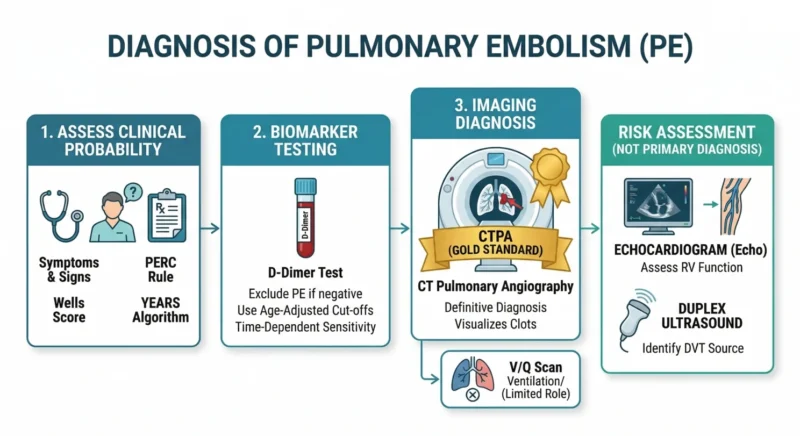
Key 2026 Updates:
- Age-Adjusted Thresholds: For patients >50, use the formula: Age x 10 (e.g., a 70-year-old’s cutoff is 700 ng/mL).
The Anticoagulation Caveat: If a patient is already on therapeutic anticoagulation, D-dimer kinetics are unreliable. Skip the biomarker and proceed directly to imaging.
4. Imaging: Gold Standards and RV Strain
- CTPA (1A Recommendation): Still the first line. Beyond finding the clot, look for RV overload markers: an RV/LV ratio ≥ 0.9, septal bowing, or contrast reflux into the hepatic veins.
- V/Q Scans: Reserved for severe renal insufficiency or contrast allergies.
- The Shift in Venous Duplex: We are moving away from routine screening. Unless the patient has leg symptoms or we need a baseline after a confirmed PE, routine duplex is often an unnecessary cost.
The Bottom Line
Diagnosis is a staircase: Start with clinical probability.
If low, use PERC or YEARS to rule out. If high, go straight to CTPA.
By utilizing age-adjusted D-dimers and validated algorithms, we provide faster, more accurate care while reducing unnecessary radiation.”
Stay updated with Hemostasis Today.
-
Sep 14, 2026, 20:53YoonHwa An: Rusfertide in Polycythemia Vera – From Clinical Benefit to Strategic Value
-
Sep 14, 2026, 20:52Andres Alberto Mercado Pompa: External Validation of Prognostic Risk Scores in Cerebral Venous Thrombosis
-
Sep 14, 2026, 20:50Balaji Kirushnan: Advancing Regional Citrate Anticoagulation in CRRT – From Experience to Implementation
-
Sep 14, 2026, 20:48Valerie Dehondt: Nutritional Anemia Is Associated With Increased Risk of Severe COPD Exacerbations
-
Sep 14, 2026, 20:46Nupur Choudhury: Exploring AI-Based Detection of Anemia Using Eye and Fingernail Images
-
Sep 14, 2026, 20:44Shamee Shastry: Chart Before You Chase – Diagnosing Drug-Induced Hemolytic Anemia
-
Sep 14, 2026, 20:43David Reiner: Blood Tests That Can Reveal Nutrition Clues
-
Sep 14, 2026, 20:40Giuseppe Biondi Zoccai: Balancing Thrombosis and Bleeding in Acute MI With Hemophilia A
-
Sep 14, 2026, 20:39Kemal Karaagac: Kounis Syndrome as a Possible Cause of Very Late Stent Thrombosis