


Kalyan Roy: Rediscovering Cold-Stored Platelets in Modern Transfusion Medicine
Kalyan Roy, Transfusion Medicine Specialist at Square Hospitals LTD, shared a post on LinkedIn:
“Cold-Stored Platelets (CSP): A Rediscovered Tool in Modern Transfusion Medicine
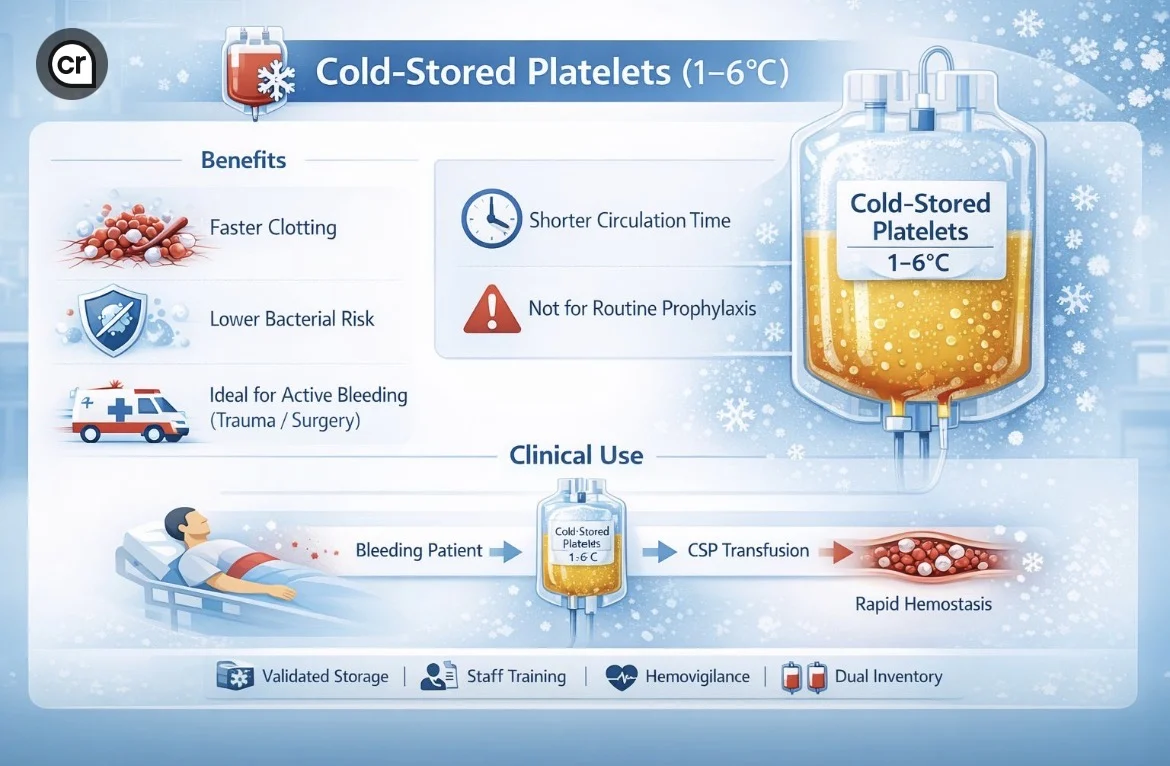
Cold-stored platelets are gaining renewed attention as a targeted option for treating active bleeding, especially in trauma and surgical settings.
A brief history
Before the 1960s, platelets were naturally transfused cold within refrigerated whole blood.
In 1969, research showed cold-stored platelets had shorter post-transfusion survival, leading to the shift toward room-temperature (RT) platelet storage, which remains the standard today.
Why the renewed interest?
- CSP show stronger early clot formation and may resist fibrinolysis better than RT platelets.
- In bleeding patients, rapid hemostasis matters more than long circulation time.
- Early clinical studies (trauma, surgery, cardiopulmonary bypass) suggest similar bleeding outcomes and transfusion needs, supporting potential non-inferiority.
Operational advantages
- Longer shelf life – up to ~14 days vs ~5 days for RT platelets.
- Lower bacterial growth risk due to cold storage (1–6°C).
- No agitation or bacterial mitigation required, simplifying storage logistics.
Manufacturing updates
- Produced in platelet additive solution (PAS) to reduce aggregates.
- Pathogen reduction (PR) removes need for irradiation and CMV-negative units.
- Lower rates of allergic reactions and minimal risk of hemolysis.
Current regulatory guidance
The FDA recommends CSP primarily for active bleeding when conventional platelets are unavailable or impractical. Hospitals are encouraged to define institution-specific protocols for use.
What’s next?
Large trials such as CHIPS, CriSP-HS, and CriSP-TBI are underway to better define the role of CSP in trauma, hemorrhagic shock, and cardiac surgery.
Bottom line:
Cold-stored platelets are not a replacement for standard platelet inventory—but they may become a valuable targeted therapy for rapid bleeding control, especially when logistics or availability are challenging.
Discussion:
Is your institution exploring CSP implementation or dual platelet inventory strategies?”
Stay updated with Hemostasis Today.
-
Sep 30, 2026, 11:36Basit Ali: A Closer Look at CT Venography
-
Sep 30, 2026, 11:16Christina Pohlman: Could aPL Levels Help Predict Stroke Recurrence?
-
Sep 30, 2026, 10:55Rana Al Hrout: Diagnostic Approach to Hypochromic Microcytic Anemia
-
Sep 30, 2026, 01:52Javed Anees: DADA2 – When a Young Stroke Is More Than a Stroke
-
Sep 30, 2026, 01:51How a Venous Thrombus Becomes Revascularized – ISTH
-
Sep 29, 2026, 22:45Victor Agunyego: Paracetamol – The Most Common Drug We Underestimate
-
Sep 29, 2026, 22:42Nova Sinclair: Advancing the Future of Hematology – Meet Our 2027 Organizing Committee
-
Sep 29, 2026, 22:41Lorenz Räber: Intracoronary Imaging in PCI – Why, When, How, and Which Modality?
-
Sep 29, 2026, 22:31Selma Turkovic: Pleased to Deliver the Opening Presentation at Kingston Hospital