


Wolfgang Miesbach: From Heparin to Vaccines – The Expanding Biology of Anti-PF4 Immunothrombosis
Wolfgang Miesbach, Professor of Medicine at Frankfurt University Hospital, shared a post on LinkedIn:
”Anti-PF4 Immunothrombosis: From HIT to VITT and Beyond – Andreas Greinacher and Linda Schönborn (Greifswald University Hospital) delivered one of the standout sessions of the 70th GTH Annual Meeting, tracing the full spectrum of anti-PF4 immunothrombosis:
How PF4 becomes immunogenic:
PF4 (CXCL-4), a positively charged tetrameric protein stored in platelet α-granules, forms immunogenic complexes with polyanions.
This drives FcγRIIA-mediated platelet activation to thrombin generation – thrombosis with thrombocytopenia.
The same mechanism links three clinical entities:
- Classic HIT — triggered by heparin/PF4 complexes
- VITT — triggered by adenoviral vector-based COVID-19 vaccines, 5–30 days post-injection, causing thrombosis at unusual sites
- Spontaneous HIT — autoantibodies activate platelets even without heparin or any polyanion
- HIT antibodies are not VITT antibodies — they bind distinct epitopes on PF4, a critical distinction for diagnosis and management.
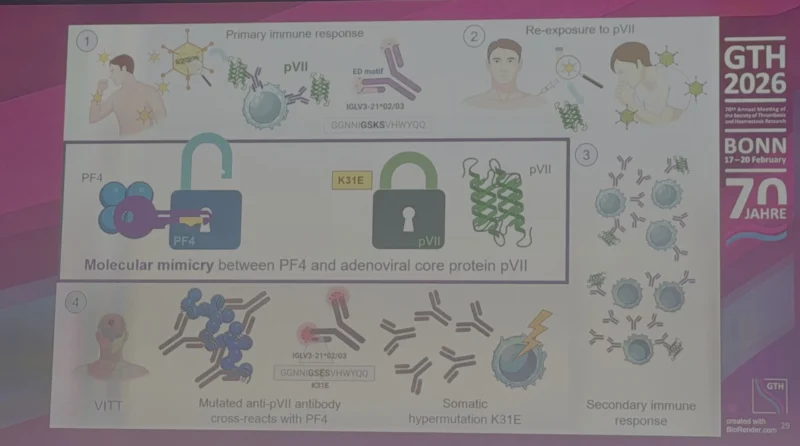
New insights: molecular mimicry plus somatic mutation.
Molecular mimicry between PF4 and adenoviral core protein pVII is the trigger.
In individuals carrying the IGLV3-21*02/03 light chain haplotype (~60% of Caucasians), primary exposure to pVII generates an antibody with an ED motif.
Upon re-exposure, a somatic K31E hypermutation creates an antibody that cross-reacts with PF4 — triggering VITT via a clonal secondary immune response.
These findings just published in N Engl J Med 2026.
Broader implications
This model also illuminates acquired haemophilia post-vaccination, postinfectious APS, ITP in children, posttransfusion purpura, and more.
For future adenoviral vaccine platforms — Ebola, HIV, Zika, Rabies — modifying pVII in the vector could prevent VITT entirely.”
Stay updated with Hemostasis Today.

-
Sep 18, 2026, 16:51Adarsh Krishnan Sundara Rajan: Is VTE the Most Underdiagnosed Critical Threat in Modern Healthcare?
-
Sep 18, 2026, 16:19CRISPR and Hemophilia: The Next Frontier of In Vivo Gene Editing
-
Sep 18, 2026, 16:13Christian Irsara: PF4 Immunothrombosis Following Natural Adenovirus Infection
-
Sep 18, 2026, 16:10Leo Nicolai։ The Spleen Emerges as a Key Regulator of Thromboinflammation
-
Sep 18, 2026, 16:05Targeting Factor XI to Reduce Thrombosis Without Compromising Hemostasis – ISTH
-
Sep 18, 2026, 15:54Swapnil Pawar: Why Aren’t We Using Cryopreserved Platelets Everywhere Yet?
-
Sep 18, 2026, 15:37Abdul Mannan: Evaluating Longitudinal Platelet Trends Beyond Standard Reference Intervals
-
Sep 18, 2026, 15:30Peter A. Everts։ Platelet Phenotype May Hold the Key to More Consistent PRP Therapy
-
Sep 18, 2026, 15:25Brandon Temple: Turning Personal Experience Into Advocacy for wAIHA Research