


Simon Senanu: Rouleaux Formation – When Red Cells Stack Like Coins
Simon Senanu, Medical Laboratory Scientist at Perkins Medical Centre, shared a post on LinkedIn:
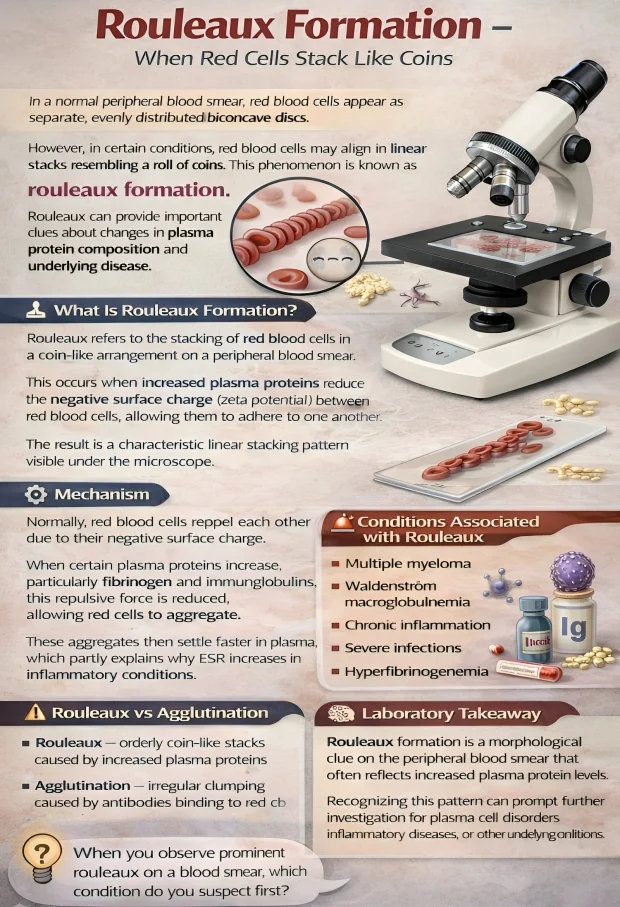
”Rouleaux Formation – When Red Cells Stack Like Coins
In a normal peripheral blood smear, red blood cells appear as separate, evenly distributed biconcave discs.
However, in certain conditions, red blood cells may align in linear stacks resembling a roll of coins. This phenomenon is known as rouleaux formation.
Rouleaux can provide important clues about changes in plasma protein composition and underlying disease.
What Is Rouleaux Formation?
Rouleaux refers to the stacking of red blood cells in a coin-like arrangement on a peripheral blood smear.
This occurs when increased plasma proteins reduce the negative surface charge (zeta potential) between red blood cells, allowing them to adhere to one another.
The result is a characteristic linear stacking pattern visible under the microscope.
Mechanism
- Normally, red blood cells repel each other due to their negative surface charge.
- When certain plasma proteins increase, particularly fibrinogen and immunoglobulins, this repulsive force is reduced, allowing red cells to aggregate.
- These aggregates then settle faster in plasma, which partly explains why ESR increases in inflammatory conditions.
Conditions Associated with Rouleaux
Rouleaux formation may be seen in several clinical conditions, including:
- Multiple myeloma
- Waldenström macroglobulinemia
- Chronic inflammation
- Severe infections
- Hyperfibrinogenemia
These conditions often involve elevated plasma proteins, which promote red cell aggregation.
Rouleaux vs Agglutination
It is important to distinguish rouleaux from red cell agglutination.
- Rouleaux – orderly coin-like stacks caused by increased plasma proteins
- Agglutination – irregular clumping caused by antibodies binding to red blood cells
Agglutination is typically associated with immune-mediated processes, such as cold agglutinin disease.
Laboratory Takeaway
Rouleaux formation is a morphological clue on the peripheral blood smear that often reflects increased plasma protein levels.
Recognizing this pattern can prompt further investigation for plasma cell disorders, inflammatory diseases, or other underlying conditions.”
Other posts featuring Simon Senanu on Hemostasis Today.
-
Sep 25, 2026, 10:49Shefina S: From Presenting to Hosting at TRANSCON 2026
-
Sep 25, 2026, 10:37Michelle Leona Cecil: Hemophilia Advocacy and the Power of Community
-
Sep 25, 2026, 10:13Michael Baria: Platelet Concentration and PRP Outcomes in Partial Rotator Cuff Tears
-
Sep 25, 2026, 09:49Haley Coleman: Volunteering to Support Hemophilia Awareness
-
Sep 25, 2026, 08:55Hitarth Mehta: BHMS Students Gain Practical Exposure to Haemophilia Diagnosis
-
Sep 25, 2026, 07:25Varun Capoor: How Therapeutic Apheresis and Transfusion Medicine Can Complement Clinical Management in SCD
-
Sep 25, 2026, 07:14Manshi Kesharwani: SAK-GQDs Modulate Thrombus Burden and Endothelial Function in Deep Vein Thrombosis
-
Sep 25, 2026, 06:20Farjah Hassan Algahtani: How Can We Better Identify Patients at Risk of Blood Clots after Metabolic and Bariatric Surgery?
-
Sep 25, 2026, 05:59Carla Lewis: Kids Conquering Sickle Disease Joins Nemours Children’s Hospital for 2nd Annual Awareness Event