


Georges Chahoud: Top Take-Home Messages from the AHA/ACC/Multisociety Acute PE Guideline
Georges Chahoud, Heart Failure Cardiologist at St. Louis Cardiology, shared a post on LinkedIn:
“The following Top Take-Home Messages are taken directly from the AHA/ACC/Multisociety Acute PE Guideline.
1 Messages 1, 5, and 6 (in bold below) were selected as key themes by the ACC Acute PE Guideline Dissemination Workgroup for this Guideline-at-a-Glance as they represent the most impactful changes and address established gaps in clinical practice.
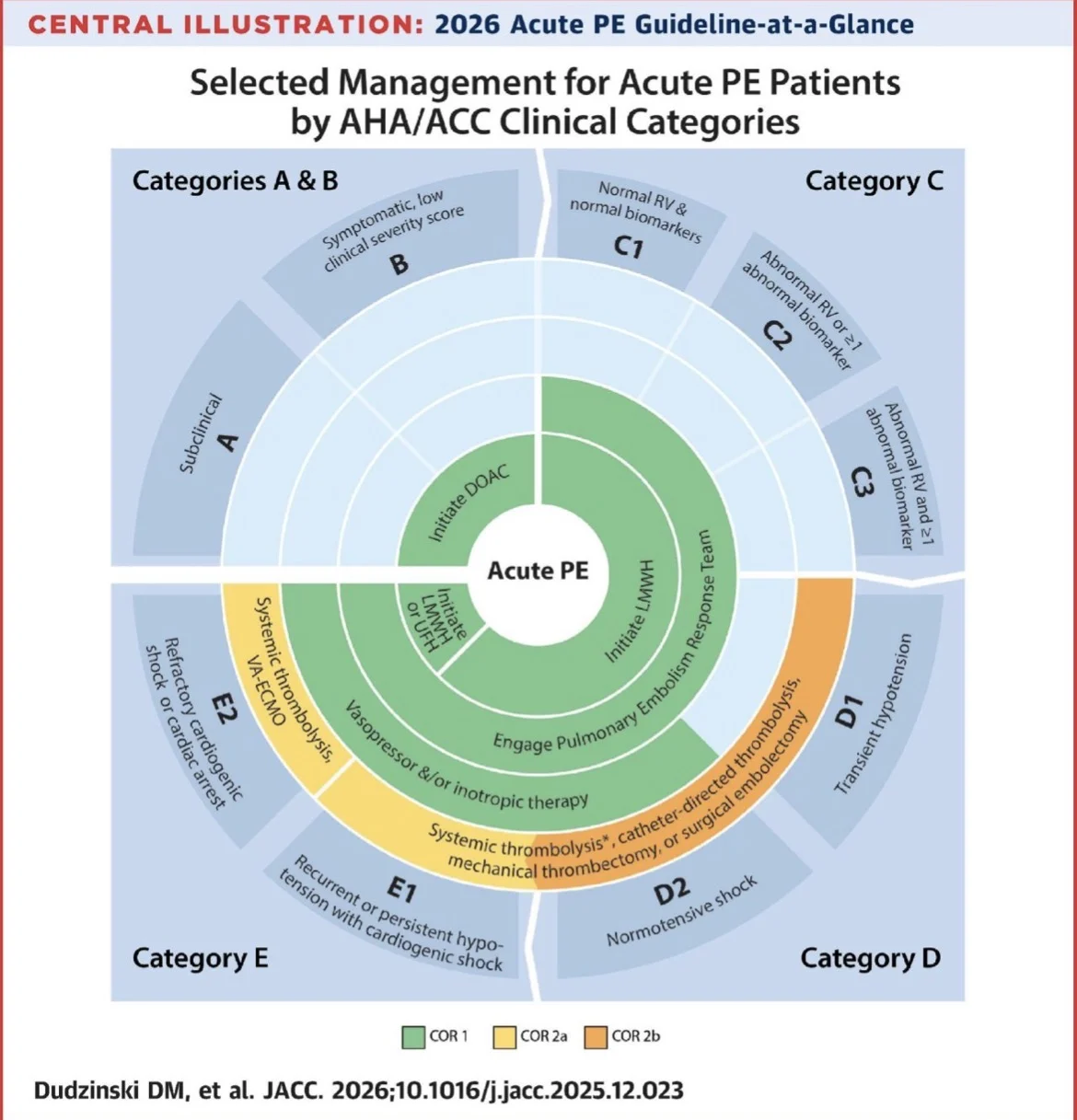
1. A new clinical classification scheme is presented, entitled “Acute Pulmonary Embolism Clinical Categories,” with 5 categories (A-E) and subcategories, ranging from low to high risk for adverse outcomes, in order to enhance the precision of severity classification, prognosis assessment, and evidence-based therapeutic decision-making for patients presenting with acute PE.
2. Patients with acute PE who are asymptomatic (AHA/ACC PE Category A) can safely be discharged home from the emergency room and do not need to be hospitalized.
3. Early hospital discharge is generally recommended for patients with acute PE who are symptomatic but have a low clinical severity score (AHA/ACC PE Category B).
4. Symptomatic patients with acute PE and an elevated clinical severity score, including those with elevated biomarkers and/or right ventricular dysfunction (AHA/ACC PE Category C), incipient cardiopulmonary failure (AHA/ACC PE Category D), and those with cardiopulmonary failure characterized by persistent hypotension (AHA/ACC PE Category E) should be hospitalized to optimize treatment strategies.
5. Advanced therapies, including systemic thrombolysis, catheter-based thrombolysis, mechanical thrombectomy, and surgical embolectomy are reasonable for patients with acute PE in AHA/ACC PE Category E1 and can be considered for patients with acute PE in AHA/ACC PE Category D1-2.
6. PE response teams (PERTs) are recommended to improve timeliness of care.
7. In patients with acute PE who require initial parenteral anticoagulant therapy, low-molecular-weight heparin is recommended over unfractionated heparin.
8. In patients with acute PE who are eligible for oral anticoagulation, direct oral anticoagulants are recommended over vitamin K antagonists, unless contraindicated, to prevent recurrent venous thromboembolism and reduce major bleeding.
9. In patients with a first acute PE without a major reversible risk factor and in those with a persistent risk factor, continuing anticoagulation beyond the initial treatment phase (3-6 months) into the extended phase is recommended.
10. Patients who have had acute PE should be asked about PE-related symptoms and functional limitations at every visit for at least 1 year to screen for chronic thromboembolic pulmonary disease or other causes of dyspnea and functional limitation.”
American College of Cardiology shared a post on LinkedIn:
“The 2026 ACC/AHA/Multisociety Clinical Guideline on acute pulmonary embolism focuses on evaluation, management, and follow-up of adult patients.
This Guideline-at-a-Glance highlights practice-changing recommendations from the guideline to accelerate adoption.”
Title: 2026 Acute Pulmonary Embolism Guideline-at-a-Glance
Authors: David M. Dudzinski, Morgane Cibotti-Sun, Mykela M. Moore
Read the Full Article on JACC Journals
Stay updated on all scientific advances with Hemostasis Today.
-
Sep 30, 2026, 01:52Javed Anees: DADA2 – When a Young Stroke Is More Than a Stroke
-
Sep 30, 2026, 01:51How a Venous Thrombus Becomes Revascularized – ISTH
-
Sep 29, 2026, 22:45Victor Agunyego: Paracetamol – The Most Common Drug We Underestimate
-
Sep 29, 2026, 22:42Nova Sinclair: Advancing the Future of Hematology – Meet Our 2027 Organizing Committee
-
Sep 29, 2026, 22:41Lorenz Räber: Intracoronary Imaging in PCI – Why, When, How, and Which Modality?
-
Sep 29, 2026, 22:31Selma Turkovic: Pleased to Deliver the Opening Presentation at Kingston Hospital
-
Sep 29, 2026, 22:31Miguel Teran: Ultrasound and Simulation in Arterial Blood Sampling
-
Sep 29, 2026, 22:28Mohammad Refaei: Navigating Your Career in Hematology From Training to Practice
-
Sep 29, 2026, 22:27Matteo Foschi: 10 Clinical Pearls for Antithrombotic Therapy in Secondary Stroke Prevention