

Caitlin Raymond: A Call for Improved Clinical Integration in Transfusion Medicine
Caitlin Raymond, Assistant Professor of Pathology and Transfusion Medicine at University of Wisconsin-Madison, shared a post on LinkedIn:
“Most clinicians don’t know when to call transfusion medicine.
Some don’t know we exist.
This is not a criticism — it’s a visibility problem, and it’s nearly universal.
The blood bank is infrastructure.
Like the electrical grid, you mostly notice it when something goes wrong.
The consequences are real: transfusion reactions managed in isolation, complicated antibody cases that never get a clinical conversation, decisions made without a map.
So I made a map.
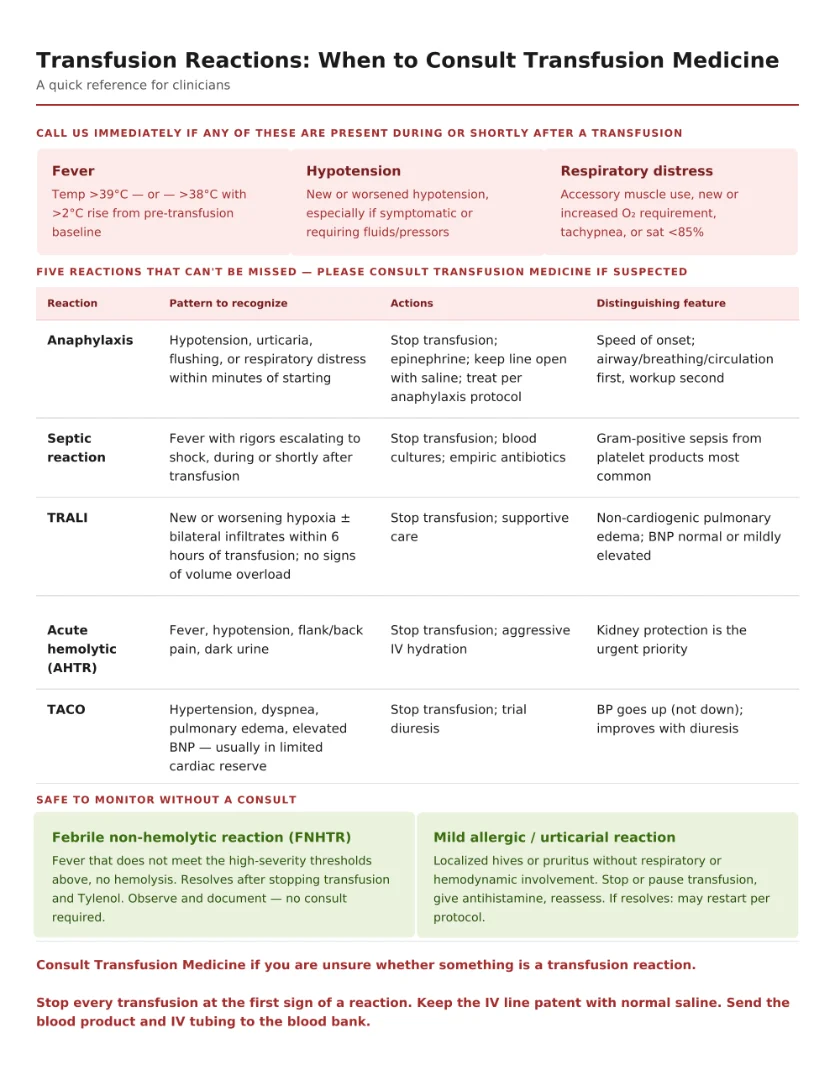
Attached: a one-page clinical reference covering when to consult transfusion medicine, what the five can’t-miss reactions look like, and when it’s safe to monitor without a consult.
The most important line on it: consult us if you’re unsure.
Uncertainty is enough.
That’s what we’re here for.”
Other posts featuring Caitlin Raymond on Hemostasis Today.
-
Oct 21, 2026, 02:52Aymar Akilimali: Bleeding During Anticoagulation as a Potential Signal of Occult Cancer
-
Oct 21, 2026, 00:58Anees Ur Rahman: Completing a Two-Week Clinical Rotation at Haemophilia Treatment Centre Rawalpindi
-
Oct 21, 2026, 00:56Caitlyn Mooney: Pulmonary Embolism in Athletes, Recognition and Return to Sport
-
Oct 21, 2026, 00:54Hani Karrar: Pleased to Share Our Review on Emicizumab in Hemophilia A Management
-
Oct 21, 2026, 00:53Akshay Sharma: HSCT Leads to Sustained Improvements in Sickle Cell Cardiomyopathy for Up to 3 Years
-
Oct 21, 2026, 00:51Prateek Meena: The F. A. T. R. N. Mnemonic for Recognizing TTP
-
Oct 20, 2026, 23:51Registration Is Open for WFH CCS 2027 – World Federation of Hemophilia
-
Oct 20, 2026, 23:44Edward Lee Carter: AF in Nursing Homes – When Stroke Risk Scores Tell Only Part of the Story
-
Oct 20, 2026, 22:59Building Effective Patient Advocacy Through Collaboration Between Patients and Clinicians – EHC