


Edward Lee Carter: AF in Nursing Homes – When Stroke Risk Scores Tell Only Part of the Story
Edward Lee Carter, Clinical Pharmacist Practitioner at U.S. Department of Veterans Affairs, stared a post on LinkedIn:
“Atrial Fibrillation in Nursing Homes: When Stroke Risk Scores Tell Only Part of the Story
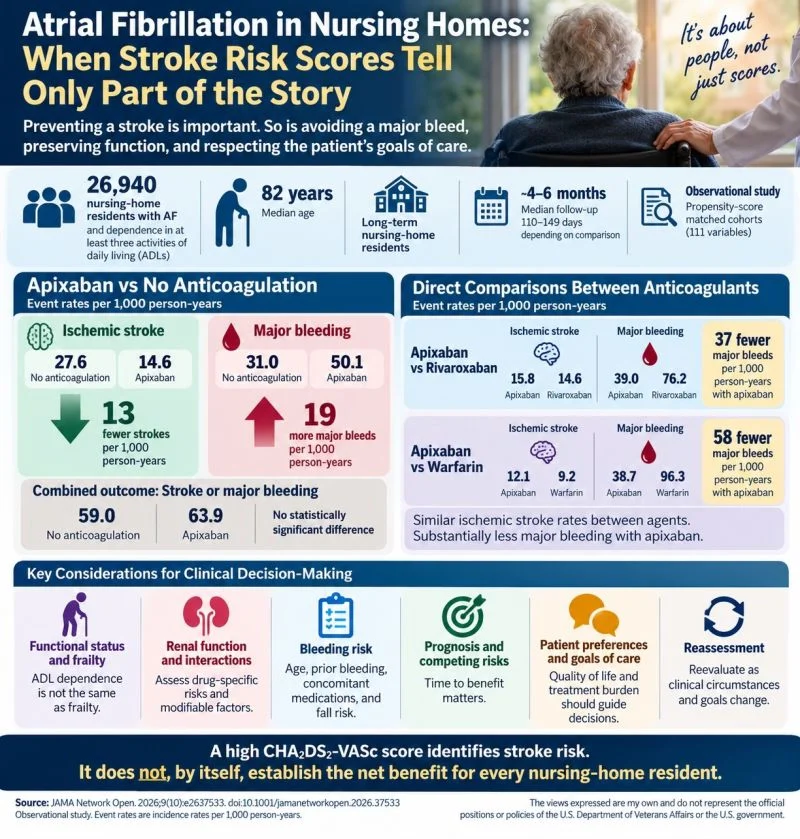
For an older nursing-home resident with atrial fibrillation, preventing a stroke is important. But so is avoiding a major bleed, preserving function, and respecting the patient’s goals of care.
A new JAMA Network Open study examined 26,940 nursing-home residents with AF and dependence in at least three activities of daily living.
Median age: 82 years.
The findings reveal a difficult trade-off.
Compared with matched nonusers, apixaban was associated with:
- 13 fewer ischemic strokes per 1,000 person-years
- 19 additional major bleeding events per 1,000 person-years
- No statistically significant difference in the combined outcome of stroke or major bleeding
Rivaroxaban and warfarin were also associated with fewer strokes, but substantially higher major bleeding rates.
In direct comparisons, apixaban was associated with approximately 37 fewer major bleeds per 1,000 person-years than rivaroxaban and 58 fewer than warfarin, with no clear difference in ischemic stroke.
These are observational associations—not randomized treatment effects.
And the geriatric perspective matters.
Functional dependence is not synonymous with frailty. Frailty does not automatically contraindicate anticoagulation. Yet prognosis, cognitive impairment, competing mortality risks, medication burden, and patient preferences can meaningfully alter the treatment decision.
Notably, stroke-reduction associations were attenuated in the study’s 180-day intention-to-treat analyses, while increased bleeding remained evident.
Three questions deserve attention:
- Is anticoagulation appropriate for this resident’s prognosis and goals?
- If so, which agent offers the most favorable safety profile?
- When should the decision be reassessed as functional status and clinical circumstances change?
A high CHA₂DS₂-VASc score identifies stroke risk. It does not, by itself, establish the net benefit of treatment for every nursing-home resident.
The goal is not anticoagulation at all costs. It is meaningful stroke prevention with the least avoidable harm.
The views expressed are my own and do not represent the official positions or policies of the U.S. Department of Veterans Affairs or the U.S. government.”
Find more posts featuring Edward Lee Carter on Hemostasis Today.
-
Oct 20, 2026, 23:51Registration Is Open for WFH CCS 2027 – World Federation of Hemophilia
-
Oct 20, 2026, 22:59Building Effective Patient Advocacy Through Collaboration Between Patients and Clinicians – EHC
-
Oct 20, 2026, 21:22Intezar Mehdi: When Prolonged Bleeding May Indicate an Underlying Bleeding Disorder
-
Oct 20, 2026, 21:06Nandini Pethe: Sharing My Experience as a Caregiver in the HOPE Factor Resource Guide
-
Oct 20, 2026, 16:51Suzan Nakasendwa: A Growing Stroke Challenge in Uganda
-
Oct 20, 2026, 16:38Steve Moon: How Does Smoking Cessation Duration Affect Ischemic Stroke Risk
-
Oct 20, 2026, 16:25Cedrice Mentor: Reducing Platelet Wastage Through Cold Storage
-
Oct 20, 2026, 16:09Thirunavukkarasu Angappan: Can a Purified Fibrinogen Concentrate Replace Cryoprecipitate
-
Oct 20, 2026, 16:01Kalyan Roy: Platelet Conservation Through Evidence-Based Transfusion Practice