


Timothy Lesaca: How SSRIs Influence Hemostasis Through Platelets
Timothy Lesaca, Child And Adolescent Psychiatrist at Transformations Care Network, shared a post on LinkedIn:
“SSRIs and Bleeding Risk
Selective serotonin reuptake inhibitors’ association with increased bleeding risk reflects an important pharmacological principle: drugs targeting neurotransmitter systems often exert clinically significant effects outside the central nervous system.
This effect is mediated through platelets.
Unlike neurons, platelets lack the ability to synthesize serotonin.
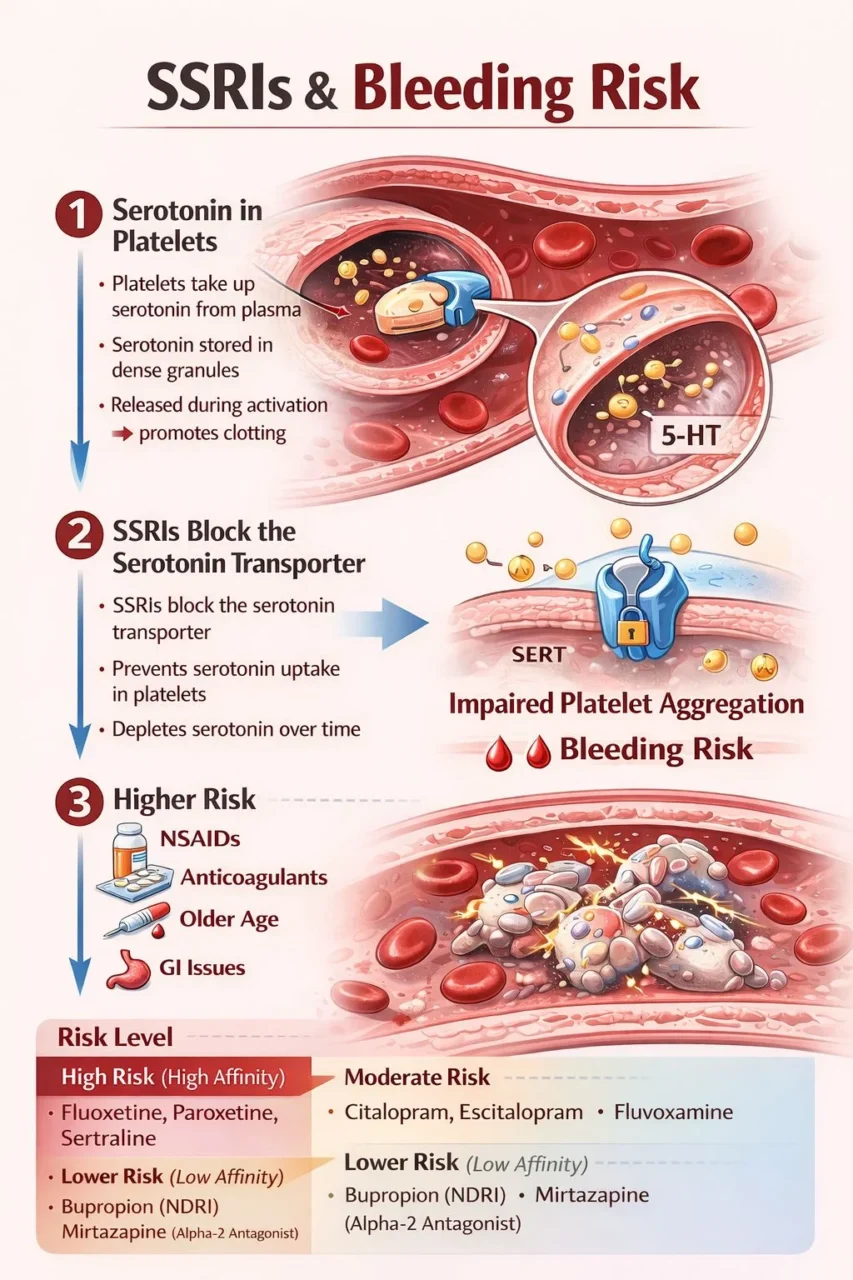
Instead, they depend on uptake from plasma via the serotonin transporter (SERT), the same target inhibited by SSRIs.
Under normal conditions, serotonin is stored in platelet dense granules and released during activation, where it amplifies aggregation and promotes vasoconstriction at sites of vascular injury.
This contributes to primary hemostasis.
SSRIs inhibit SERT on platelets, preventing serotonin uptake.
Over time, this leads to depletion of intraplatelet serotonin stores.
The result is impaired platelet aggregation, particularly in response to weak agonists, and reduced amplification of the hemostatic response.
Importantly, this does not abolish clotting.
Rather, it reduces the efficiency and stability of platelet plug formation.
Clinically, this manifests as an increased tendency toward mucosal and superficial bleeding.
The most consistently observed association is with upper gastrointestinal bleeding.
Several large observational studies and meta-analyses have demonstrated that SSRI use is associated with approximately a 1.5–2-fold increased risk of GI bleeding.
This risk becomes substantially higher when SSRIs are combined with other agents that affect hemostasis.
Nonsteroidal anti-inflammatory drugs (NSAIDs) impair platelet aggregation via cyclooxygenase-1 inhibition and also disrupt gastric mucosal integrity.
When combined with SSRIs, the risk of GI bleeding increases synergistically, with estimates ranging from 3- to 6-fold compared to baseline.
Anticoagulants and antiplatelet agents further amplify this effect.
Not all SSRIs carry equal risk.
Agents with higher affinity for SERT, such as fluoxetine, sertraline, and paroxetine, are more strongly associated with platelet serotonin depletion and may confer a higher bleeding risk compared to agents with lower SERT affinity.
This suggests a dose- and potency-dependent effect.
From a clinical standpoint, risk stratification is essential.
Higher-risk populations include:
- older adults
- patients with prior gastrointestinal bleeding
- those taking NSAIDs, anticoagulants, or dual antiplatelet therapy
- patients with liver disease or coagulopathy
- High Risk: Fluoxetine, Paroxetine, Sertraline
- Moderate Risk: Citalopram, Escitalopram, Fluvoxamine
- Lower Risk: Bupropion, Mirtazapine
This phenomenon highlights a broader concept in psychopharmacology.
Neurotransmitter systems are not confined to the brain.
Peripheral expression of targets such as SERT means that centrally acting drugs can influence systemic physiology in meaningful ways.”
Stay updated with Hemostasis Today.
-
Oct 4, 2026, 15:06Vasiliki Gkalea: Journal of Clinical Medicine Launches Special Issue on Hematologic Thrombosis and Bleeding
-
Oct 4, 2026, 14:55Quentin Brebant: What Defines a High-Quality Red Blood Cell Concentrate?
-
Oct 4, 2026, 14:47Rana Al-Hrout: Recognizing Non-Anemic Iron Deficiency – Why Iron Matters Beyond Hemoglobin
-
Oct 4, 2026, 14:41David McIntosh: International Plasma Awareness Week 2026 – Closing the Global Plasma Gap
-
Oct 4, 2026, 14:33Pete Stibbs: CleanerVac Real-World Study Presented at VIVA and The VEINS 2026
-
Oct 4, 2026, 13:56Maria Elisa Mancuso: EHC 2026 Highlights the Unmet Needs of Women with Bleeding Disorders
-
Oct 4, 2026, 13:53Nirmal Shaji George: Individualizing Anticoagulation in Complex APS and Thrombocytopenia
-
Oct 4, 2026, 13:5210 Posts Not to Miss This Week
-
Oct 4, 2026, 13:45Suswapna Singh Rawat: The Clinical Significance of Coronary Plaque Stability