


Bastu Odoka: Storage Lesions – What Really Happens to Stored Blood
Bastu Odoka, Transfusion Scientist at Effia-Nkwanta Regional Hospital, shared a post on LinkedIn:
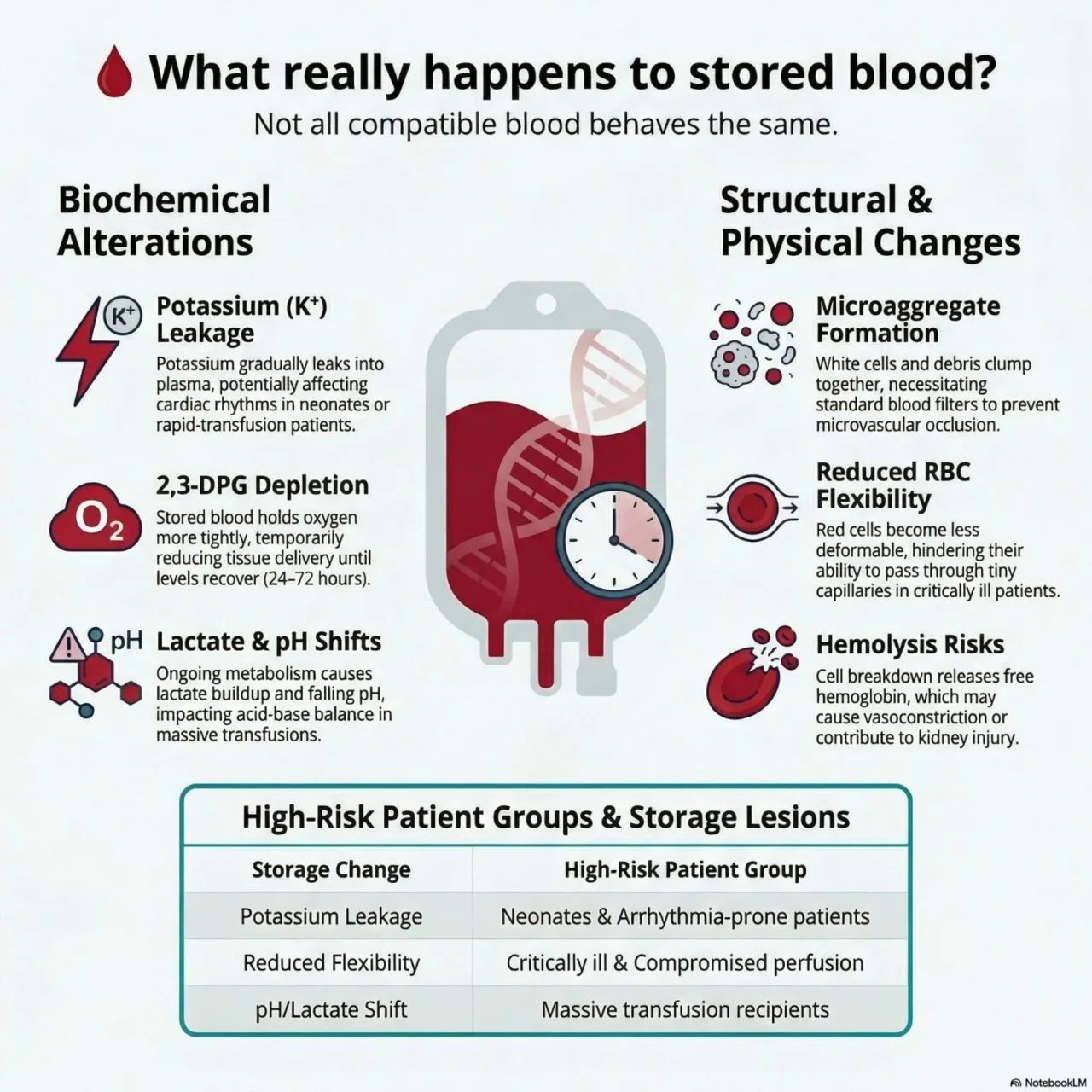
“Storage lesions: what really happens to stored blood
We often focus on compatibility before transfusion.
But there’s another layer we don’t talk about enough, how blood changes during storage.
Over time, stored red cells undergo what we call storage lesions.
Most of the time, this doesn’t change clinical decisions.
But in certain patients, it’s worth paying attention.
1. Potassium leakage
As red cells sit in storage, potassium gradually leaks into the plasma.
This becomes relevant in:
- Neonates
- Patients at risk of arrhythmias
- Rapid or large-volume transfusion
Because high potassium can affect cardiac rhythm.
2. Loss of 2,3-DPG
Stored blood loses 2,3-DPG, which helps haemoglobin release oxygen.
So early after transfusion:
- Haemoglobin holds oxygen more tightly
- Tissue oxygen delivery may be reduced
This matters most in patients who need immediate oxygen delivery.
Good thing: levels recover within 24–72 hours after transfusion.
3. Microaggregate formation
With time, white cells, platelets, and cellular debris aggregate together.
This adds to the particulate load in blood and has been linked to concerns about microvascular flow, may cause pulmonary microvascular occlusion
This is one reason why:
- Leukoreduction
- Standard blood filters
are important in routine practice.
4. Reduced red cell flexibility
Stored red cells become less deformable.
Meaning: They don’t pass through tiny capillaries as easily, which can affect microcirculation in vulnerable patients (critically ill, neonates, and those with already compromised perfusion.)
5. Hemolysis and free haemoglobin
Some red cells break down during storage, releasing free haemoglobin.
This can:
- Bind nitric oxide, causing vasoconstriction
- Contribute to oxidative stress
In certain settings, it may also play a role in kidney injury.
6. Lactate accumulation and pH changes.
Red cells continue to metabolise during storage.
Result:
- Lactate builds up
- pH falls
In most patients, this is well tolerated.
But in large-volume transfusion, especially in:
- Critically ill patients
- Neonates
it can contribute to acid–base imbalance.
So what does this mean in practice?
For the majority of patients, standard-issue blood is safe and appropriate.
These changes are not a reason to avoid transfusion or reject older blood.
But in specific situations, critically ill patients, neonates, massive transfusion, being aware of storage-related changes can help guide safer decisions.
Blood saves lives.
But understanding how it changes helps us use it more thoughtfully.”
Other posts featuring Bastu Odoka on Hemostasis Today.
-
Oct 4, 2026, 06:12David McIntosh: 900 Plasma Donations One Patient One Lifeline
-
Oct 4, 2026, 06:00Aadil Sheikh: Menopausal Hormone Therapy and Thrombosis Rethinking Route Dose and Risk
-
Oct 4, 2026, 05:39Alicja Urbaniak: Targeting CD148 for Novel Antithrombotic Therapy
-
Oct 4, 2026, 05:27Nirali Thakkar: Influenza and Myocardial Infarction An Unexpected Cardiovascular Connection
-
Oct 4, 2026, 05:03Hisham Fahmi: Thromboprophylaxis in Children With ALL A Risk Adapted Approach
-
Oct 4, 2026, 05:00Mary Cushman: Erin Michos Highlights Rising Heart Disease Mortality Among Younger Women in the US
-
Oct 4, 2026, 04:48Liv Tybjærg Nordestgaard: Is Fasting Necessary Before Blood Sampling?
-
Oct 4, 2026, 04:31Sonal Sonu: Gen Z doesn’t just set trends – Gen Z saves lives
-
Oct 4, 2026, 04:22Registration Opens for 2027 Highlights of ASH – American Society of Hematology