


John Abraham: Telomere Biology Disorders – From Bench to Bedside
John Abraham, Assistant Professor at Christian Medical College and Hospital, shared a post on Linkedin about a recent article by Madeline Franke et al., published in Haematologica, adding:
“Telomere Biology Disorders (TBD): From Bench to Bedside
Recently revisited an excellent review in Haematologica (March 2026) by Madeline Franke et al., focusing on the diagnosis and management of adult telomere biology disorders.
Here are key takeaways
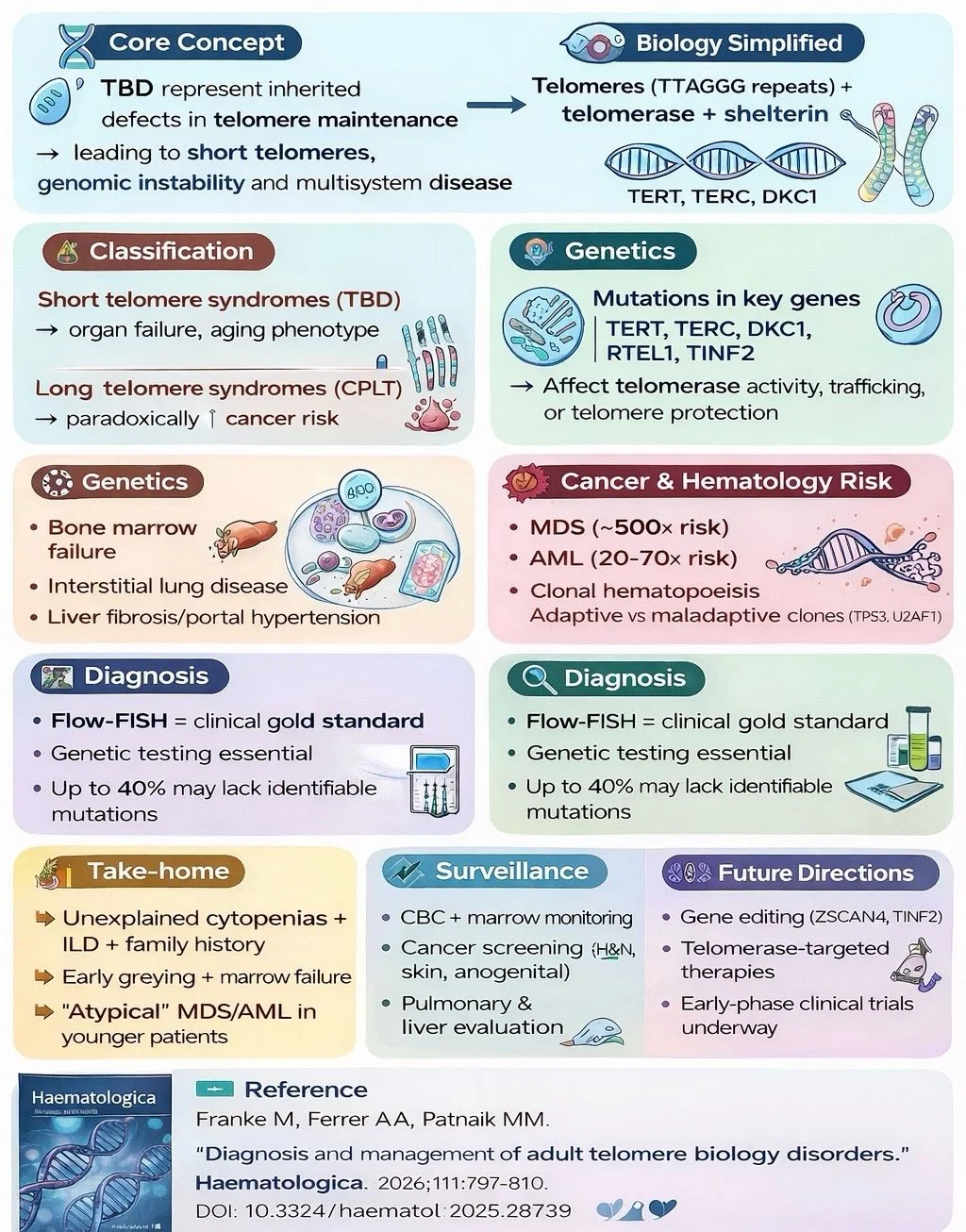
Core concept
TBD represent inherited defects in telomere maintenance leading to short telomeres, genomic instability, and multisystem disease.
Biology simplified
Telomeres (TTAGGG repeats) plus telomerase plus shelterin complex
- Maintain chromosomal integrity
- Progressive shortening triggers cell senescence and malignancy risk
Classification
- Short telomere syndromes (TBD) – organ failure, aging phenotype
- Long telomere syndromes (CPLT) – paradoxical increased cancer risk
Genetics
Mutations in key genes (TERT, TERC, DKC1, RTEL1, TINF2)
- Affect telomerase activity, trafficking, or telomere protection
Clinical spectrum (Adults)
- Bone marrow failure
- Interstitial lung disease (often the presenting feature)
- Liver fibrosis/portal hypertension
- Premature aging features
Cancer and hematology Risk
- MDS (approximately 500 fold increase risk)
- AML (20–70 fold increase risk)
- Clonal hematopoiesis plays a central role
Adaptive vs maladaptive clones (TP53, U2AF1)
Diagnosis
- Flow-FISH is clinical gold standard
- Genetic testing essential
- Up to 40% may lack identifiable mutations
Unique concepts
- Genetic anticipation – earlier, more severe disease
- Phenocopying – TBD phenotype without mutation
Management
- Androgens (e.g., danazol) – potential telomere elongation (mixed evidence)
- Transplant remains definitive (HSCT / lung / liver)
Requires reduced-intensity conditioning
Surveillance
- CBC plus marrow monitoring
- Cancer screening (H and N, skin, anogenital)
- Pulmonary and liver evaluation
Multidisciplinary care is key
Future directions
- Gene editing (ZSCAN4, TINF2)
- Telomerase-targeted therapies
Early-phase clinical trials underway
Take-home
Think TBD in:
- Unexplained cytopenias plus ILD plus family history
- Early greying plus marrow failure
- ‘Atypical’ MDS/AML in younger patients
Early recognition – better outcomes.”
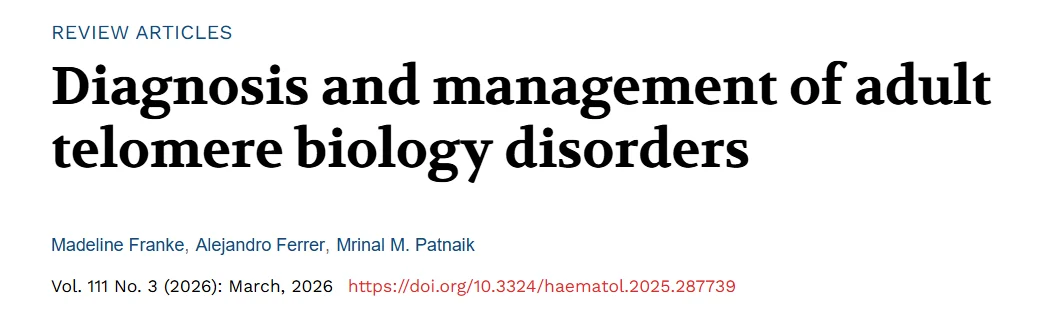
Title: Diagnosis and management of adult telomere biology disorders
Authors: Madeline Franke, Alejandro Ferrer, Mrinal M. Patnaik
Read the Full Article on Haematologica
Stay updated with Hemostasis Today.
-
Oct 15, 2026, 19:41Looking Beyond Platelet Counts to Quality of Life in ITP – American Society of Hematology
-
Oct 15, 2026, 19:32Markus Gregorio Barbosa: Hepatic VPS35 and Cholesterol Homeostasis
-
Oct 15, 2026, 19:18Emerging Novel Therapies for Hereditary Hemorrhagic Telangiectasia – The Lancet Haematology
-
Oct 15, 2026, 19:04Umberto Pensato: EVT Treatment Effects Across Perfusion Profiles in MeVO Stroke
-
Oct 15, 2026, 18:26Chanakya Nayudu: Presenting My Research at ISTH Congress 2026 in Paris
-
Oct 15, 2026, 18:09Maha Othman: Students Lead World Thrombosis Day 2026 Awareness Events
-
Oct 15, 2026, 17:52Jill de Mol։ Rapamycin Modulates Immune Responses in Aged Atherosclerosis
-
Oct 15, 2026, 17:41Victor Aboyans։ Think About Lipids in VTE
-
Oct 15, 2026, 17:08Babu Mia։ Targeting PPM1D to Eliminate Malignant Stem Cells in Myeloproliferative Neoplasms