


Umar Jawed: The Most Dangerous Anti-D Result Is Not the Highest One – It’s the One You Underestimate Early
Umar Jawed, Consultant Haematologist at King’s College Hospital London, Jeddah, shared a post on LinkedIn:
“‘The most dangerous Anti-D result is not the highest one – it’s the one you underestimate early.’
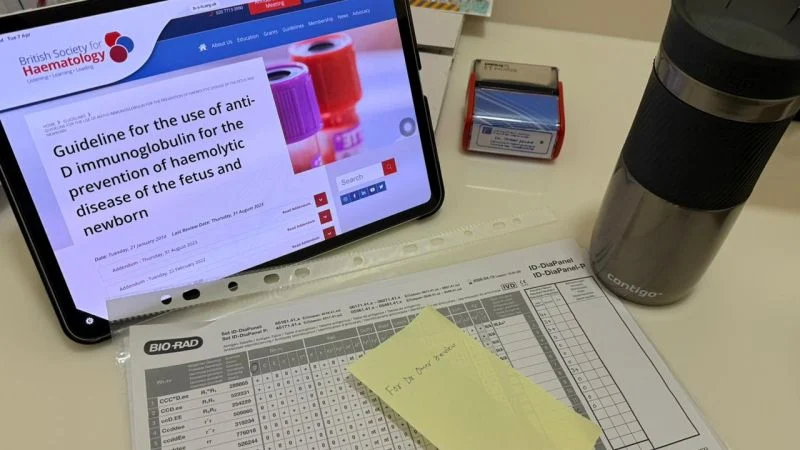
My morning today at King’s College Hospital London – Jeddah started with exactly that.
A routine antenatal screen.
Young patient. Early gestation.
- Anti-D detected.
- Titre: High.
And instantly, what looks like a lab result becomes a time-sensitive fetal risk assessment problem.
Because:
- High-titre Anti-D this early is never reassuring.
It raises one critical question:
Are we already behind in this pregnancy?
The Clinical Shift (Not Just ‘Follow the Titre’)
Following principles from Royal College of Obstetricians and Gynaecologists (RCOG), British Committee for Standards in Haematology (BCSH) and American College of Obstetricians and Gynecologists (ACOG):
This was not a ‘watch and wait’ case.
Management mindset shifted immediately to:
- Early risk stratification
- Urgent fetal medicine referral
- Consideration of fetal RhD genotyping (non-invasive where available)
- Planning for MCA Doppler surveillance
Because once sensitisation is established:
Titre is not the disease – fetal anemia is.
What Makes Anti-D Different
In transfusion medicine, Anti-D is unique:
- Preventable – yet still encountered
- Predictable – yet still underestimated
- Detectable early – but often acted on late
And importantly:
Early high titre is not equal mild disease starting early
It may reflect a sensitised immune system already primed for rapid fetal impact
The Bigger Perspective
This is where transfusion medicine extends beyond the lab.
It becomes:
- Predictive medicine
- Fetal risk stratification
- Multidisciplinary decision-making
Because one antibody, detected at the right time, can completely alter the trajectory of a pregnancy.
Questions for colleagues in transfusion and fetal medicine:
- At what titre (and gestation) do you escalate immediately to fetal medicine?
- Are you routinely integrating non-invasive fetal RhD typing into your pathway?”
Stay updated on Hemostasis Today.
-
Oct 20, 2026, 22:59Building Effective Patient Advocacy Through Collaboration Between Patients and Clinicians – EHC
-
Oct 20, 2026, 21:22Intezar Mehdi: When Prolonged Bleeding May Indicate an Underlying Bleeding Disorder
-
Oct 20, 2026, 21:06Nandini Pethe: Sharing My Experience as a Caregiver in the HOPE Factor Resource Guide
-
Oct 20, 2026, 16:51Suzan Nakasendwa: A Growing Stroke Challenge in Uganda
-
Oct 20, 2026, 16:38Steve Moon: How Does Smoking Cessation Duration Affect Ischemic Stroke Risk
-
Oct 20, 2026, 16:25Cedrice Mentor: Reducing Platelet Wastage Through Cold Storage
-
Oct 20, 2026, 16:09Thirunavukkarasu Angappan: Can a Purified Fibrinogen Concentrate Replace Cryoprecipitate
-
Oct 20, 2026, 16:01Kalyan Roy: Platelet Conservation Through Evidence-Based Transfusion Practice
-
Oct 20, 2026, 15:28Stacy E. Croteau: 33 Countries, One Mission – Better Bleeding Disorder Care