


Kalyan Roy: A Critical Safety Intervention in Transfusion Medicine
Kalyan Roy, Transfusion Medicine Specialist at Square Hospitals LTD, shared a post on LinkedIn:
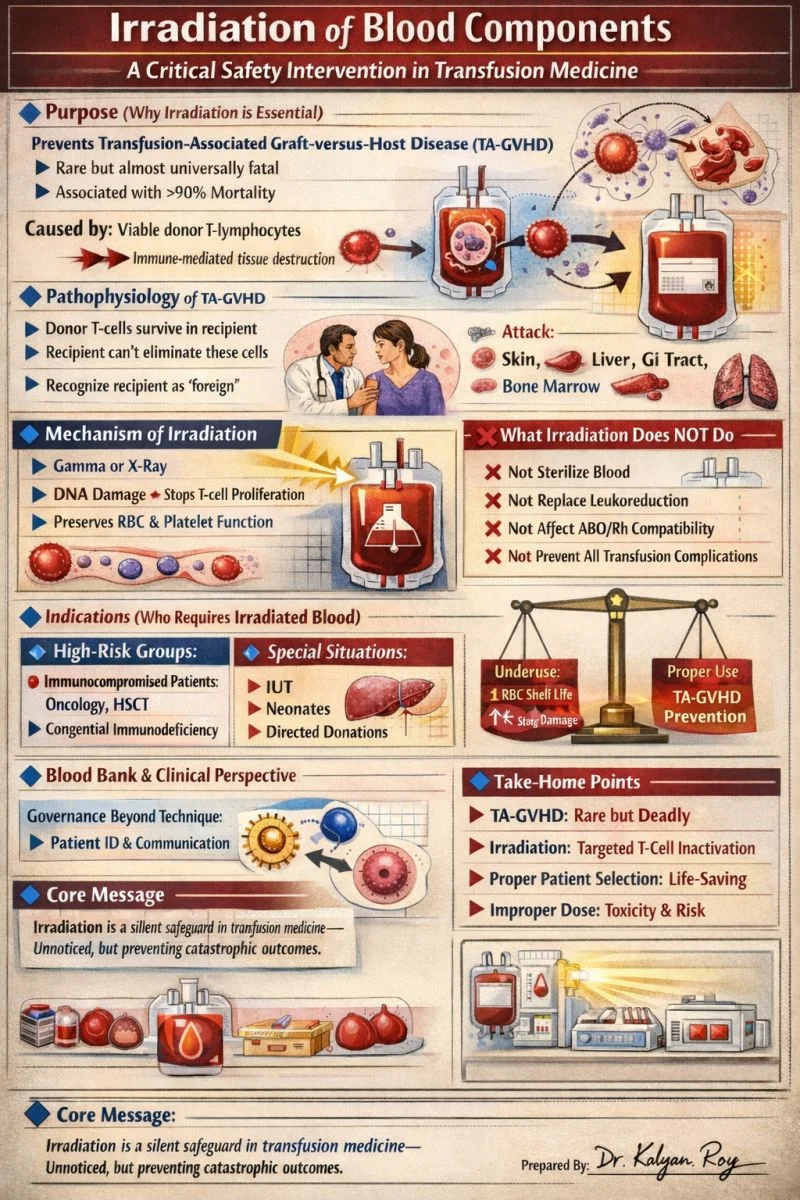
”Irradiation of Blood Components
A Critical Safety Intervention in Transfusion Medicine
Purpose (Why Irradiation is Essential)
Prevents Transfusion-Associated Graft-versus-Host Disease (TA-GVHD) TA-GVHD is: Rare but almost universally fatal Associated withmore than 90% mortality rate Caused by:
Viable donor T-lymphocytes Engraftment in recipient and lead to immune-mediated tissue destruction
Pathophysiology of TA-GVHD Donor immunocompetent T-cells survive in recipient circulation Recipient (often immunocompromised) cannot eliminate these cells Donor T-cells:
Recognize recipient tissues as foreign Initiate cell-mediated immune attack Target organs: Skin Liver Gastrointestinal tract Bone marrow
Mechanism of Irradiation Utilizes: Gamma radiation or X-ray irradiation Action: Causes DNA damage in donor T-lymphocytes Prevents cellular proliferation and clonal expansion Outcome: Eliminates risk of TA-GVHD while preserving RBC/platelet function
What Irradiation Does NOT Do
- Does not sterilize blood products
- Does not replace leukoreduction
- Does not affect ABO/Rh compatibility
- Does not prevent all transfusion-related complications
Indications (Who Requires Irradiated Blood)
High-Risk Groups: Immunocompromised patients: Hematology/Oncology cases
- Chemotherapy recipients
- Hematopoietic Stem Cell Transplant (HSCT)
- patients Congenital immunodeficiency disorders
Special Clinical Situations:
- Intrauterine transfusion (IUT)
- Neonatal exchange transfusion / selected neonatal cases
- Directed donations from first-degree relatives
Key Risk Factor:
HLA similarity leads to reduced immune recognition, which increases the risk of transfusion-associated graft-versus-host disease (TA-GVHD).
Key Considerations in Practice Irradiation should be:
Indication-based, not routine Applied with clinical judgment and protocol adherence
Balance is Critical:
- Overuse: Decreased RBC shelf life increased Potassium leakage (risk of hyperkalemia) Increased storage lesion
- Underuse: Risk of fatal TA-GVHD Irreversible clinical consequences
Blood Bank and Clinical Perspective Not just a technical process leads to a governance decision Requires: Proper patient identification Clear communication between clinician and blood bank Reflects: Precision medicine in transfusion practice
Core Message Irradiation is a silent safeguard in transfusion medicine – often unnoticed, but critical in preventing catastrophic outcomes.
Take-Home Points TA-GVHD is rare but highly fatal and Preventable Irradiation causes targeted T-cell inactivation Right patient selection is a Life-saving decision Improper dose leads to either toxicity or fatal risk.”
Other posts featuring Kalyan Roy on Hemostasis Today.
-
Oct 22, 2026, 15:37Alina Mitina: Key Concerns Surrounding DVT and Pulmonary Embolism
-
Oct 22, 2026, 14:45Seyed Mehrab Safdari: Prenatal Diagnosis in Hemophilia – Two Decades of Progress and Remaining Challenges
-
Oct 22, 2026, 14:39Mahmoud Abdelnabi: Evaluating the Evidence on Elevated Lp(a) and VTE Before Clinical Translation
-
Oct 22, 2026, 14:34David McIntosh: Fundamental Flaws in National Blood Systems Are Root Causes of Failure
-
Oct 22, 2026, 14:32Aurelio Maggio: Bridging Scientific Progress and Equitable Access to SCD Care in Sub-Saharan Africa
-
Oct 22, 2026, 14:26Khaled Musallam: Longevity and Healthy Aging in Thalassemia
-
Oct 22, 2026, 14:26Deise Catamo Vaz: Two Years of Growth and a New Way of Seeing the World of Stroke
-
Oct 22, 2026, 14:24Yara Mohamed: A Silent Killer Plots his Victim’s Death Over Years
-
Oct 22, 2026, 14:19Shailendra Singh: Two Different Pulmonary Embolism Cases, One Critically Important Lesson