


Jack Hadfield: Understanding the Immune and Genetic Basis of VITT Post-COVID Vaccines
Jack Hadfield, Co-founder and Research Lead at Amatica Health, shared on Linkedin about a recent article by Jing Jing Wang et al, published in NEJM, adding:
”Researchers have identified the cause of clotting seen after some COVID vaccines.
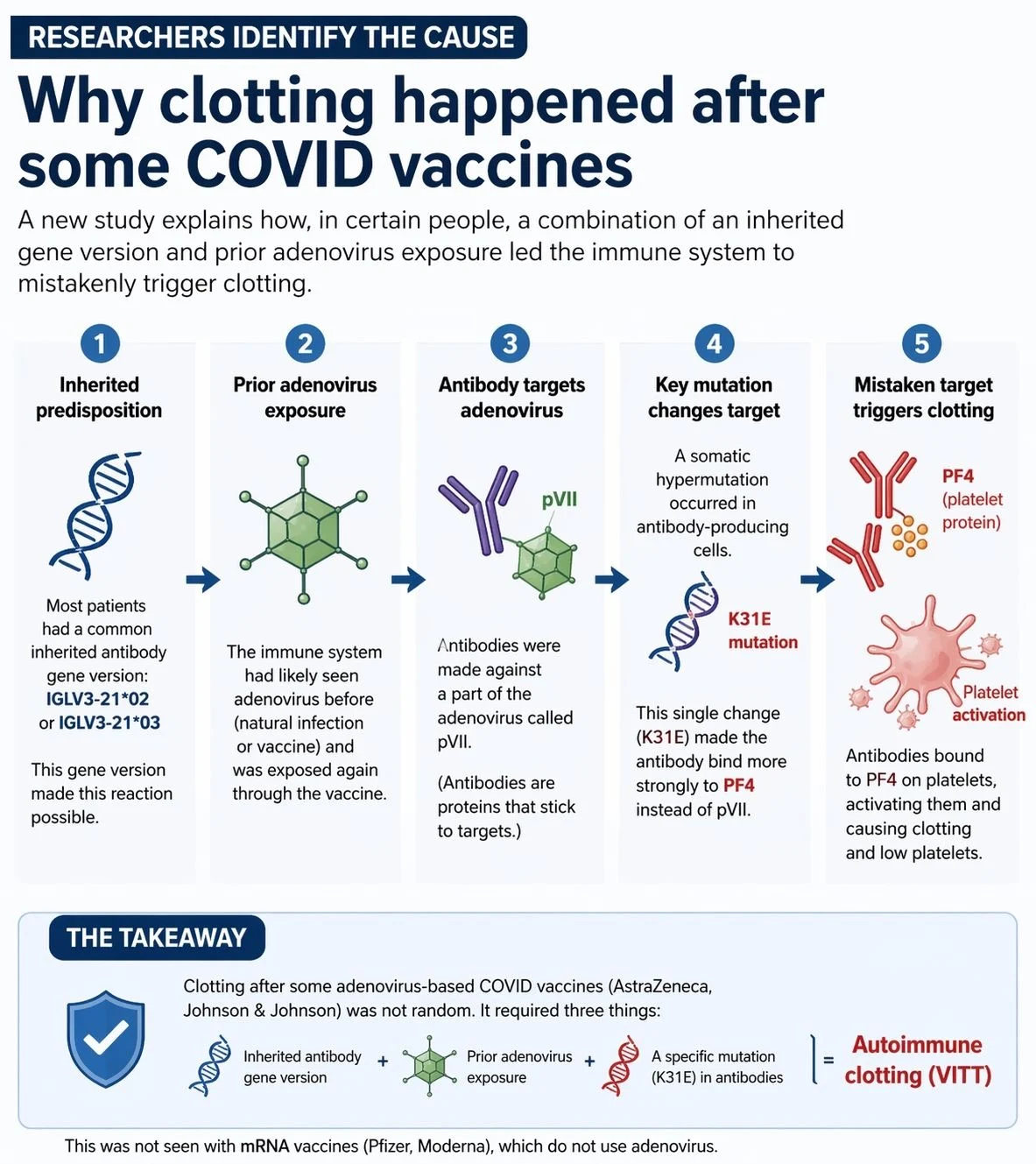
In certain people, a common inherited gene version plus prior adenovirus exposure led to an immune mistake that triggered clotting.
The paper is about VITT, which stands for vaccine-induced immune thrombocytopenia and thrombosis.
In simple terms, this means dangerous blood clots together with low platelets. Platelets are blood cells that help clots form.
This was mainly seen after the AstraZeneca and Johnson and Johnson COVID vaccines.
These used an adenovirus delivery system. It was not the same issue seen with the mRNA vaccines from Pfizer or Moderna.
The new study found that most patients carried a certain inherited antibody gene version called IGLV3-2102 or IGLV3-2103.
In simple terms, they were born with a version of an immune gene that made this reaction more possible.
But that gene version on its own was not enough.
The study says there also had to be repeat exposure to adenovirus, meaning the immune system had likely seen adenovirus before and then saw it again through the vaccine.
The antibodies first recognised a part of adenovirus called pVII.
An antibody is a protein made by the immune system to stick to a target. pVII is one of the virus proteins inside the adenovirus used in these vaccines.
Then one extra change happened inside some antibody-making cells.
This is called a somatic hypermutation. In plain language, it is a small DNA change that can happen naturally while the immune system is refining an antibody.
That one change, called K31E, shifted the antibody so it bound more strongly to PF4 instead of pVII.
PF4 is a normal blood protein released by platelets. Once antibodies started binding PF4, they could activate platelets and drive clotting.
The researchers tested this directly.
When they reversed that key K31E change in the lab, the clot-causing effect disappeared.
That gave strong evidence that this was a real mechanism, not just an association.
What this gives us is a clear explanation for why this clotting happened in some people and not most others.
It also gives vaccine researchers a clearer target to avoid when designing future adenovirus-based vaccines.”
Title: Adenoviral Inciting Antigen and Somatic Hypermutation in VITT
Authors: Jing Jing Wang, Linda Schönborn, Theodore Warkentin, Luisa Müller, Thomas Thiele, Lena Ulm, Uwe Völker, Sabine Ameling, Sören Franzenburg, Lars Kaderali, Ana Tzvetkova, Alex Colella, Tim Chataway, Chee Wee Tan, Bridie Armour, Alexander Troelnikov, Lucy Rutten, James McCluskey, Roland Zahn, Tom Gordon, Andreas Greinacher
Stay updated on all scientific advances with Hemostasis Today.
-
Oct 21, 2026, 18:13Wolfgang Miesbach: Hereditary Hemorrhagic Telangiectasia An Overlooked Bleeding Disorder
-
Oct 21, 2026, 17:55Gayatri Kotwal։ New Review on Anemia, Pain, and Nutritional Deficiencies in Cancer Patients
-
Oct 21, 2026, 17:40Tetsuzan Ron: Iron Deficiency Without Anemia Clinical Impact and Management
-
Oct 21, 2026, 17:29Amir Hossien Esfandiari։ The Association Between Viral Infections and Aplastic Anemia
-
Oct 21, 2026, 17:16Melissa Hollo: A Meaningful Step Forward for Women’s Health
-
Oct 21, 2026, 17:09Chipili Ng’onga: Have You Ever Seen a Result That Just Didn’t Make Sense?
-
Oct 21, 2026, 16:57Fabrice Cognasse: Celebrating the Next Generation of Platelet Research and Transfusion Medicine
-
Oct 21, 2026, 16:47Christabel Odeta: Treating Pediatric Cancer in Children With Sickle Cell Disease
-
Oct 21, 2026, 16:36Sharlene Haywood: Bringing Multidisciplinary Learning Into Nursing Practice