


Mazou Ngou Temgoua: Cancer and VTE – Toward Truly Personalized Anticoagulation
Mazou Ngou Temgoua, Cardiology Intensive Care Physician at Châteauroux–Le Blanc Hospital Centre, shared a post on LinkedIn about recent article by Faizan Khan et al., published in European Heart Journal:
“Cancer and VTE: toward a truly personalized (and finally nuanced) anticoagulation
A major meta-analysis (>96,000 patients) provides a key message:
- Not all cancers expose thrombosis vs bleeding to the same balance
- And above all, the profiles are not symmetrical
What the study really shows: getting out of shortcuts
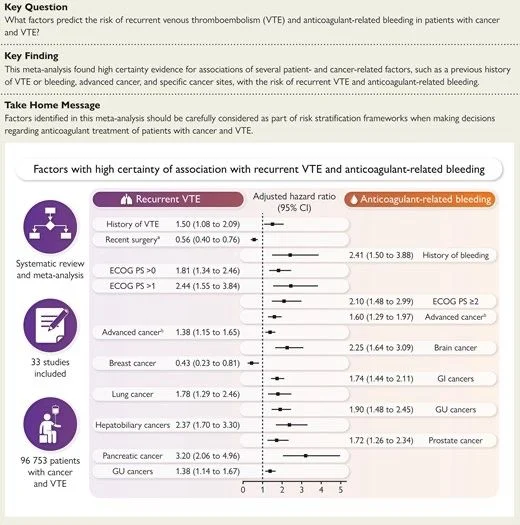
High thromboembolic risk (without necessarily increased bleeding) (e.g. pancreas, hepatobiliary, lung, history of VTE, ECOG >0)
- Dominant pro-thrombotic profile
High bleeding risk (without clear evidence of reduced VTE risk) (e.g. gastrointestinal cancers [non-pancreas/hepatobiliary], brain, prostate, history of bleeding, ECOG ≥2)
- Dominant haemorrhagic profile
- But thrombotic risk is not necessarily low
High dual risk (critical profile) (e.g. cancers of the genitourinary tract, advanced cancer and deterioration of general condition)
- High risk of recurrence and bleeding
Lower risk of recurrence (e.g. recent surgery, breast cancer)
- More favourable profile
- To be recontextualized according to tumor activity
Major implication: reasoning in terms of risk dominance (not simplistic categories)
Dominant thrombotic profile
- Prolonged, intensive anticoagulation (greater than or equal to 6 months, no early reduction)
Dominant bleeding profile
- Cautious, individualized anticoagulation
- Not necessarily short, but adapted to the real context of VTE
High dual risk (the real challenge)
- No standard solution
- Tailor-made strategy:
- LMWH preferred
- Close reassessment
- Multidisciplinary discussion
- Shared decision-making
Lower risk profile (relative)
- Standard anticoagulation
- If active cancer, tendency to still prolong treatment (greater than or equal to 6 months)
What this study really changes
Breaks the simplistic opposition ‘high risk vs low risk’
Shows that some cancers are:
- Purely thrombogenic (pancreas)
- More haemorrhagic (digestive, brain)
- Or mixed (genitourinary)
Bleeding risk does not equal protection against recurrence
Important limitations
Heterogeneity of studies
- Combined factors not assessed
- Absence of biomarkers
- Current scores insufficient
- Uncertain applicability after the acute phase
Key message (essential takeaway)
- The real advance is not to add risk factors
- But to understand their interaction and clinical dominance
Anticoagulation in cancer becomes:
- Dynamic
- Personalized
- Patient-centred
Future progress will require integrated models (clinical, biomarkers, and artificial intelligence) to manage these complex profiles.”
Title: Predictors of recurrent venous thromboembolism and bleeding in patients with cancer: a meta-analysis
Authors: Faizan Khan, Tobias Tritschler, Caterina E. Marx, Vincent Lanting, Bram Rochwerg, Alexandre Tran, Shannon M. Fernando, Diane L. Lorenzetti, Hannah Wunsch, Jessalyn Holodinsky, Kirsten Fiest, Henry Thomas Stelfox, Aurélien Delluc, Dean A. Fergusson, Grégoire Le Gal, Philip S. Wells, Tzu-Fei Wang, Kristen Sanfilippo, Nick van Es, Deborah Schrag, Jean M. Connors, Marc Carrier
Stay updated with Hemostasis Today.
-
Sep 14, 2026, 20:53YoonHwa An: Rusfertide in Polycythemia Vera – From Clinical Benefit to Strategic Value
-
Sep 14, 2026, 20:52Andres Alberto Mercado Pompa: External Validation of Prognostic Risk Scores in Cerebral Venous Thrombosis
-
Sep 14, 2026, 20:50Balaji Kirushnan: Advancing Regional Citrate Anticoagulation in CRRT – From Experience to Implementation
-
Sep 14, 2026, 20:48Valerie Dehondt: Nutritional Anemia Is Associated With Increased Risk of Severe COPD Exacerbations
-
Sep 14, 2026, 20:46Nupur Choudhury: Exploring AI-Based Detection of Anemia Using Eye and Fingernail Images
-
Sep 14, 2026, 20:44Shamee Shastry: Chart Before You Chase – Diagnosing Drug-Induced Hemolytic Anemia
-
Sep 14, 2026, 20:43David Reiner: Blood Tests That Can Reveal Nutrition Clues
-
Sep 14, 2026, 20:40Giuseppe Biondi Zoccai: Balancing Thrombosis and Bleeding in Acute MI With Hemophilia A
-
Sep 14, 2026, 20:39Kemal Karaagac: Kounis Syndrome as a Possible Cause of Very Late Stent Thrombosis