


Salih Ehsan: Bradykinin-Mediated Transfusion Reactions in Patients on ACE Inhibitors
Salih Ehsan, Chief Executive Officer at Kulsoom Society of Hematology, shared Caitlin Raymond’s post on LinkedIn:
“Thanks for this information.
When an anemic patient comes to a transfusion center, take a look on the drugs that patient is taking regularly (ACE inhibitors, diuretics).
If the patient is taking ACE inhibitors, be ready for hypotensive transfusion reaction in the middle of transfusion.
Correct measures are:
- stop transfusion
- watch for BP, pulse, respiration, oxygen saturation, temperature, subjective feeling of patient.
If everything is okay, except BP then go for IV fluids (volume expander like normal saline).”
Caitlin Raymond, Assistant Professor of Pathology and Transfusion Medicine at University of Wisconsin-Madison, shared a post on LinkedIn:
“The transfusion reaction with the cleanest workup and the most interesting mechanism.
BP drops 40 points mid-transfusion.
No fever. No rash. No hemolysis.
DAT negative. Everything comes back normal.
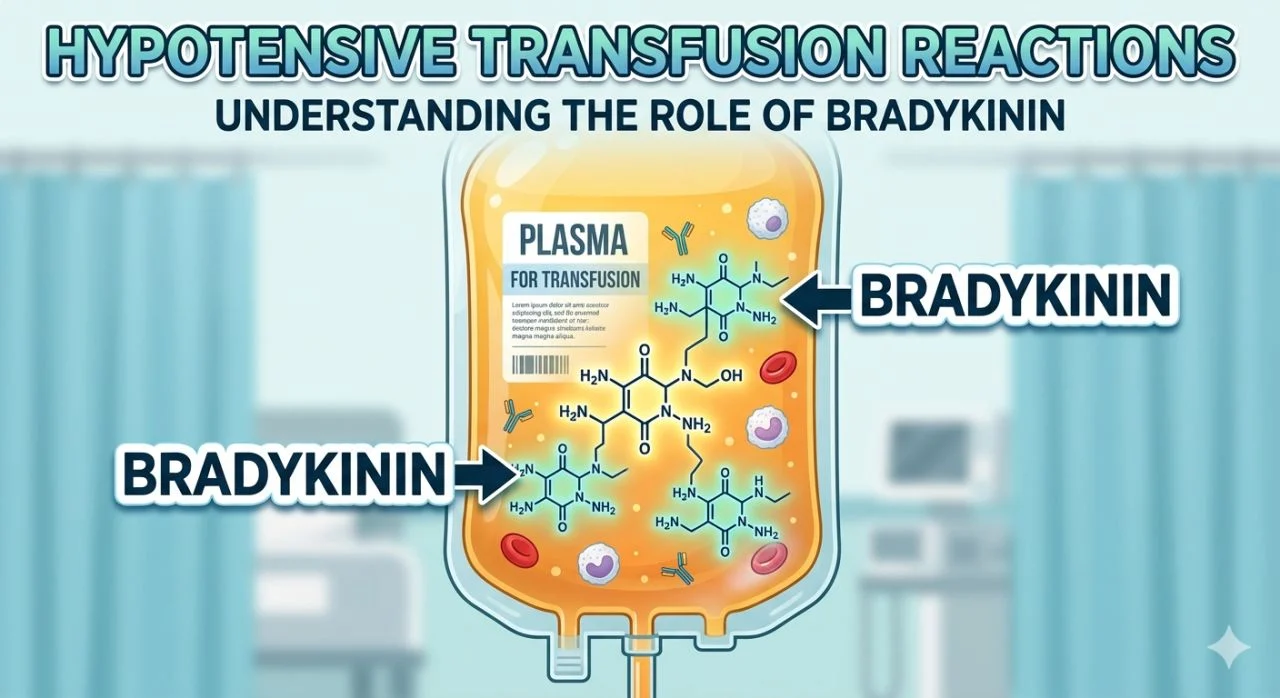
This is a hypotensive transfusion reaction — and it’s not immunologic.
It’s pharmacologic.
Here’s what’s happening:
- Transfusion tubing and leukoreduction filters present a negatively charged surface to blood
- That contact activates Factor XII – kallikrein – bradykinin
- Bradykinin is a potent vasodilator with a half-life measured in seconds
- ACE normally clears it — but patients on ACE inhibitors can’t
- Result: bradykinin accumulates, vessels dilate, pressure drops
This is why ACE use is the most consistently identified risk factor for hypotensive transfusion reactions.
It’s not an allergy.
The drug is doing exactly what it was prescribed to do.
Management is straightforward: stop, fluids, recover.
No pre-medications indicated — Benadryl and acetaminophen do nothing for bradykinin-mediated hypotension.
The harder question is how many of these reactions we’re missing.
Hypotension is common in sick patients.
A modest BP dip in a patient on antihypertensives and diuretics may never trigger a workup.
New post on Blood Bytes Beyond.”
Stay updated with Hemostasis Today.
-
Sep 19, 2026, 01:53Thomas Dayspring: Understanding Genome and Lipid Interactions in Lipidology
-
Sep 19, 2026, 01:47Abdurrahman Tufan: Combination Targeted Therapy in Refractory Systemic Autoinflammatory Diseases
-
Sep 19, 2026, 01:44Patrick James Lynch: Mother of a Thousand Sons Premieres at BDC 2026
-
Sep 19, 2026, 01:41Genetic Fate Mapping Reveals Endothelial Cells During Venous Thrombus Resolution – RPTH Journal
-
Sep 19, 2026, 01:39Mostafa Hammam: Three Different Platelet Defects – One Common Symptom
-
Sep 19, 2026, 01:38Jeff Sternlicht: A Heart Attack Should Not Be the Starting Line
-
Sep 19, 2026, 01:28Luis Oliverio Ambriz Garcia: Key Points From the ASH 2026 Guidelines on Iron Deficiency
-
Sep 19, 2026, 01:27Farjah Algahtani: A New Era in the Treatment of Transfusion-Dependent Thalassaemia
-
Sep 19, 2026, 01:24Aravind Palraj: 2025 EULAR Behçet’s Syndrome Update – 5 Practical Take-Home Points